

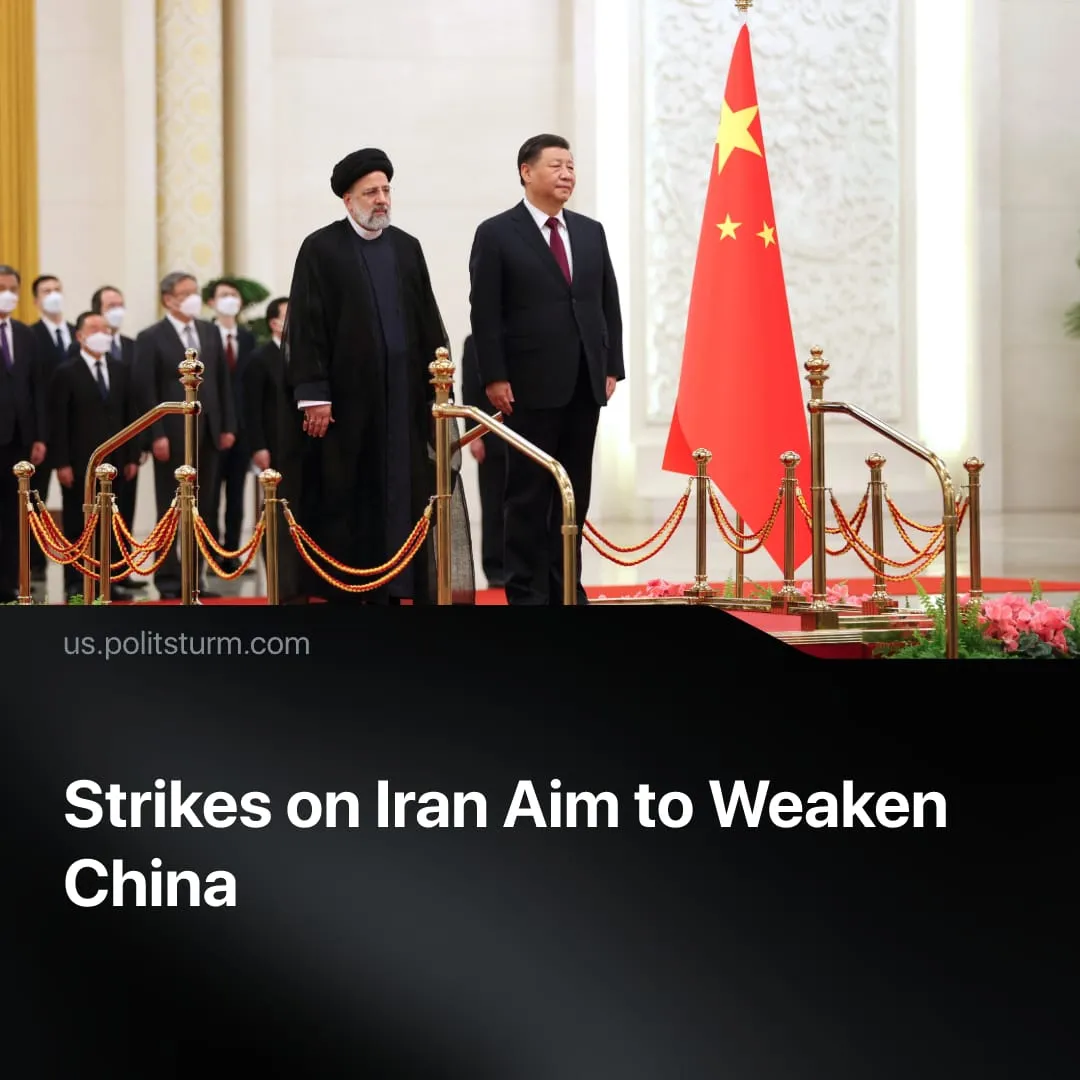
China risks losing one of its major dependencies if US strikes succeed in Iran, threatening energy supplies, proxy networks, and Belt and Road investments.
Details. Iran is integrated into China’s imperialist bloc. China is Iran’s largest trading partner and dominant energy customer. Despite US sanctions, estimates suggest over 90% of Iran’s crude oil exports are purchased by China, with Iranian crude accounting for roughly 13.4% of China’s seaborne imports, importing about 1.2 million barrels per day.
► Around 45% of Chinese crude imports pass through the Strait of Hormuz, which Iran has largely closed amid the conflict; authorities have reportedly signalled that only Chinese‑flagged vessels will be permitted to transit as a sign of gratitude for Beijing’s stance.
► In 2021, Iran and China signed a 25-year strategic partnership agreement. In exchange for oil supplies to China at reduced prices, China agreed to invest $400 billion in Iran's oil and gas sector and petrochemical industry.
► Iran is closely aligned with China’s other major dependent, Russia. In 2025, Iran and Russia signed a Comprehensive Strategic Partnership Treaty to expand economic, security, and political cooperation. China, Iran, and Russia also conduct joint naval exercises in the Gulf of Oman and Strait of Hormuz.
► Despite the joint military exercises, China’s response has been limited to diplomatic protest and calls for de‑escalation. Beijing has condemned US and Israeli strikes, called for de‑escalation, and stressed respect for sovereignty – mirroring their response to the US capture of Venezuela.
► If the US eliminates Iran as a threat, China would face major strategic setbacks. Iranian proxy forces would weaken, the US would gain greater control over the Middle East and the Strait of Hormuz. Loss of discounted Iranian – and recent Venezuelan – oil would tighten energy supplies, while China’s Belt and Road projects in the region would be undermined, weakening Beijing’s growing economic leverage and enabling the US to further consolidate military encirclement.
Context. The US has expanded its use of economic and military pressure against states aligned with China’s sphere of influence, deepening the broader US–China rivalry.
► On February 28, the US and Israel launched major strikes on Iran aimed at destroying its missile capabilities, navy, proxy networks, and nuclear program. While officials insisted the operation was not a regime‑change war, Trump encouraged the Iranian people to “seize control of their destiny,” and numerous Iranian leadership figures were killed. Trump stated that he had leaders in mind who could take over, but that they had been killed.
► The US and Israel previously struck Iran, leading to the 12-day war. The US has also taken a number of other hawkish foreign policy actions aimed at undermining China's sphere of influence in Latin America, including the recent embargo on Cuba and, before that, the kidnapping of Venezuelan President Nicolás Maduro, with the US now having control over the country's vast oil reserves.
► Trump’s trade war, while achieving some initial success, pushed numerous countries – including traditional allies – toward China, which was still able to reach record trade surpluses, and some sections of US capital pushed back against this strategy. As economic pressure falters, the US, by targeting China’s sphere of influence, is forcing China to confront it where the US still holds the advantage – military conflict.