

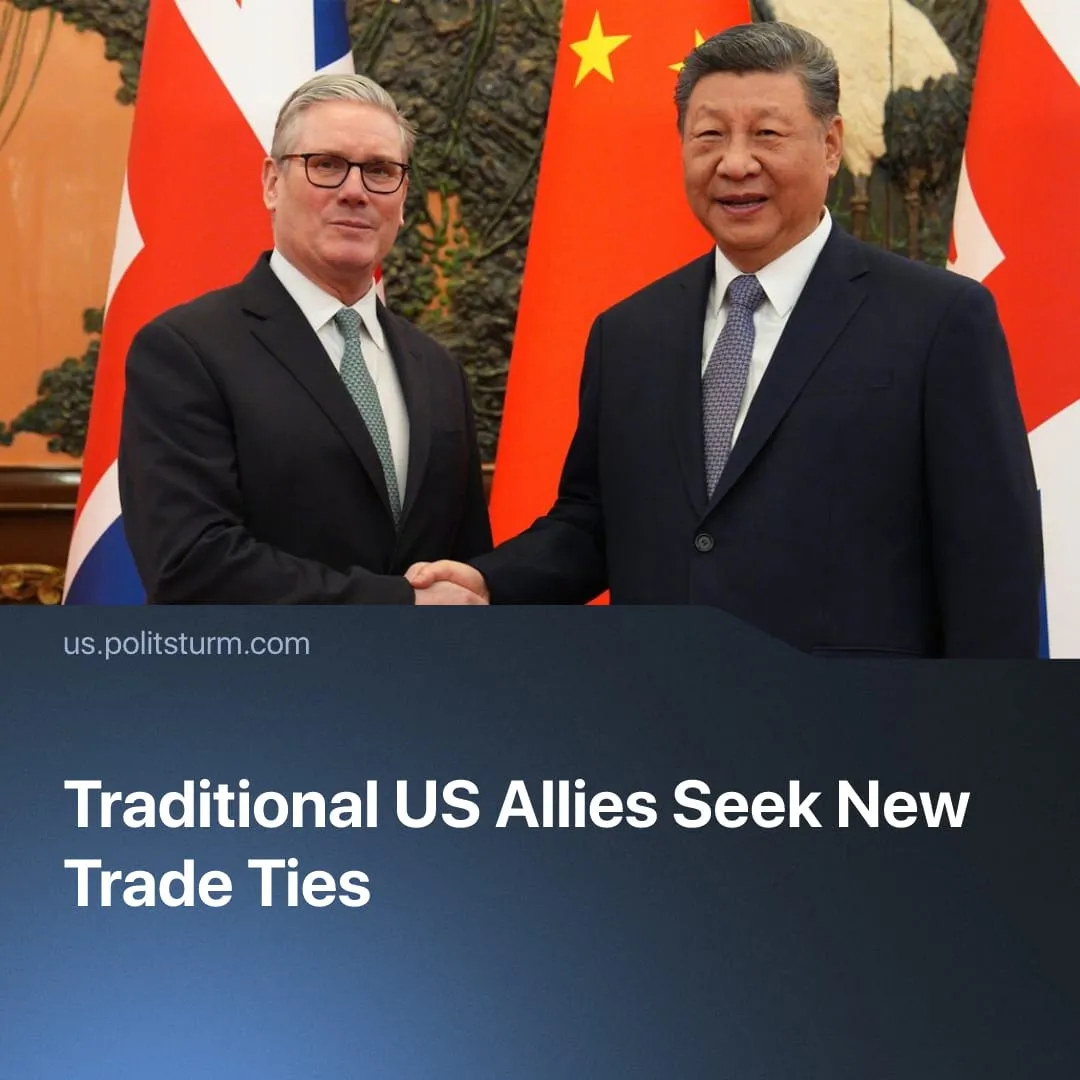
New trade relations with China sought by traditional US allies, prompting threats from Trump.
Details. Marking the first UK prime ministerial visit to Beijing since 2018, UK PM Keir Starmer travelled to deepen bilateral economic ties, securing reduced tariffs on whisky exports, potentially expanded services cooperation, a forthcoming 30-day visa-free travel arrangement, and the lifting of Chinese sanctions on several Conservative MPs. Trump called the talks “very dangerous.” Shortly before the trip, London approved a long-stalled Chinese “super embassy.”
► Canada has reached an initial trade agreement with China aimed at reducing tariffs on electric vehicles and agricultural exports. Speaking at the World Economic Forum, Prime Minister Mark Carney presented the move as a break from “US hegemony,” defensively framing it by likening Canada’s position to living in a socialist bloc.
► Trump responded by threatening a 100% tariff on Canadian goods. On Truth Social, he claimed China was “completely taking over” Canada, warning it could become a “drop-off port” for Chinese commodities to bypass US trade restrictions. He later told Carney at Davos to “remember” Canada’s existence depends on the US.
► Since the start of the year, China has also hosted talks with other traditional US allies such as South Korean President Lee Jae Myung, Finnish Prime Minister Petteri Orpo, and Irish leader Micheál Martin. German Chancellor Friedrich Merz is also expected to visit Beijing later this month.
Context. The sharpening of inter-imperialist contradictions is forcing formerly compliant allies to choose between economic submission to Washington or retaliatory trade wars as they defend their own national capital interests. The EU has emphasised “strategic autonomy,” expanding militarisation budgets to lessen dependence on US military force, and has begun making some formal foreign policy moves against US wishes.
► This same reorientation is pushing these allies to seek new trade relations and alternative markets. The China talks are part of a wider diversification, reflected in EU agreements with India and Latin America, as well as negotiations with the Gulf states.
► The aggressive US response, involving coercive threats, tariff ultimatums, and open economic pressure, is a central element of its strategy to contain its principal imperialist rival, China. Washington is tightening control over “its” hemisphere and closing “loose ends” in an effort to sustain its eroding global hegemony.
For a deeper analysis of the China–US rivalry, see our in-depth article on this subject.