

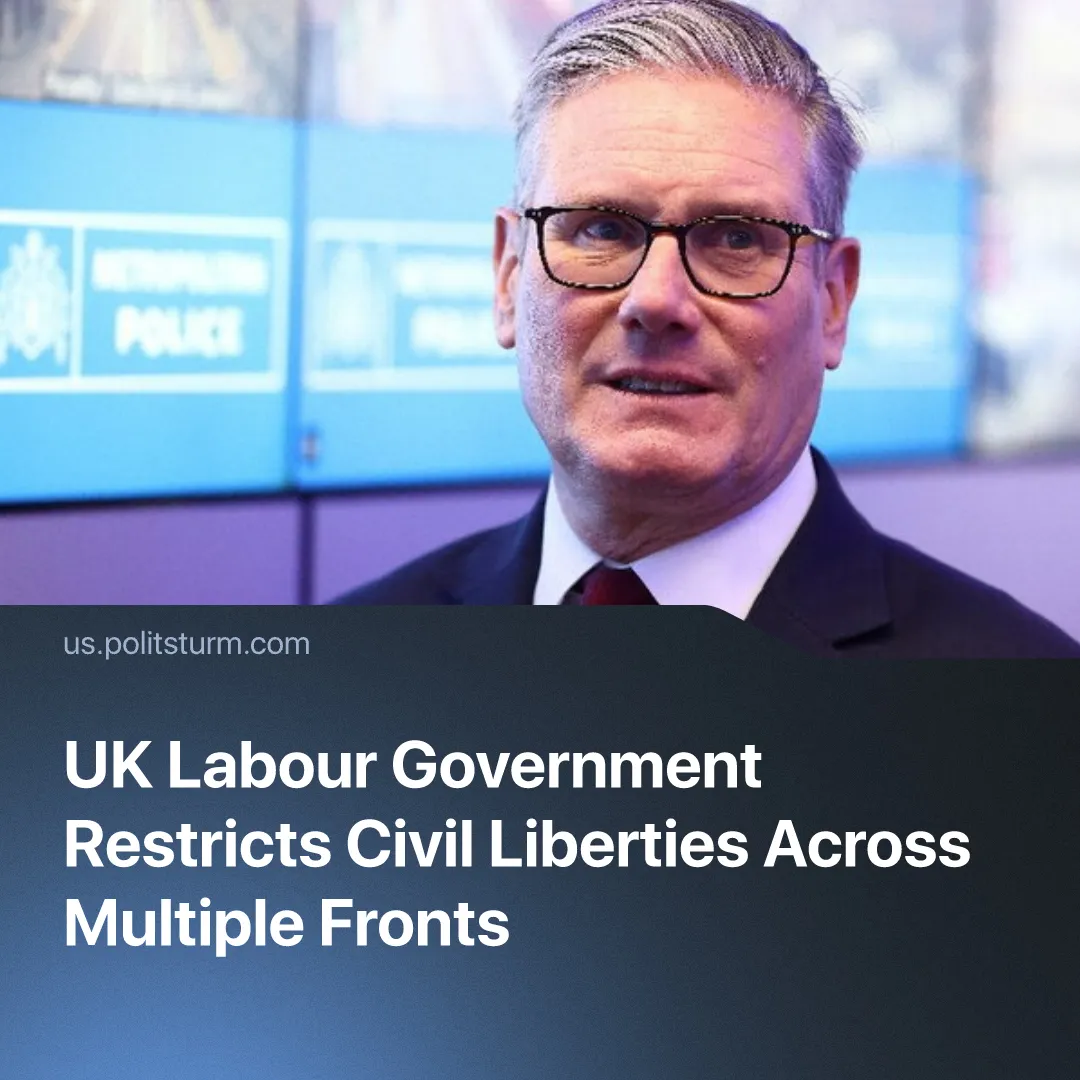
The UK Labour government claims to be "for the working people." Its policies have included expanded surveillance, curtailing of protests rights, and restrictions on jury trials.
Details. The government invested £115 million in the largest-scale rollout of facial recognition technology for police, despite cameras being more likely to misidentify Black people. Facial scans are now required to access many “adult websites”, with some phone updates locking in “child-mode” without biometric verification.
► A mandatory digital ID programme was announced and then walked back to a voluntary scheme after public pressure, though the infrastructure remains in place.
► Labour has not repealed the Conservative Police, Crime, Sentencing and Courts Act 2022 or the Public Order Act 2023, which criminalised previously legal protest tactics and granted police sweeping new powers over demonstrations. Labour’s Crime and Policing Bill 2025 goes further, proposing to ban face coverings at protests and on 16 May, the Met deployed facial recognition at a protest for the first time.
► Labour expanded the use of anti-terrorism powers against protest movements. Palestine Action was proscribed as a terrorist organisation – the first domestic adventurist group to receive this designation – with over 2,000 arrests made in connection with related peaceful support demonstrations.
► The government has proposed major reductions in jury trials by expanding the use of judge-only courts for lower and mid-level offences.
► Labour continued to enforce strict immigration policies, including increased raids, arrests, and deportations, politically justifying the anti-immigration rhetoric of the far-right. On 16 May 2026, authorities permitted a large billionaire funded far-right Tommy Robinson rally in London.
Context. British capitalism is characterised by slow economic growth, stagnant wages, weak investment, insecure employment, and deteriorating public services, intensified by a rising cost of living and worsening housing affordability. These worsening conditions are producing political shifts unlike anything seen in a century.
► Labour and the Conservatives are losing their historic dominance. Polls in May show Labour and the Conservatives both stuck at around 19–20%, while Reform UK has been leading at 27%. The Green Party is polling at about 14%, and the Liberal Democrats around 12%, which is relatively strong compared to their usual levels.
► Following a disastrous performance in the 2026 local election, Labour Prime Minister, Keir Starmer claimed to be "on the side of working people”, while announcing policies aimed at defending British capital.
Important to Know. Faced with a deepening economic crisis and political unrest, the British ruling class has responded by increasing fascisation. Greater pressure will continue to be exerted on the domestic workforce while simultaneously expanding militarisation to stabilise the system and maintain profits.
► Labour's constantly shifting positions reflect the contradictions of managing capitalism in crisis. It defended the two-child benefit cap – pushing 300,000 children into poverty at a rate of 100 per day – before dropping it under public pressure. Under the guise of “getting people into work”, It proposed cutting disability benefit payments for 370,000 people by £4,500 a year, then partially retreated after a rebellion by over 100 of its own MPs.
► Before Labour, the Conservative government had already moved in the same direction, as evidenced by the Police, Crime, Sentencing and Courts Act 2022 and the Public Order Act 2023.
► Starmer claimed that "only Labour can stop the populist right", yet the 2026 local elections saw Reform UK make significant progress while both Labour and the Conservatives experienced a sharp decline. These populist right-wing forces will intensify the current trend through further reductions in workers' rights, including attacks on protections such as those set out in the Equality Act.