

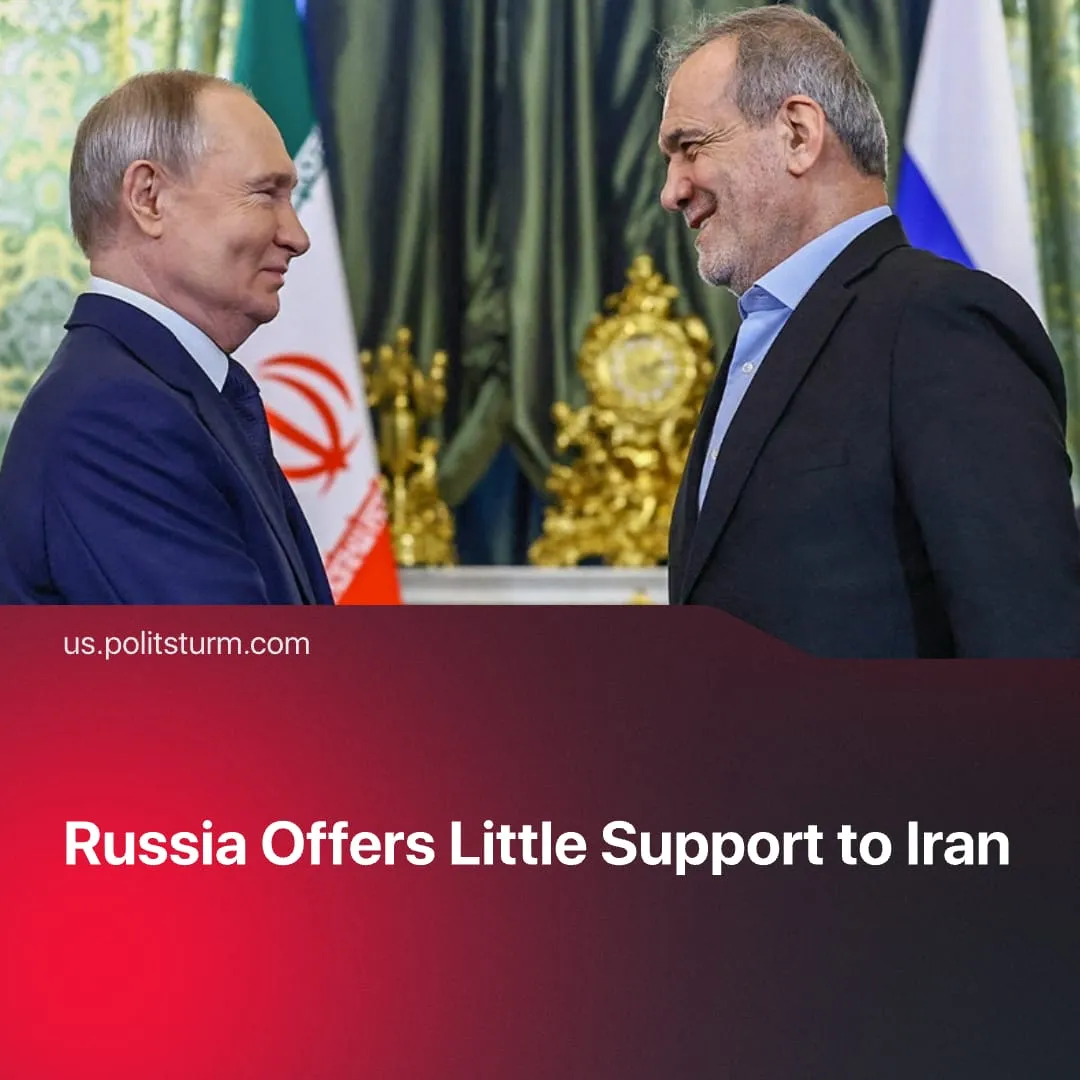
Russia gives only minimal support for allied Iran. The same happened previously with Armenia, Syria and Venezuela
Details. Following the launch of the US-Israeli military operation against Iran, Russia condemned the strikes as a violation of international law. President Putin denounced the assassination of Supreme Leader Ayatollah Khamenei as a “cynical” murder and sent condolences to the Iranian leadership.
► Russia has provided no official military or material aid to Iran in response to the operation.
► In 2025, Russia and Iran signed a “comprehensive strategic partnership treaty” expanding cooperation in political, economic, and military‑technical areas, but stopped short of establishing a formal military alliance. Under the agreement, the two states have participated in joint naval exercises – including drills in the Strait of Hormuz with Chinese forces.
► Trilateral negotiations between Washington, Moscow, and Kyiv over the SMO were effectively paused, as Ukrainian officials cited the Iran escalation as a distraction. US sources alleged Russia is sharing limited intelligence with Tehran, which Moscow denied, while Ukraine announced it is sending counter‑drone specialists to assist US and Gulf partners.
► The escalation has temporarily benefited Russian capital. Disruptions to Middle Eastern energy markets pushed oil prices above $100 per barrel, increasing demand for Russian exports and easing pressure from sanctions, with Russian monopolies moving from selling crude at roughly a $5pb discount to enjoying premiums of around $10pb.
► A US victory in strategically located Iran would threaten Russia’s southern flank and its regional investments. Russia – the largest foreign investor in Iran since 2024 – risks losing billions in assets, a key geopolitical partner, and key trade corridors connecting Russia to the Persian Gulf and Indian Ocean.
Context. The US attack on Iran – an ally of the Russo-Chinese imperialist bloc – followed the fourth anniversary of Russia’s “SMO”, which began in 2022. The “SMO” has now lasted longer than the Great Patriotic War of the Soviet people (1941–1945).
► In 2025, Trump pushed for peace talks with Russia. Negotiations progressed slowly, with major imperialist powers vying for influence over the terms. In early 2026, trilateral meetings were held, but the US began exerting stronger pressure on Russia with new sanctions and tariffs.
► Russia has failed to defend its dependent proxy leaders: Bashar al-Assad in Syria, Nicolás Maduro in Venezuela, and Ayatollah Khamenei in Iran – all three have been ousted or killed within less than 18 months. Additionally, Russia suffered the loss of control of Nagorno-Karabakh and the Zangezur corridor.
► After the US operation in Venezuela, Trump asserted that “nobody [...] has the capability that we have” and ridiculed what he described as “primitive” Russian military tactics. He also threatened further regime-change operations in Cuba and Iran.