

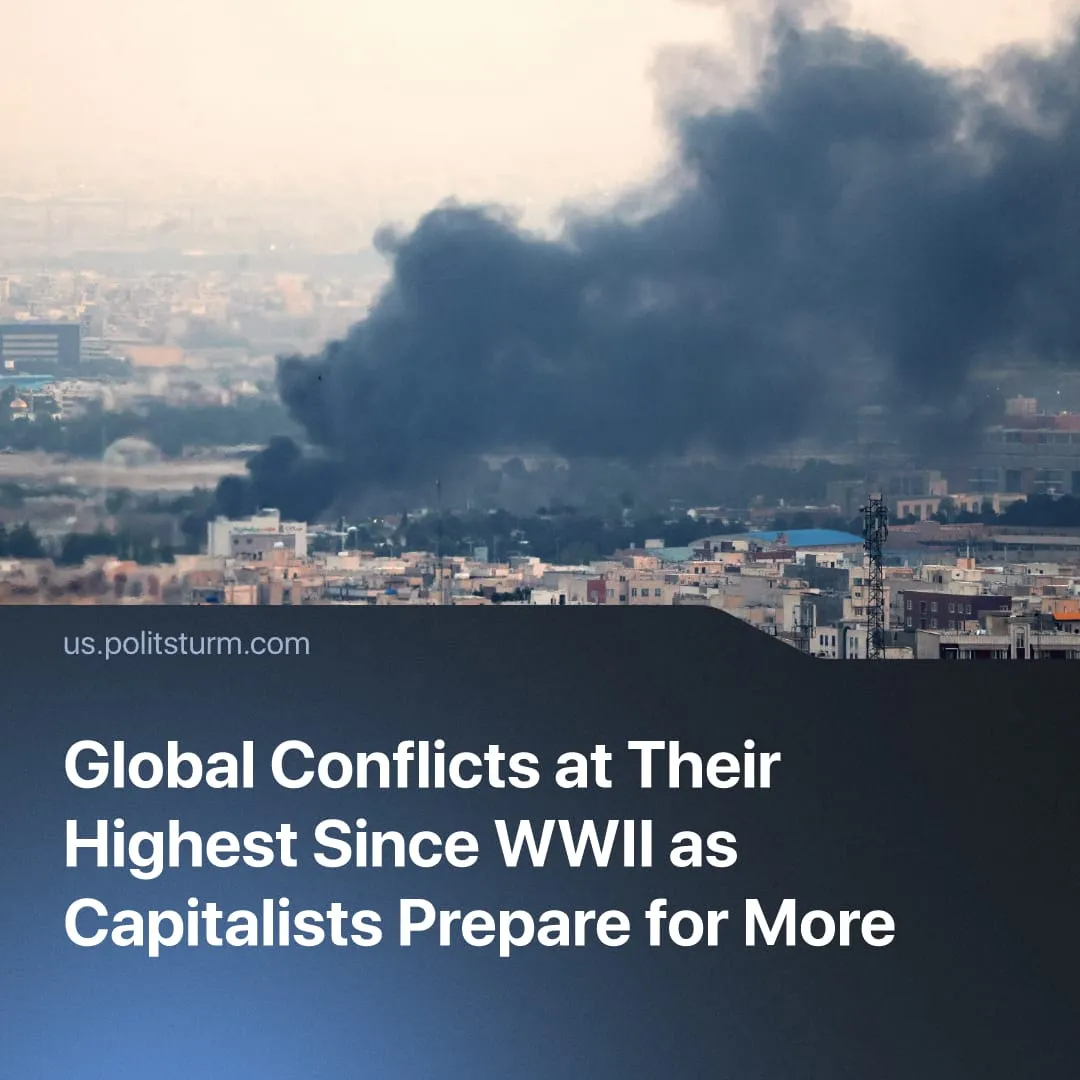
87 years after World War II, the number of conflicts has risen to its highest level since then. Capitalists are openly preparing for wars, and some declare World War 3 “inevitable”.
Details. The Peace Research Institute Oslo (PRIO) has released an overview of conflict trends for 2025, stating that the number of concurrent global conflicts was at its highest point (65 active conflicts across 35 countries) since World War II.
► This follows a trend observed in their 2024 report – which previously held the record for the highest number of conflicts since 1946. The 2025 report notes that civil conflicts remain the most common type, but that international conflicts have doubled, from 4 to 8. These range from increased border clashes (such as between India and Pakistan), regional tensions (such as in the Middle East), or invasions (such as Israel’s invasion of Syria).
► The number of combat-related deaths was 153,000, a small increase over the previous year, making it one of the most violent years since the Cold War. The number of accumulated deaths between 2021 and 2025 is approximately 930,000, around the same as the number of deaths in the 20 years prior to 2021.
► These trends have continued in 2026, with the threat of new conflicts and invasions. On top of the many 2025 tensions that persisted, the US attacked Venezuela to remove the regime’s President, Nicolás Maduro, and is threatening similar action against Cuba; in the Middle East, Tehran claimed it will move to the offensive. Many Western nations have been echoing the idea that World War III is now “inevitable”.
Context. World War II began 87 years ago and was the most devastating conflict in human history. It occurred after WWI violently redistributed markets, colonies, and spheres of influence between imperialist blocs without resolving the underlying contradictions, which became even more amplified by the breakaway of the USSR from the world market. Current conditions have similarities and differences to those leading up to both World Wars.
► Today's situation more closely resembles WWI, with several competing imperialist blocs each pursuing their own spheres of influence, forming new alliances, breaking old ones, and drawing smaller states into their rivalries.
► As before both World Wars, an economic crisis is once again looming over capitalism. The most powerful capitalist countries find themselves in enormous debt; the bursting of the “AI bubble” threatens to lead to a global economic crash; the closure of the Strait of Hormuz revealed how exposed trade is to rising military tensions and led to the near-depletion of multiple oil stockpiles.
► Capitalist countries are preparing for military conflict through continuous drives to increase military expenditure (at the expense of workers’ living standards), the linking of reindustrialization to remilitarisation, the development of new war technologies, the formation of new defence treaties and the breakdown of old ones.
► In the lead-up to WWII, the League of Nations, whose objective was to maintain global peace, had shown itself to be impotent; today, a similar trend is observed in the United Nations, which has lost most of the US's backing and is facing financial collapse.
► Capitalist media is playing its historical role. Before WWI, capitalist countries employed “invasion literature” to justify militarisation as a necessary defensive measure. This is observed in today’s media, through constant fearmongering about hypothetical invasions.
► The various capitalist countries were drawn into the World Wars due to the multitude of imperialist connections which tied them together both economically and politically. The same is happening today: the US-Iran conflict and the conflict in Ukraine overlapped at various points and threatened to merge into a single conflict.
Important to Know. Fascism is the logical product of capitalism in decay, defined as "the open terroristic dictatorship of the most reactionary, most chauvinistic, and most imperialist elements of finance capital". Before WWII, monopoly capital chose war and open dictatorship as a way out of crisis. Today we also see the rise of numerous far-right forces across nearly all countries, intensifying anti-communism, and rapid fascisation even where the far-right has not taken power.
► Communists were and are the only consistent force for peace through proletarian internationalism and the fight for an alternative system. The existence of the socialist bloc, led by the USSR, was a concrete restraint on imperialist aggression that prevented a third world war. Its dissolution has removed that restraint.
► Inflation, unemployment, rapidly deteriorating quality of life and the ecological crisis are reflected in the growth of popular discontent which leads to an increased interest in communist ideas. The authorities need conflicts to maintain their positions: capitalists will suppress discontent, justify repression and utilise some of the surplus labour through wars.
► As a major imperialist conflict approaches today, communists are once again the primary target of repression. This year has seen a further spread of anti-communist measures in the US and Europe. A mass spread of such laws in all EU countries should be expected.
Politsturm regularly publishes Marxist-Leninist analyses on militarisation and fascisation, as well as other key political and economic issues. Follow us on Telegram, YouTube, Discord, Reddit and X. Join us to help us in our work.