

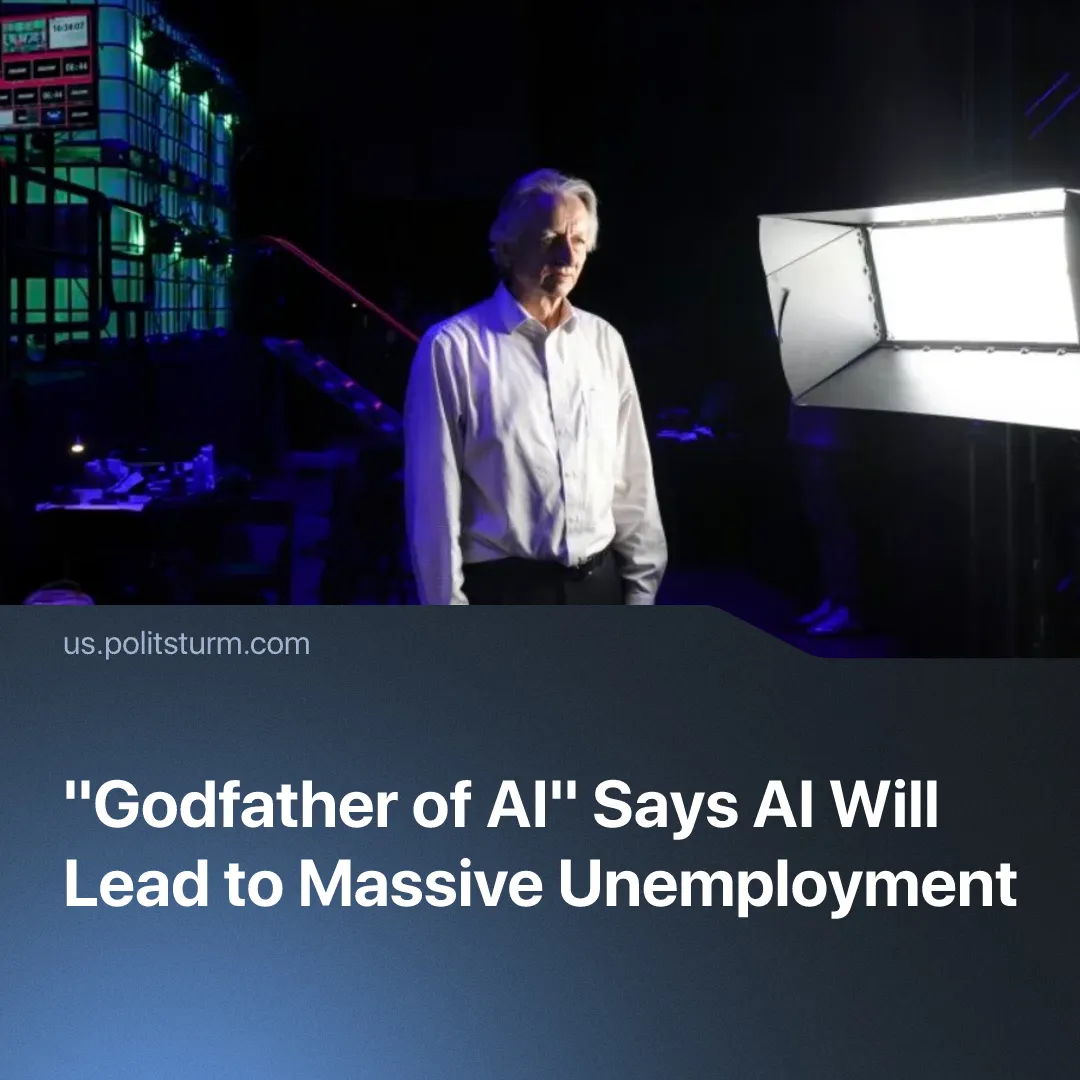
“Godfather of AI” admits it will lead to massive unemployment. Marxists know the problem isn’t AI, but the capitalist system in which it is used.
Details. In a conversation with US Senator Bernie Sanders, computer scientist Geoffrey Hinton, considered the “Godfather of AI”, explained that he believes it is very likely AI will lead to massive unemployment. According to Hinton, AI companies need to assure investors that they will see a return on their invested trillions of dollars.
Quote: “If you ask where are these guys going to get the roughly trillion dollars they're investing in data centres and chips... one of the main sources of money is going to be by selling people [that] AI that will do the work of workers much cheaper [...]. And so these guys are really betting on AI replacing a lot of workers”.
► This stands in contrast to predictions given by the capitalists that invest in the technology. The Chief Executive of NVIDIA, Jensen Huang, spoke about AI “transforming” work and leading to 4-day work weeks. Elon Musk, who was briefly the world's first and only trillionaire, claimed that, thanks to AI, most people would not have to work at all. OpenAI chief executive Sam Altman admitted that the technology actually makes us busier, but that “secretly we're going to be happy” about it.
Context. AI has already led to mass layoffs across numerous industries – for example, Oracle is cutting 30,000 jobs, whilst Nestlé is cutting 16,000, partly due to automation. By June, the number of AI-related layoffs in the US reached 101,743, nearly double the layoffs attributed to the whole of 2025.
► Historically, the introduction of new machinery and technology under capitalism has repeatedly led to mass layoffs. During the British Industrial Revolution, mechanisation transformed the textile industry, replacing many skilled handicraft occupations with unskilled factory labour. The introduction of power looms, in particular, contributed to one of the “first great instances of technological unemployment”. This helped fuel the Luddite movement, in which skilled textile workers attacked machinery that threatened their livelihoods – a reaction which resembles today’s attitudes towards AI.
Important to Know. Hinton explains that greater productivity doesn't mean shorter working days, but greater numbers of unemployed – and we add that it also leads to greater exploitation of those who remain employed. As Marx puts it: “[machines] supplant skilled labourers by unskilled [...], where newly introduced, [automation] throws workers upon the streets in great masses; and as it becomes more highly developed and more productive it discards them in additional though smaller numbers”.
► But Hinton’s explanation does not address the fundamental driving force behind the need to improve productivity – under capitalism, the driving force is competition for profit. Every capitalist must implement every new machinery and technique which squeezes more output from workers ASAP, in the hopes of obtaining extra profit. Those that fail to do so are ruined in the process of competition, and must join the ranks of the working class.
► Marx described this law as “the law that continually throws capitalist production out of its old ruts and compels capital to strain ever more the productive forces of labour for the very reason that it has already strained them – the law that grants it no respite, and constantly shouts in its ear: March! March!”