

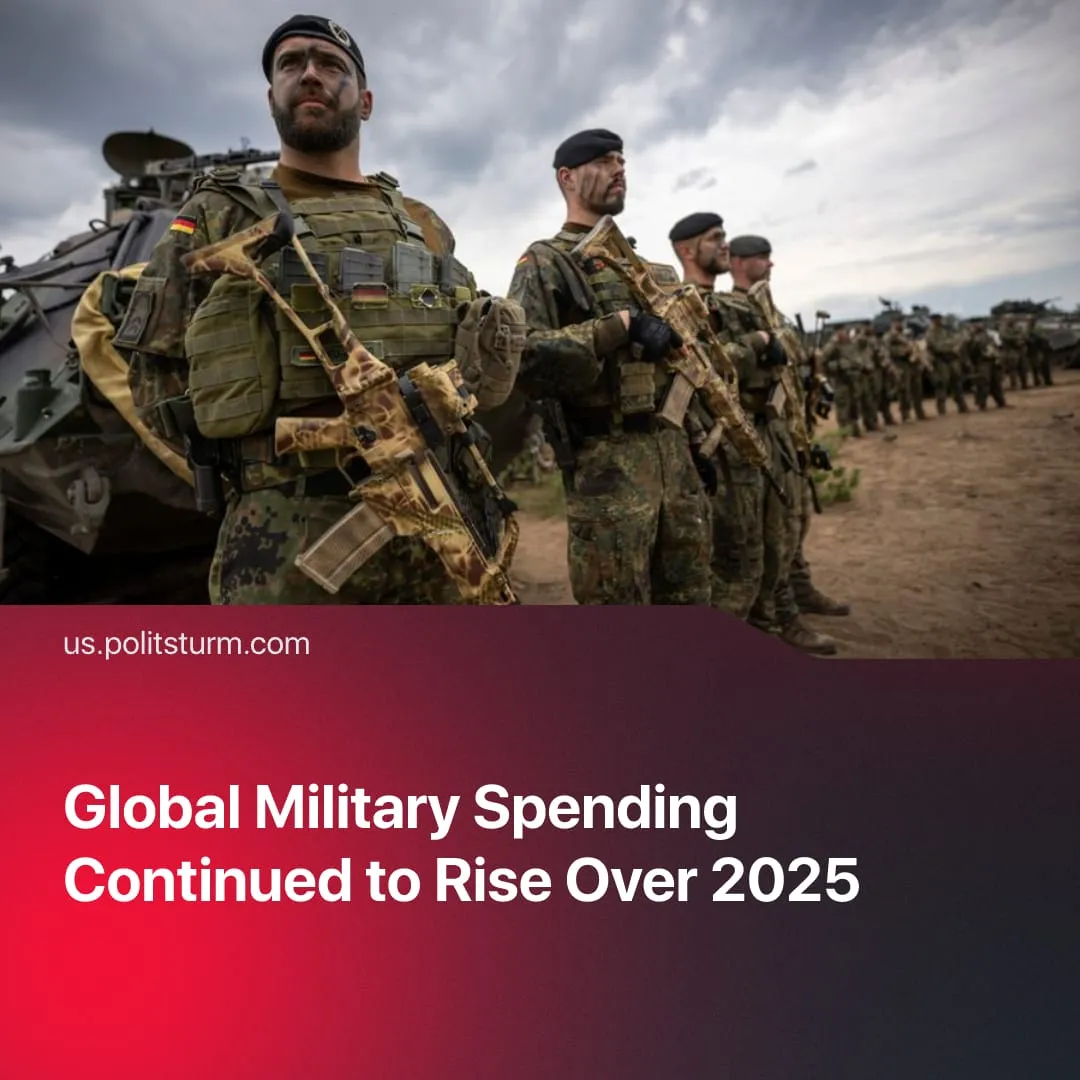
In 2025, global military spending hit $2.88 trillion, up 41% from the previous decade.
Details. The Stockholm International Peace Research Institute (SIPRI) reports global military spending reached a record $2.88 trillion in 2025, up 2.9% from the previous year.
► The United States remains the world's largest military spender, followed by China, Russia, and Germany. In 2025, Germany saw a 24% rise in military spending, while China grew by 7.4%, Japan by 9.7%, and India by 8.9%. Russia and Ukraine continued to maintain extremely high spending levels.
► Notably, Europe recorded both the largest single-year regional increase – up 14% in 2025 – and the steepest long-term growth, with military spending having doubled since 2016.
Context. This record spending coincides with a surge in global conflict. Over 2024, the highest frequency of armed conflict since 1945 was recorded.
► 2026 has already seen major escalations, including US actions in Venezuela, the escalation in the Middle East, blockades in the Strait of Hormuz, and ongoing conflict in Ukraine.
► This spending comes at the direct cost of social welfare. Last year's US budget cut $120 billion from welfare and healthcare while expanding military and ICE spending by $150 billion. Trump recently stated the country "cannot afford" further healthcare costs while "fighting wars."
Important to Know. Armed conflicts under capitalism arise from competition between capitalist states over markets, resources, and spheres of influence. The ongoing conflicts are expressions of major powers fighting for control over energy routes, trade corridors, and strategic regions.
► These conflicts only benefit monopolies through securing maximum profits, while workers pay the price with a fall in real wages and with their lives. Defence company revenues have soared across Europe, and firms like Shell recorded surging profits following the Hormuz blockade.
► The Soviet Union demonstrated that a different world is possible. The Nagorno-Karabakh dispute predated the USSR, yet for nearly 70 years, Soviet governance managed it through peaceful diplomacy. More broadly, from 1945 to 1991, the strength of the socialist bloc prevented a third world war and saw a period of relative peace.