

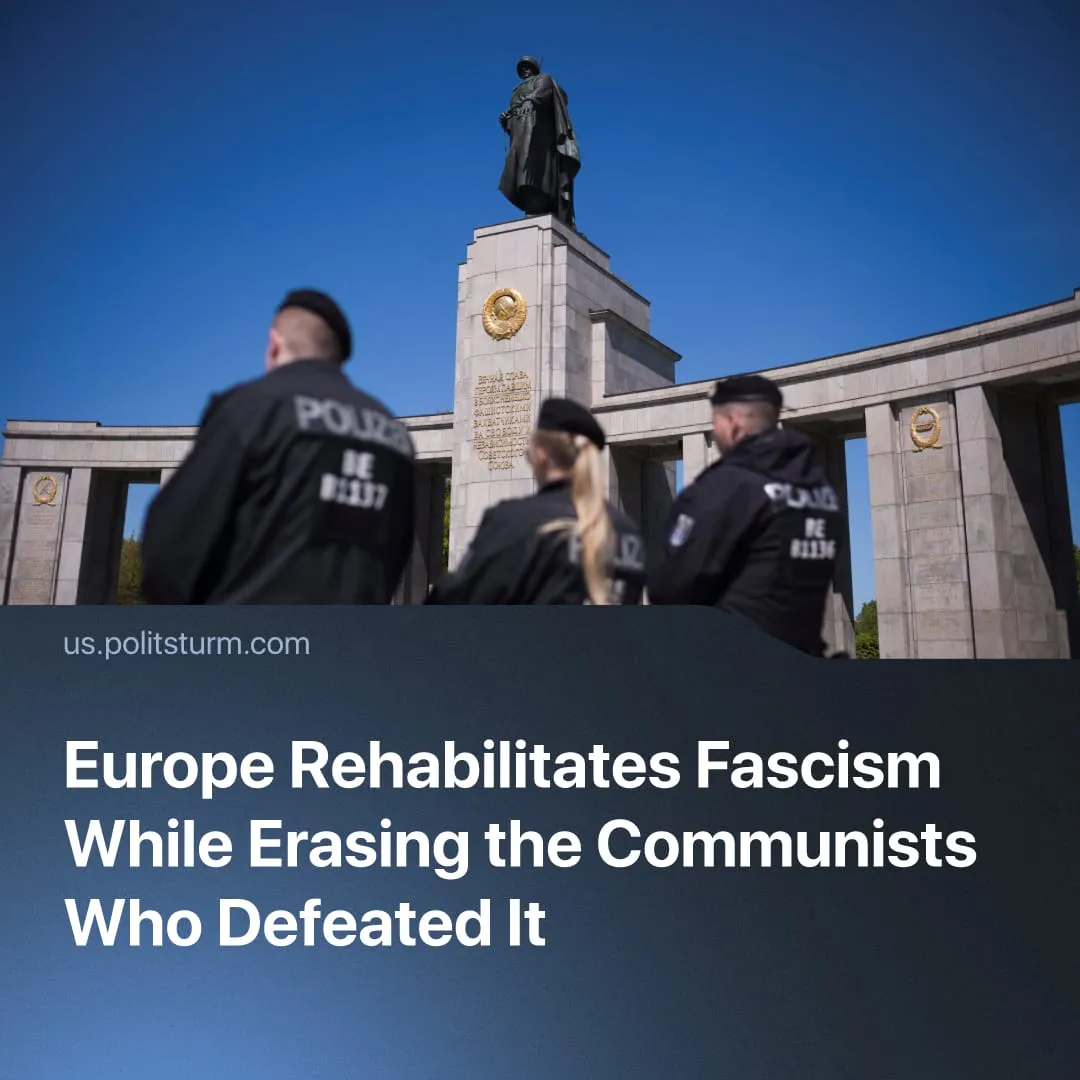
Communists and the Soviet Union played a vital role in liberating France, the Czech Republic, Poland, and Germany from Nazism. 81 years later, efforts are underway to erase their role from public memory.
Details. Over the past two years, governments across Europe have moved to criminalise communist ideology, destroy Soviet monuments, and ban communist parties – while far-right and fascist parties freely grow in popularity. Politsturm prepared a review of European countries where the persecution of communists has intensified over the past year, in comparison with the contribution made by communists and the USSR to the liberation of these countries from fascism.
France. The far-right National Rally – founded by former Waffen-SS members as “National Front” – is now on course to win the 2027 presidential election.
► In 2025, the annual fascist march in Paris proceeded with legal permission – with far-right delegations from Hungary, Germany, Italy, and Spain – and openly using WW2 Axis symbolism. The march deliberately coincided with Victory Day commemorations. Meanwhile, counter-protests were banned, and multiple counter-demonstrators were arrested.
► On Victory Day this year, a WW2-era fascist collaborator anthem was played on public loudspeakers in a French town with a National Rally mayor. Last year, an official monument dedicated to the "victims of communism" was revealed in another French city. To justify it, the mayor cited the debunked “100 million deaths” statistic from The Black Book of Communism.
Historically, communists formed the backbone of French anti-fascism. Before the war, the Communist Party of France led the formation of the Popular Front against fascism, winning the 1936 elections and bringing about major social reforms for workers, while significantly weakening fascism in France.
► During WW2, the communist-led “Francs-Tireurs et Partisans” was one of the largest resistance forces in occupied France, claiming 1,500 operations in three months of 1943 alone. Many thousands of Soviet citizens who found themselves there as prisoners of war or driven into Nazi slavery took an active part in the French Resistance movement.
► The French “Normandie-Neman” Squadron fought as part of the Red Army's 303rd Fighter Aviation Division from 1942 to 1945. French pilots flew over 5,000 combat sorties on the Eastern Front, shooting down 268 and damaging 80 German aircraft in aerial combat, losing only 46 men.
Germany. The far-right Alternative for Germany leads electoral polling at 27.5% as of 2026. The party has been repeatedly linked to fascist currents within its ranks, with senior figures investigated over the use of Nazi-era slogans.
► German courts have officially banned the display of USSR flags, Red Army symbols and songs at Soviet war memorials in Berlin during Victory Day commemorations – now for the fourth consecutive year. Displaying symbols of the German Communist Party (KPD) remains illegal since it was banned in 1956.
Historically, German communists became the first target of German fascism. The first act of the Nazi government was to ban KPD, imprisoning 150,000 party members – the majority of early concentration camp inmates – and executing over 30,000 including Chairman Ernst Thälmann. Despite the Nazis capturing about 50% of KPD members, at least 10% not only evaded capture but also actively resisted.
► In 1943, the National Committee for a Free Germany was established in the USSR. The committee played an important role in coordinating the German Resistance and eliminating the consequences of Nazism in post-war Germany.
► The Red Army destroyed 80% of the Wehrmacht during WW2, making a decisive contribution to the victory over Nazi Germany. Tens of thousands of German resistance members, largely communists, died fighting the Nazi regime in WW2 – including the “Red Orchestra” group, and Heroes of the Soviet Union Richard Sorge and Fritz Schmenkel.
► During the final battles, the Red Army sought to preserve the architectural appearance of the cities where the fighting took place whenever possible. While examining the ruins of the Dresden Gallery, destroyed by Allied bombing, Soviet soldiers discovered a map that helped locate hidden paintings. As a result, approximately 1,200 masterpieces of world art were saved and returned to Germany after the war.
Czech Republic. Right-wing populist and nationalist forces remain dominant, with the ruling Orban-aligned ANO 2011 Party consistently leading at around 30%+ support. In 2025, President Petr Pavel signed a law criminalising “communist propaganda” with penalties of up to five years in prison.
Historically, communists played a central role in resisting and defeating fascism in Czechoslovakia. Before WW2, the Communist Party of Czechoslovakia (KSČ) was banned in 1938, but continued to organise underground.
► Communist partisans played a major role in the 1944 Slovak National Uprising, which was launched in coordination with the advancing Soviet Red Army. After the uprising was crushed, partisan resistance continued until the final liberation of Czechoslovakia by Soviet forces in 1945.
► Czechoslovak military units actively participated in combat operations within the Red Army. By 1944, they had been consolidated into the 1st Czechoslovak Army Corps, numbering 16,000 soldiers. The corps' advance detachment, armed with Soviet tanks, entered Prague on May 10, 1945, and fought its last major battle. After the war, the corps served as the foundation of the socialist Czechoslovak People's Army.
Poland. The 2025 presidential election was won by anti-communist candidate Karol Nawrocki, backed by Law and Justice (PiS), with 50.89% of the vote. His election was welcomed by the European far-right and MAGA figures.
► Poland banned the social-chauvinist Communist Party of Poland from participating in elections for its “totalitarian” ideals, which do not align with the constitution, establishing a precedent for restricting genuine communist political activity. Meanwhile, far-right figures, who consider “globalist communism” the greatest threat in the world, “compared to which Auschwitz could be called a holiday camp,” are allowed to participate.
► As part of a “decommunisation” campaign, hundreds of Soviet monuments are being demolished. At the same time, Poland’s annual November 11 Independence Marches in Warsaw continue to see heavy far-right participation, drawing nationalist delegates from across Europe.
Historically, communists and the Soviet Union played a decisive role in the liberation of Poland from Nazi occupation, acting through both partisan forces and regular army units.
► The partisan Armia Ludowa (People’s Army), which by mid-1944 numbered around 34,000 fighters and carried out over 1,500 operations against German forces. Fighting alongside Soviet troops, they took part in the 1944-45 offensives that broke German control of Poland, including the liberation of Auschwitz-Birkenau in January 1945, where around 231 Red Army soldiers were killed.
► The USSR formed Polish forces twice. The right-wing leadership of “Anders' Army”, numbering over 70,000 men, having received Soviet training and equipment, refused to fight and the army was withdrawn through Iran to British control. Subsequently, the 1st Polish Corps was formed within the Red Army, from which Berling's 1st Polish Army was deployed. Numbering nearly 100,000 men by the end of the war, the Polish Army participated in the capture of Berlin. It became the largest regular force of a foreign state to fight alongside the Red Army on the Soviet-German front. The best Polish soldiers participated in the Victory Parade on Red Square on May 24, 1945, alongside Red Army soldiers.
Context. Since 1964, 9 May (Victory Day) has been proclaimed in the EU as “Europe Day”, commemorating the 1950 Schuman Declaration. It was done in order to replace the Soviet Victory Day and prevent communists in European countries from using this date. The EU also marks 23 August as “Black Ribbon Day”, an anti-communist date that falsely equates fascism and socialism, remembering the “victims of all totalitarian and authoritarian regimes”.
► Anti-communist legislation has been intensifying across several European states. In Ukraine, 2015 decommunisation laws banned communist symbols and propaganda, removed Soviet-era monuments and place names, and were followed by restrictions on communist parties. Similar legal restrictions on communist symbolism or political activity have been introduced in Lithuania, Latvia, Estonia, and Slovakia.
► Recent EU foreign policy rhetoric recycles Cold War and Nazi-era propaganda. EU High Representative Kaja Kallas has repeatedly implied the USSR was ‘naturally aggressive’ – echoing Nazi Germany’s claims, which framed the invasion of the USSR as ‘saving European civilisation from Bolshevist aggression’, and the US Red Scare, in which official propaganda declared the USSR sought to "impose its absolute authority over the rest of the world."
Important to Know. Repressive laws against communists and against the Soviet legacy are being strengthened, despite the dissolution of the USSR in 1991 and the long-term crisis of the communist movement, which prevents it from effective actions. Even though there was a temporary victory of capitalism, its inherent contradictions haven’t gone away. Capitalists are having to increase exploitation and prepare for a violent imperialist redivision of the world – naturally leading to intensified worker resistance.
► In an attempt to erase the memory of the victory of the USSR and the communists over fascism, the ruling capitalist groups within Europe are seeking to distract workers from the crisis and deteriorating living conditions. The EU’s surveillance powers have also intensified through cross-border biometric scans, a push to scan private messages, and access to biometric and facial recognition records by the EU’s law enforcement body (Europol).
► Meanwhile, Europe is rapidly remilitarising, with military spending doubling since 2016, and many countries either having already reintroduced conscription or preparing to reintroduce it.