

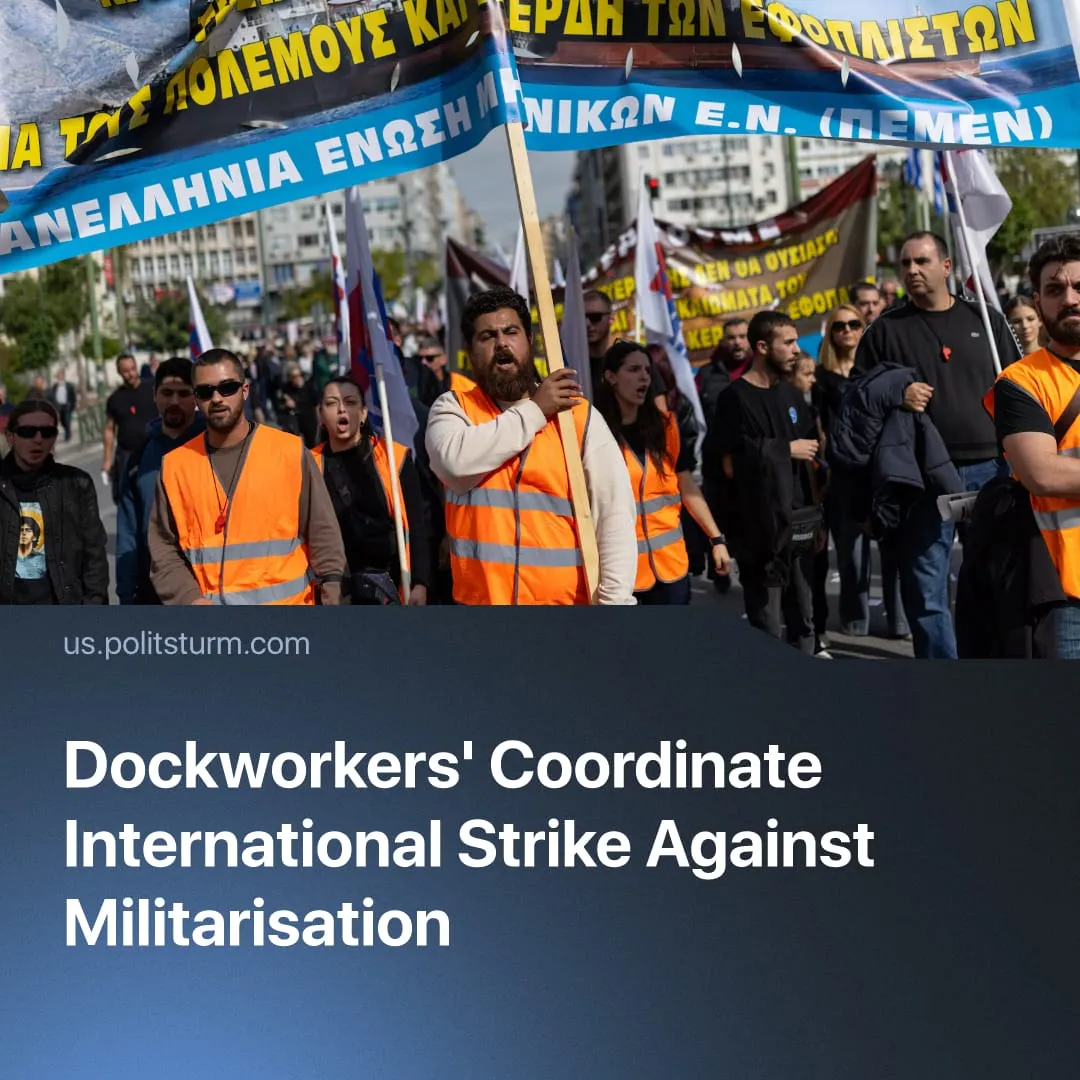
Dockworkers from 22 countries coordinated strikes against war and militarisation. Was it effective?
Details. On 30 October 2026, dockworkers organised an international day of action under the slogan “Dockworkers Do Not Work for War”, mobilising across five continents. They demanded an end to military shipments and involvement in wars, stronger worker protections, higher wages, and a redirection of military spending towards social needs.
► The international mobilisation began with six leading trade unions and was joined by other organisations, including the French CGT Ports et Docks, the Italian Unione Sindacale di Base (USB) and the Greek ENEDEP.
► An earlier coordinated strike in February involved 20 ports across seven countries. At a later meeting in Istanbul on 18–19 May, representatives of over 35 ports agreed to organise another international day of action in October.
► Similarly, a Trotskyist-led coalition of European organisations is organising anti-war walkouts and demonstrations on 20 November under the slogan “Fight for Our Future, Not Their Wars.” Participation is planned in at least 12 European countries. Organisers expect hundreds of thousands of young people to participate, demanding an end to militarisation and conscription and the redirection of military spending towards education, healthcare and housing.
Context. In 2025, global military spending reached $2.88 trillion while the number of armed conflicts worldwide rose to 65 amid erosion of bourgeois democratic rights. Meanwhile, 7.1 million people in the UK are struggling to afford basic necessities, France has announced €40 billion in public spending cuts, and the world's 500 richest individuals have accumulated another $2.2 trillion.
► Anger among workers and young people over their living conditions and the worsening global capitalist crisis is growing, inspiring them to take political action together across borders. The most recent example of this is the series of spontaneous protests that spread across European countries in October. The international "Gen Z" movement has spread across the world, from South Asia to Europe.
► Previously isolated anti-war movements, ranging from anti-conscription protests in Germany to US demonstrations against the Iran war and Italian dockworkers' protests against the shipment of arms to Israel, are increasingly forming international connections.
Important to Know. The dockworkers’ strike delayed $2.8 billion in military cargo, causing $57 million in disruption costs, less than 0.002% of annual global military spending. Despite its international coordination, the strike failed to produce any lasting disruption to military logistics, limiting its impact to a largely symbolic protest against imperialist militarisation.
► The leadership of opportunists, primarily social democrats, Trotskyists and centrists, alongside bureaucratic trade unions, restricts workers' struggles to symbolic strikes and protests, adventurist actions and reformist demands. The crisis of the communist movement continues to deprive the working class of genuine leadership capable of transforming this discontent into an organised, conscious struggle against capitalism.
► Throughout capitalism’s history, opportunists have served the interests of the bourgeoisie. In 1914, reformist social democrats and trade unions proposed an international general strike to prevent WWI. Yet no such strike materialised. Instead, reformist parties and unions supported the war under the slogan of “defending the fatherland,” abandoning proletarian internationalism for social chauvinism. The revolutionary internationalists, including the Bolsheviks, opposed the war and exposed its imperialist character.