

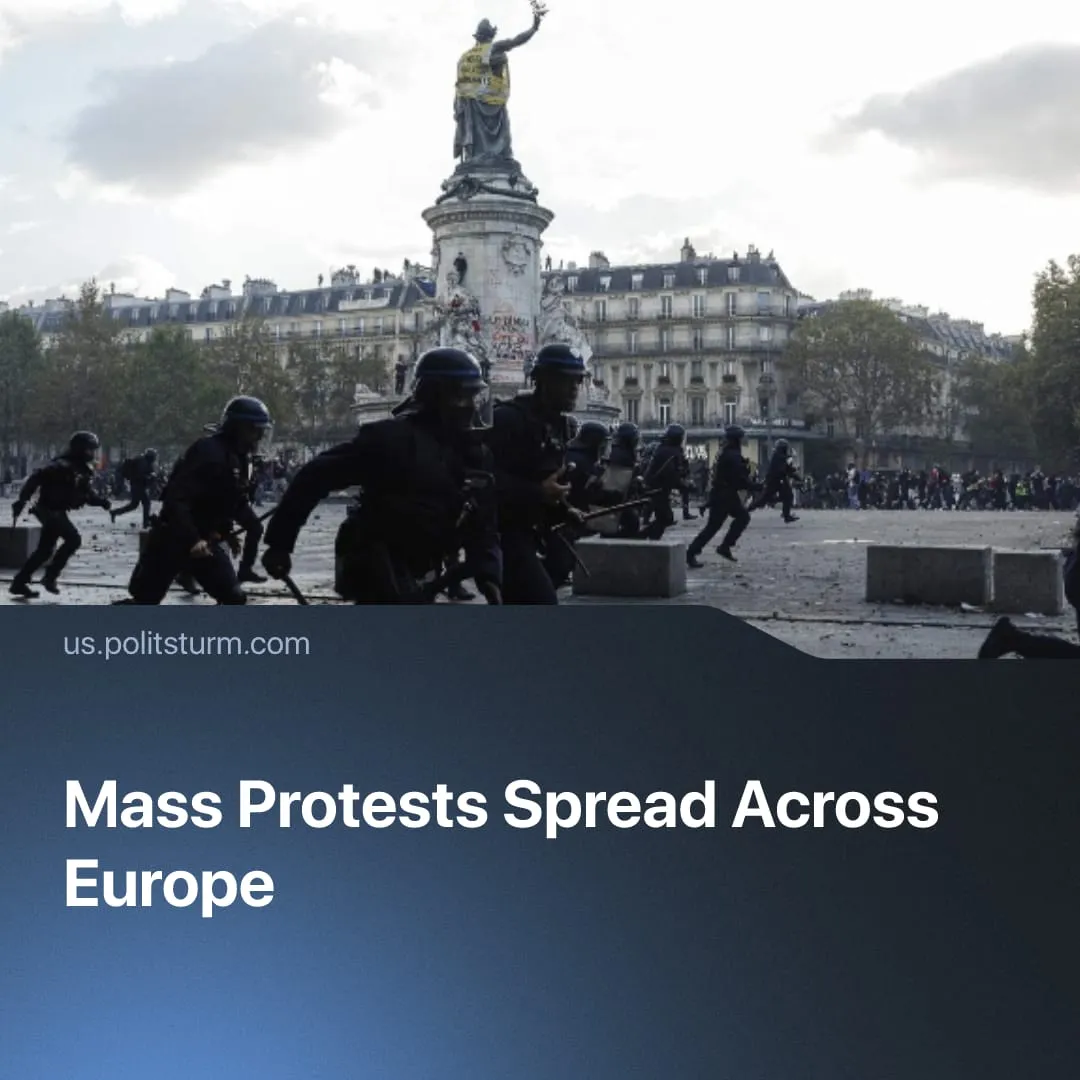
Protests in France expanded to a European scale. Governments responded by imposing curfews, firing on demonstrations, and blamed leftists, communists, and migrants. What is the real cause of the protests?
Details. The student protest movement in France has grown into a wave of protests across Europe, including Spain, Belgium, Italy, Portugal, Albania, Greece and others. Hundreds of thousands participated in France alone. In some places, protesters clashed with police, looted, and committed arson. In France and Albania, government buildings have been attacked and breached.
► In France, nightly curfews have been enforced as Macron cracks down on “illegitimate” protests. In Italy, 14-18-year-olds deemed a "danger" face arrest even without committing a crime. Albanian police have fired rubber bullets at protesters. In Belgium, the parliament debated legislation to ban “radical organisations”, whilst in Athens, 3,000 police officers were deployed.
► French President Emmanuel Macron and Prime Minister Lecornu blamed ‘radical left-wing groups’ – much like the Belgian Interior Minister – and criminals for the unrest. Italy and Portugal restricted their responses to formal condemnations. US President Trump claimed the protests were orchestrated by “migrants, jihadists, and Communists”, insisting that European states should “CLOSE THEIR BORDERS”. The bourgeoisie exploits chaotic riots to justify further repression under the pretext of combating “migrant” and “left-wing” threats. Such reactionary measures accelerate fascization and militarization.
Context. The initial protests started in France in early October, beginning at underfunded schools in impoverished areas and spreading nationwide. They targeted teacher shortages, poor school buildings, and an unequal university admissions system. Student demonstrations spread nationwide and drew support from the Yellow Vests movement and the CGT trade union.
► The protests are taking place against a backdrop of declining living standards across Europe. Across France, Spain, Portugal, Belgium, Italy, Greece and Albania, inflation ranged from 2.9% to 5.1%, with several nations hitting two- to three-year highs. Following the Iran war, fuel costs surged between 10.9% and 40.3% across states. Housing prices increased up to 16.5%. Thousands of teaching positions were unfilled. The specific issues varied by country, with housing for Spain and Portugal, education for France, corruption in Albania and workplace safety concerns in Greece.
► The protests fit a broader historical pattern of public outrage against declining living conditions: the 2018 Yellow Vests protests against new fuel taxes, the 2022 cost-of-living demonstrations and strikes across Europe over wages and working conditions, and Nepal’s Gen Z uprising, which ended up transferring power to a liberal party.
Important to Know. The 2026 European protests resemble outrage at the decline in living standards by workers, students, the lumpen and other strata. Beginning as organized demonstrations by workers and students, the protests were deliberately steered toward looting and arson under the influence of provocateurs and adventurist "ultra-revolutionary" groups.
► Various political organizations rushed to opportunistically gain influence within the movement, including Trotskyist groups (NPA, RP and RCI) and anarchists. An appeal published by NPA defended property damage by students, while demanding a “fundamental transformation of our society” through the movement. As Lenin warned in 1902, revolutionaries must “warn against adventurism and ruthlessly expose illusions which inevitably end in complete disappointment”.
► Despite their scale and duration, the protests in France and across Europe in 2026 have had no impact on the crisis of capitalism. One particular reason for this is the ongoing crisis of the communist movement. Strong communist parties remain absent in European countries. Existing organizations, including the ‘Marxist-Leninist Pole’ with the Communist Party of Greece at its helm, fail to provide a Marxist analysis and lack both the strength and the theoretical framework required to lead the movement. They had already demonstrated their weakness during the pro-Palestinian protests.
► Without clear goals, a disciplined party-vanguard and genuine leadership, such movements end in suppression without meaningful change, temporary concessions from capital or the replacement of one bourgeois government by another, as seen in Nepal and other examples over the last few years.
► Workers in France and other countries of Europe need their own organisations, revolutionary trade unions and, above all, a genuine communist party. As the crisis intensifies, more and more workers will come to see the ineffectiveness of spontaneous protests. Communists face the task of increasing class consciousness among the masses, and fostering the growth of class-conscious workers and communist organizations.
► This wave of protests is only the beginning. As the capitalist crisis deepens, militarization accelerates and the remaining protections of the “welfare state” are dismantled, similar struggles will increasingly emerge across the world.