

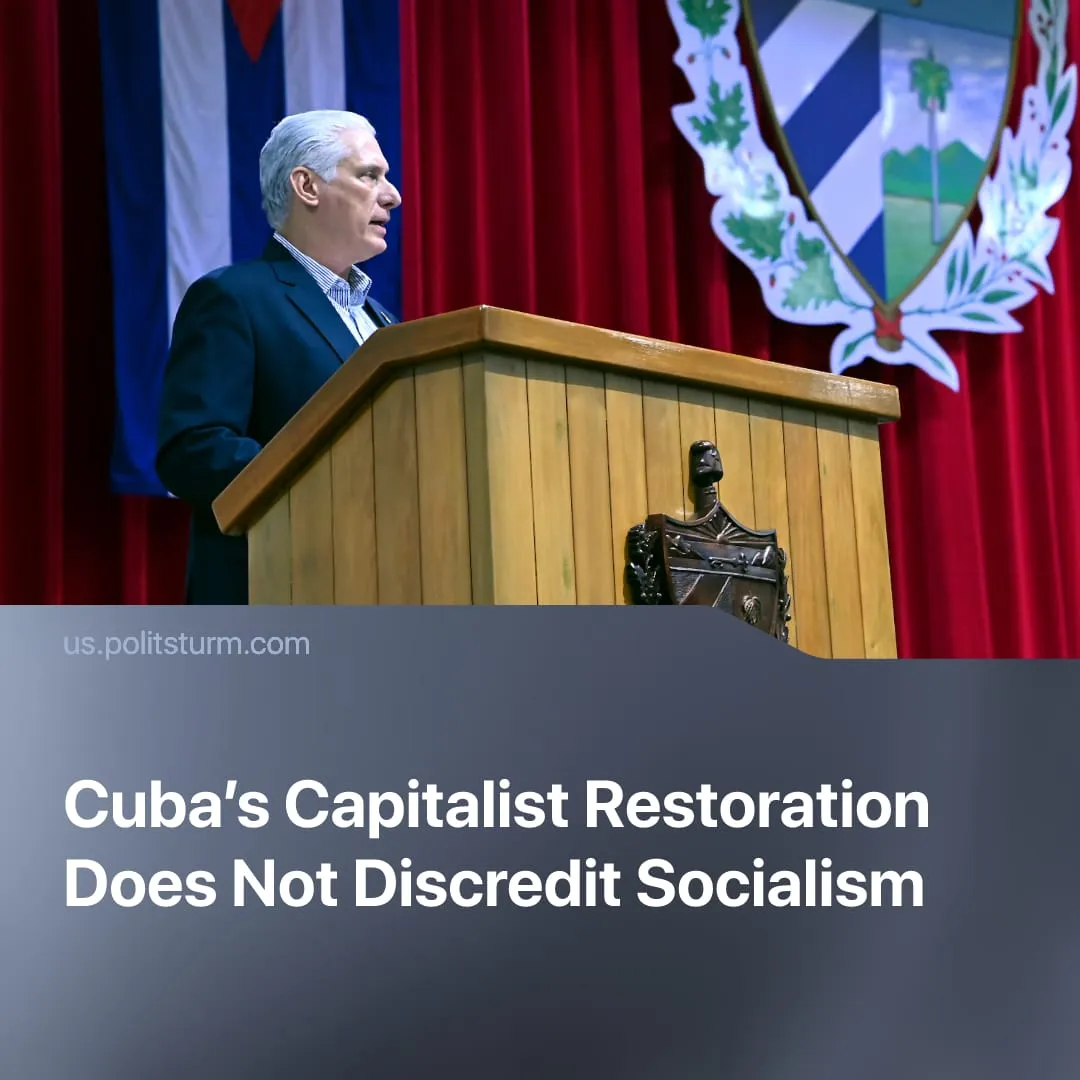
The restoration of capitalism in Cuba doesn’t prove the ineffectiveness of socialism.
Details. After the official legal restoration of capitalism, Cuba began to be portrayed as further proof of the ineffectiveness or utopian nature of socialism.
► American politicians regularly present the Cuban economic crisis as evidence of the failure of communism. On the day the reforms were adopted, US Vice President J.D. Vance declared that socialism in Cuba "didn't work" and prevented Cubans from "making money". In late September, Trump described Cuba as an "absolutely failed state" during a speech at the UN. Trotskyists reacted in a similar vein, using the defeat in Cuba as an argument against the Marxist-Leninist theory of building socialism in one country.
► While formally recognizing socialism "as a whole", in practice, Trotskyist statements merge with US bourgeois propaganda. The ideologues of American imperialism and Trotskyists converge in their attempts to exploit the counterrevolution in Cuba to convince the working class of the futility of building a real dictatorship of the proletariat and successfully constructing socialism.
Why is it wrong? The defeat of the Cuban Revolution should be seen as the final stage of the socialist bloc's general decline, which began in the 1980s.
► After the October Revolution of 1917, capitalist countries repeatedly attempted to destroy the Soviet state and, later, to weaken and destroy the socialist camp that had formed around the USSR. Military interventions, economic pressure, diplomatic isolation, and support for anti-communist forces were constant elements of this struggle.
► The Cuban Revolution triumphed in 1959, when the first socialist workers' state had already existed for over four decades. Initially, the revolution was democratic and national-liberational in nature. But thanks to the support of the Soviet Union and the Council for Mutual Economic Assistance (CMEA), the Cuban Revolution transformed into a socialist revolution by 1961. At the same time, the strong influence of petty-bourgeois leadership and revolutionarism remained, exacerbated by the impact of deviations such as Khrushchevite revisionism and Maoism.
► The island is located in close proximity to the United States, which sought to defeat the revolution. The American economic blockade became one of the most important factors limiting the country's development. On the other hand, constant counterrevolutionary attempts, with the active participation of the United States, also supported the revolutionary consciousness of Cuban communists.
► After the collapse of the USSR, Cuba lost its key foreign trade partner and source of economic support. The "special period" that began in the 1990s was accompanied by a severe decline in production and living standards, the legalization of the petty bourgeoisie, and the admission of foreign capital. Internal factors contributing to the defeat of the Cuban Revolution included strong petty-bourgeois vestiges in the former colonial country and the revolution's weak material base.
► External pressure does not absolve the Cuban leadership of its responsibility for its chosen course. The general rise of right-wing opportunism and anti-Marxist theories after the collapse of the USSR led to leadership errors. Having shifted to the right, the Cuban leadership consistently implemented and encouraged capitalism. This was reflected in a change in economic relations, the growth of a petty and middle bourgeoisie, integration into the global market, and Cuba's transformation into a dependent state of the Chinese bloc.
► Marxist-Leninist theory has become an ‘ideological facade’, divorced from reality, justifying opportunism and the transition to state capitalism. According to the Cuban leadership, the 2026 economic reforms are the implementation of a policy, initially planned to be adopted at the 2011 party congress. This suggests that the legislative enshrinement of capitalism in Cuba was in the works 15 years ago.
Context. Historically, in the Soviet Union during the NEP years, as in Cuba, there was a threat of a right-wing victory. Representatives of both the right (Bukharin) and left (Trotsky, Preobrazhensky) exaggerated the difficulties facing the USSR, downplayed the dangers of economic ties with bourgeois states, and underestimated the potential of the dictatorship of the proletariat to build socialism on its own.
► The Bolshevik Party, led by Stalin, relying on class-conscious workers, crushed both deviations and prevented the USSR from sliding toward capitalism. The Soviet Union's leadership included several generations of revolutionaries, united in a disciplined vanguard party, armed with the scientific theory of Marxism-Leninism and supported by the organized working class. By consistently defending and developing Marxist-Leninist theory, the Bolsheviks were able to quickly resolve the most important tasks facing the USSR in the 1930s and build a powerful socialist basis.
Important to Know. The Cuban leadership, unlike the Bolshevik Party, failed to maintain the correct line.
► As a result of external pressure, the influence of opportunism, the initially weak material base, and the absence of heavy industry in the last years of Fidel Castro’s life, and with his indirect support, the petty and middle bourgeoisie were legalized in Cuba.
► During the "Special Period", under the pretext of saving the economy, the Cuban government created the capitalist conglomerate GAESA (Grupo de Administración Empresarial) to manage foreign exchange flows and joint ventures with foreign capital. Having concentrated key industries in its hands, GAESA quickly transformed into a state-capitalist monopoly.
► In turn, the state, military, and party apparatus that controlled GAESA began to transform into a new bourgeoisie. Part of Cuba's current leadership, including members of the Castro family, openly flaunts a luxurious lifestyle and is prepared to negotiate with the United States on a transition to "standard" bourgeois life in countries dependent on American capital.
► The restoration of capitalism in Cuba was the result of opportunism and revisionism and does not prove the utopian nature of communism. It exposed the illusions of the opportunist tactics of "market socialism" and flirtation with capitalism. The rejection of the dictatorship of the proletariat and Marxism-Leninism led Cuba to the restoration of capitalist rule and the enslavement of the country by a foreign bourgeoisie. Similar processes had previously occurred in China and Vietnam in the 1980s and 1990s.
► The restoration of capitalism in Cuba also unmasks the pseudo-communist rhetoric of the current Cuban leadership and its defenders: pro-Chinese opportunists, as well as members of “Solidnet” and the “M-L Pole”, led by the Communist Party of Greece. Empty calls for "solidarity with the Cuban revolution" in practice translate into solidarity with the bourgeois dictatorship.
► The defeat of the Cuban Revolution confirmed the validity of Marxist-Leninist theory. Conscious communists and workers must continue to study Marxist-Leninist theory, build new types of communist parties, and ruthlessly criticize opportunism and revisionism, including the theory and practice of pseudo-socialist bourgeois regimes.