

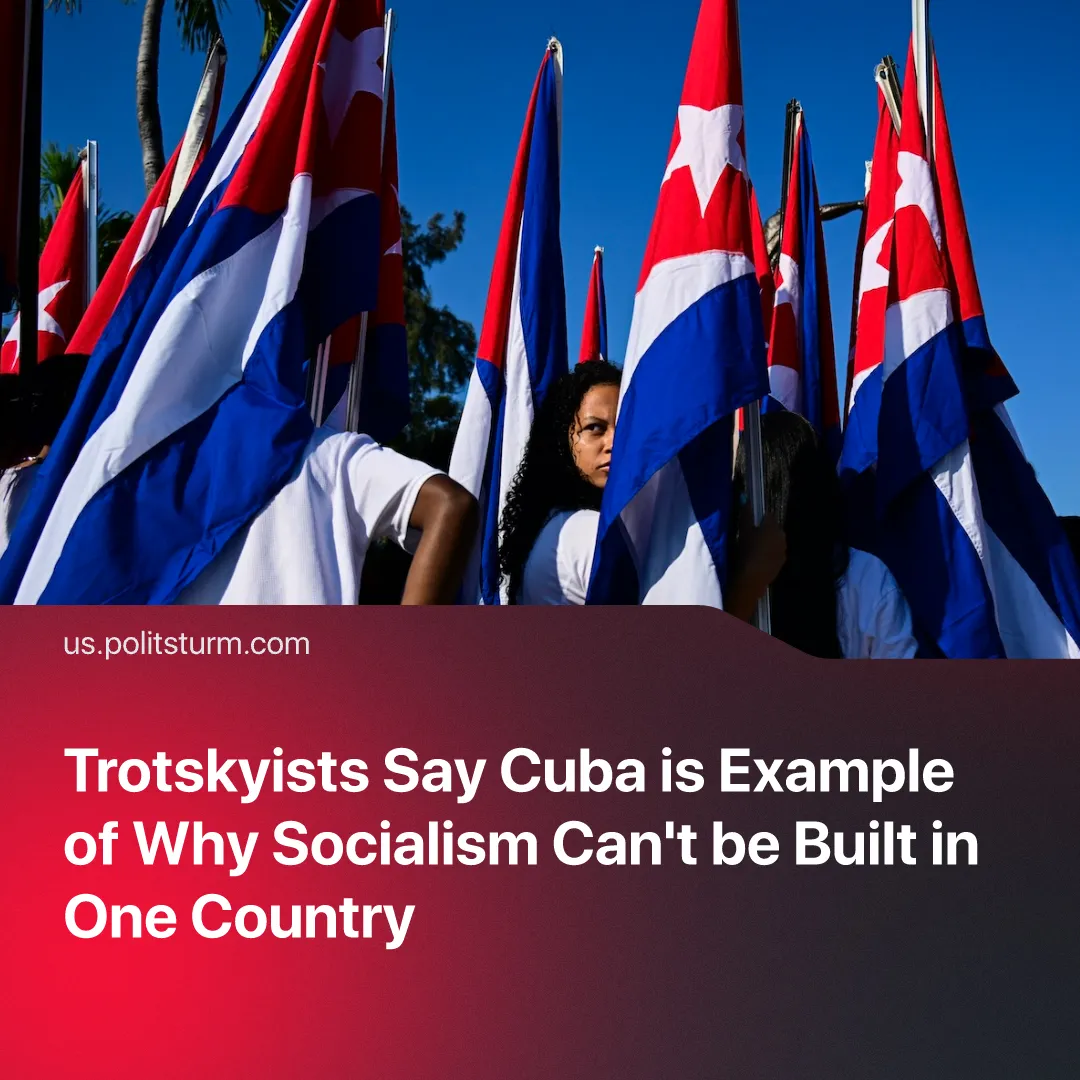
Trotskyists declared the restoration of capitalism in Cuba proof of the 'impossibility of socialism', blamed other Trotskyists and communists for this, and supported the position of the KKE. In reality, Cuba confirms the correctness of Stalin's positions.
Details. As news emerged of the US-Cuba negotiations and subsequent "economic reforms", a number of Trotskyist "internationals" began to publish their assessments of the events.
► "In Defence of Marxism" of Alan Woods and his supporters from the former "Socialist Appeal" (an entryist group within the UK Labour Party that rebranded into "Revolutionary Communist Party") published an analysis on June 22.
► Comparing Cuba to China and Vietnam, they made it appear as if reforms were just the beginning of capitalism: "In those cases, the process took decades; in Cuba, they want to push ahead in a matter of days and weeks". In reality, the Cuban economy has been becoming capitalist over decades, with the first attempt to pass the current reforms dating back to the early 2010s.
► At the same time, Trotskyists provided a positive view of Chinese imperialism: "In China, capitalist restoration in a large country, with a huge reserve of cheap labor and a strong state, eventually led to sovereign development that has turned the country into a world power capable of challenging US dominance. ... But at least it is a capitalist country that determines its own policy and competes in the world market on equal terms with US imperialism". "Revolutionary Communist Party" essentially repeated social-chauvinist narratives about the supposedly "progressive struggle" of Chinese imperialism against the Western bloc and justified its support.
► They explained Cuba's defeat by the defeat of the "Bolivarian Revolution" in Venezuela: "The defeat of the Venezuelan Revolution… deepened the isolation of the Cuban Revolution, laying the foundations for the current situation". Previously, Alan Woods and his supporters regularly spoke out in support of Hugo Chávez and his regime in Venezuela. Venezuela's leadership, in turn, had a positive attitude toward Trotsky.
► Cuba was compared to the USSR and portrayed as logical proof of the supposed impossibility of socialism in one country, despite objective differences between the countries: "It is not possible to build socialism in one country. It was not possible in Soviet Russia, which spanned an entire continent with vast material and human resources. It is even less so on a small Caribbean island 90 miles away from the world's largest and most reactionary imperialist power".
► This rhetoric suggests that building socialism is impossible even on a continental scale and requires a virtually simultaneous revolution in the entire world. It directly denies Lenin's thesis that socialism could and must be built in one country, thereby providing practical support for socialism's international development. The Trotskyist position effectively leads to a general anti-communist narrative of bourgeois propaganda about the supposed "utopian" nature of socialism.
In reality, the construction of socialism in the USSR was not only possible but also achieved thanks to the leadership of the Bolshevik Party and its theoretical line. After the Civil War, the "New Economic Policy" was introduced, under which minor concessions were temporarily given to capitalists and a few capitalist elements were introduced into the economy, whilst industry was rebuilt.
► Contrary to the claims of the Trotskyists, it was not solely "workers' control" that prevented the NEP from sliding into the restoration of capitalism in the USSR, but the dictatorship of the proletariat, of which workers' control was a part. The dictatorship of the proletariat in the USSR during the NEP included the suppression of open counterrevolution, the strengthening of the country's defense, the strengthening of ties with workers worldwide, the prevention of excessive strengthening of capitalist elements, the general protection of the interests of the working class and its allies, and their involvement in the construction of socialism.
► The guiding force of the dictatorship of the proletariat in the USSR was the Communist Party, headed by Stalin and his supporters. The party fought off both right and left deviations, including Trotskyists. Conducting a clear line on defending the dictatorship of the proletariat and eliminating various deviations within the Communist Party allowed the USSR to renew its offensive against capital in the late 1920s, successfully abolishing capitalism and building socialism in one country. The restoration of capitalism in Cuba shows that only this approach can protect the dictatorship of the proletariat and its party from defeat.
What positions did other Trotskyist organizations take? "The Committee for a Workers' International" – Woods' former comrades in the entryist "Militant" faction within the UK Labour Party – claimed that Cuba had been a "bureaucratic regime" from the very beginning of the Cuban Revolution, blamed Venezuela and the "Stalinist bureaucracy".
► The "International Committee of the Fourth International" published extensive material on Cuba in early June. It declared Cuba a confirmation of the theory of "permanent revolution" too, declared Lenin a Trotskyist, and blamed Cuba's defeat on "Lula in Brazil, Sheinbaum in Mexico, the Chavistas, the Stalinist parties, and the Pabloite tendencies". A large portion of the report was devoted to infighting within Trotskyist currents and accusations against former "comrades".
► "Socialist Workers' Party" of Tony Cliff, known for the theory of "state capitalism in the USSR", published material at the end of May. Much of the material was devoted to denigrating the Soviet Union as an alleged "imperialist".
► The "International Communist League (Fourth Internationalist)" published a position on June 20, declaring the need to form a "left opposition" in Cuba and abroad. On June 30, they published an "Open Letter to the Communist Party of Greece" from its Greek section, supporting the KKE's position on Cuba and proposing the creation of a "left opposition" against American imperialism and "an international anti-imperialist front... to break the blockade of Cuba".
Almost all Trotskyist structures included in their positions fantastic plans to save the Cuban Revolution. The position of the "Revolutionary Communist International", shown above, in addition to the mythical simultaneous revolution throughout the world, saw the salvation of Cuba in the need to continue the "Venezuelan revolution": "Had the Venezuelan Revolution followed the example of the Cuban Revolution in the period 1959-62 by expropriating imperialism and the capitalist oligarchy, this would have acted as a powerful magnet across the entire continent and beyond, and would have consolidated its gains".
► Their former allies in the CWI even went so far as to agree that, to save Cuba, Venezuela under Chávez had to unite with Bolivia and Ecuador in a "socialist confederation" that would give "an appeal to the Cuban masses to establish a genuine workers' democracy".
► “ICFI” would like to see the Cuban leadership make “an appeal to American workers to truly rise up against the aggression of their own ruling class. Such a movement from below in the United States would inevitably trigger a movement of workers in Cuba demanding an end to the privileges of the capitalist and military elite that controls the economy".
► “ICL (FI)” supported Chinese imperialism, putting forward a list of demands that the “Communist Party of China” must fulfill in defense of Cuba to “rally hundreds of millions of toilers in China and the Global South”.
Context. On June 18, Cuba's leadership adopted a set of "reforms" that consolidated the country's economy as capitalist and opened it to foreign capital. It formalised a decade-long trend of a continuous retreat from socialist construction.
► Historically, the Cuban revolution caused splits among Trotskyists due to its initial national character and later approach to the USSR, with factions disagreeing on whether to support it or not.
► The actions of the Cuban leadership were portrayed as the beginning of a repeat of the “Chinese success” by social chauvinists.
► The position of the leadership of the “Communist Party of Greece”, which leads Solidnet and the informal “M-L pole”, avoided characterizing the Cuban regime and the opportunist “Communist Party of Cuba”.
► This is not the first time Trotskyists have supported the positions of the KKE. Previously, Alan Woods' “International Marxist Tendency” (renamed the “Revolutionary Communist International”) supported the KKE's position on Gaza, its condemnation of the "popular front" tactics used by the Comintern to combat fascism in the 1930s and 1940s, and called to support the KKE in the 2019 elections.