

The Cuban government attempted to become a “second Venezuela” for American imperialism. In response, the US increased sanctions and hinted at the need for further Cuban retreat.
Details. The "economic reforms" adopted by the Cuban leadership on June 18 place significant emphasis on foreign capital access to the market and specifically stipulates "partial dollarization". In practice, this means inviting primarily American capital into the country.
► This may indicate an attempt by the opportunist “Communist Party of Cuba” to combine a transition to a dependent position on the US with the preservation of the regime and levers of economic control in the form of the state-owned corporation GAESA.
► The Cuban bourgeoisie is looking toward the examples of Venezuela and Iran. Following the kidnapping of Maduro from Venezuela, the regime of the “United Socialist Party of Venezuela” remains in place, obediently fulfilling the demands of the hegemon. During the protests in Iran, the Western bloc vocally supported the protesters and used them as one of the justifications for military actions. However, the negotiations and the "memorandum of understanding" formally intended to end the war between the US and Iran turned out to be focused exclusively on economic issues.
► The example of Venezuela and Iran has demonstrated that modern American imperialism relies on targeted intimidation and economic pressure while maintaining regime stability in the country. The stability of a regime that maintains order despite extremely acute social contradictions may be one of the Cuban leadership's trump cards.
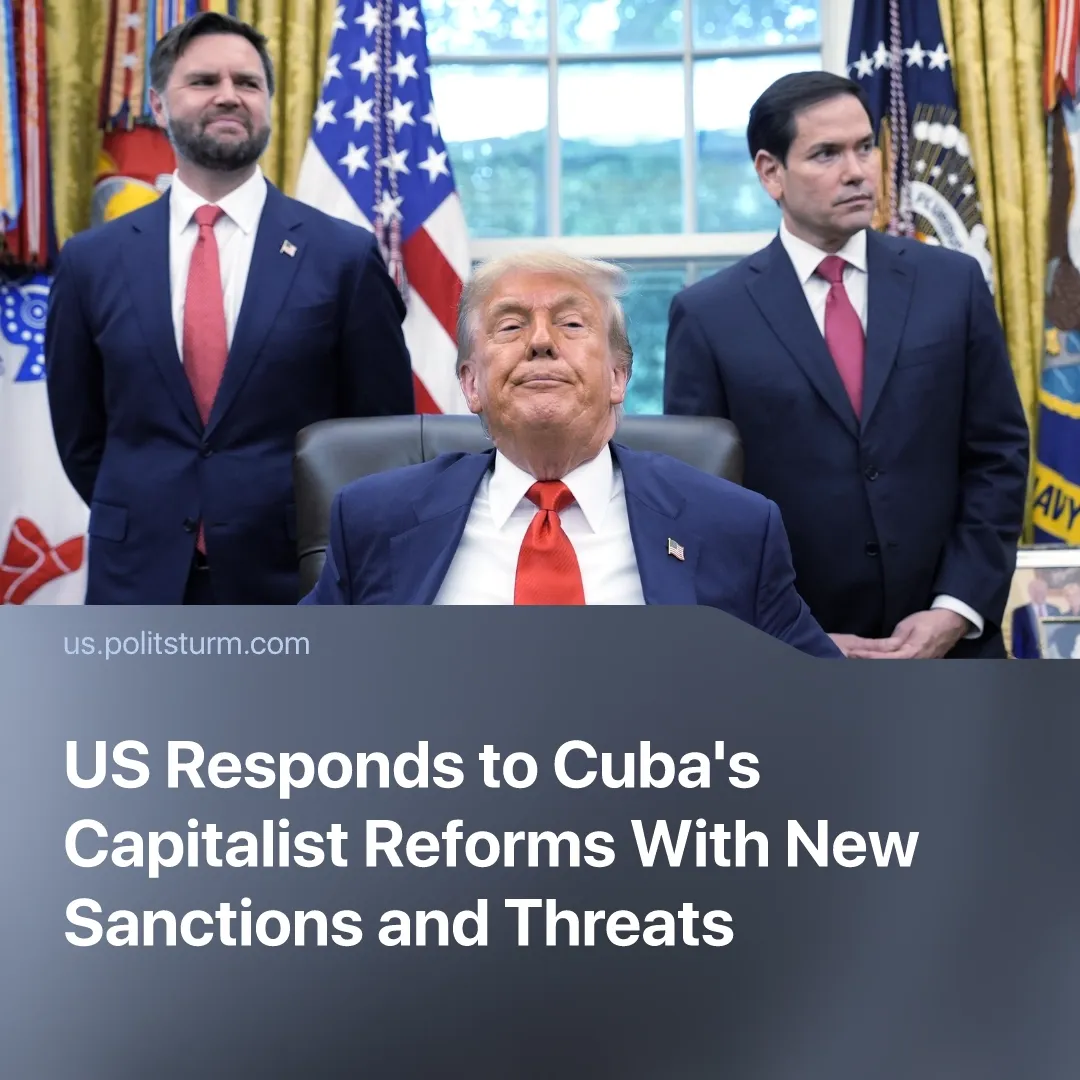
How did the US respond to Cuba's "reforms"? The first reaction came from US Vice President J.D. Vance on the day the Cuban "reforms" were adopted. His statement emphasized US participation in the negotiations and a willingness to make changes if the Cuban government makes the "right decisions": "They can't make any money. Their economy is frankly probably in worse shape than the Iranian economy. ... We're actually talking to... the Cuban government right now about how they could change their ways to change that. We're going to see what they do. And obviously, if they do one thing, we're going to do something. If they make smart decisions, we're going to have a much better relationship with that island."
► The following day, Trump mentioned Cuba in an interview. He noted the possibility of a military intervention, that "Cuba wants to talk very badly", and that the negotiations were being led by US Secretary of State Marco Rubio, who comes from a family of Cuban immigrants.
► On June 23, Rubio announced new sanctions against enterprises within GAESA. The sanctions target infrastructure, financial, and mining companies and can be linked to part of the fight with China over rare earth minerals. That same day, the US Supreme Court simplified the procedure for American companies to demand compensation from the Cuban government for the nationalization of their assets during the revolution 60 years ago.
► Vance's softer statement and Rubio's sanctions announcement, both known for their rivalry within the Trump administration, could be used by the US as a "carrot and stick" tactic.
► On June 30, the Cuban Foreign Minister stated that negotiations had reached an impasse. This could indicate that the US is dissatisfied with the Cuban leadership's current actions and will increase pressure for further retreat.
Context. The "reform" package adopted by the Cuban parliament and approved by the Communist Party of Cuba on June 18 legislatively enshrines the capitalist nature of the Cuban economy and opens the country to foreign capital.
► Cuba's leadership is trying to convince that the "reforms" are not the result of American pressure, which contradicts the facts.