

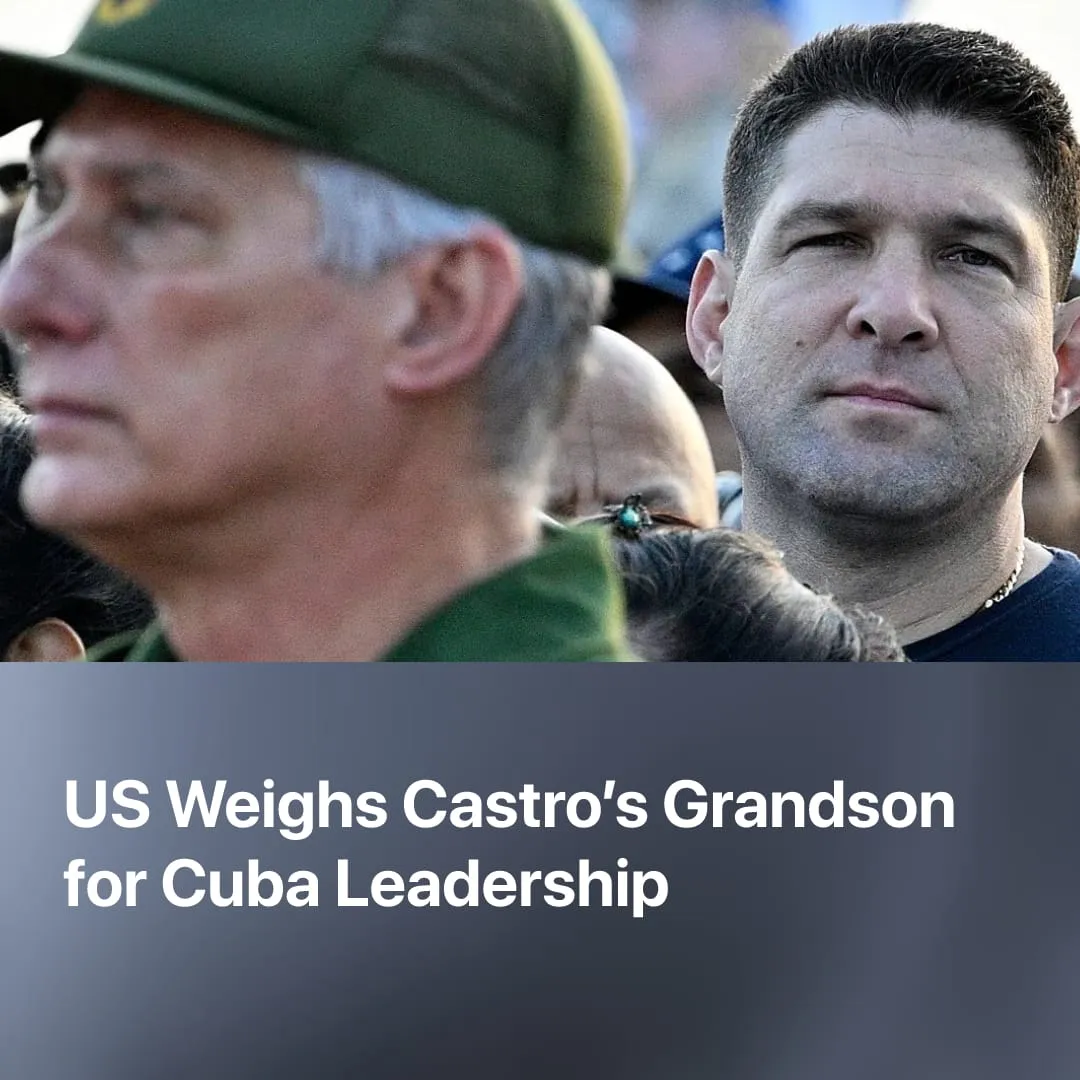
The US is considering Raúl Castro's grandson as a potential leader of a pro-American regime. He gives interviews to state-controlled American media, lives in luxury, and personally helped push through the 'reforms' to open Cuba to American capital.
Details. The Trump administration has been searching for a Cuban official willing to take over the government in Havana. The CIA is reportedly weighing Raúl Guillermo Rodríguez Castro and Interior Minister Lázaro Álvarez Casas as potential candidates
► In his first interview with a US outlet, Raúl Guillermo Rodríguez Castro positioned himself as Cuba's negotiator, saying he “can negotiate with anyone designated by the US”, even Trump.
► Rodríguez Castro met with Rubio, State Department official Jeremy Lewin, and was present when CIA Director Ratcliffe visited Havana in May. He sent a secret letter to Trump proposing economic cooperation and sanctions relief – intercepted at Miami airport. Tellingly, he was not sanctioned by the US, unlike Cuba's president and other senior officials.
► The current US government is seeking to mimic what it executed in Venezuela, replacing current Cuban leadership with a “pragmatic” and more pro-US leader, whilst preserving the ruling regime, maintaining some stability whilst avoiding an expensive conflict, like what has happened with Iran.
Who is Rodriguez Castro? He is Raúl Castro's eldest grandson and son of the late General who ran GAESA, he holds no elected office and rarely appears in state media.
► He presents himself as a continuation of the revolution. He wears a gold chain bearing the initials of Fidel and Raúl Castro, saying "if there's anything I believe in, it is these two men”, and frames his negotiations with Washington as fulfilling his revolutionary duty: "I've never been interested in politics. It's never been a calling of mine. But if at some point the revolution needs me to step up, I will do it”. At the same time, he claims he would never sacrifice the principles of Cuba's revolution.
► He conducted the interview in Hugo Boss and Hermès sneakers, has made at least 23 private jet trips to Panama, claiming to look for investment opportunities for Cuba, and appears in leaked videos on private yachts and in nightclubs. While millions of Cubans endure blackouts and food shortages, he said: "It pains me that many people can't live the way I do”.
► He gave his interview the day after the 176 reforms passed, with it suggesting he personally helped push them through, directly dismantling the revolution he claims to uphold. He points to China and Vietnam as Cuba's model.
Context. The 2026 package of 176 reforms in Cuba formalised a capitalist economy that had been developing for decades. The reforms included full privatisation of state enterprises and opening the economy to foreign investment.
► GAESA – the military conglomerate whose profits account for an estimated 37% of Cuba's GDP – already dominated the Cuban economy before the reforms. The 176 measures expand the conditions for the military-bourgeois elite to accumulate further. Rodríguez Castro's father built and ran it until 2022, Rodríguez Castro now oversees it informally, while claiming in the interview it represents only 15% of the economy.
► Figures like this are not exclusive to Cuba. In China, many relatives of Party Officials (referred to princelings) obtained privileged economic positions. Whilst the term refers to a wide range of people, it includes entrepreneurs who enriched themselves as China’s economy was opened up to foreign capital. In Vietnam, one of the architects of the opening up and privatisation of Vietnam, Nguyen Xuan Oanh, was allowed to travel abroad to open up channels for foreign investment.