

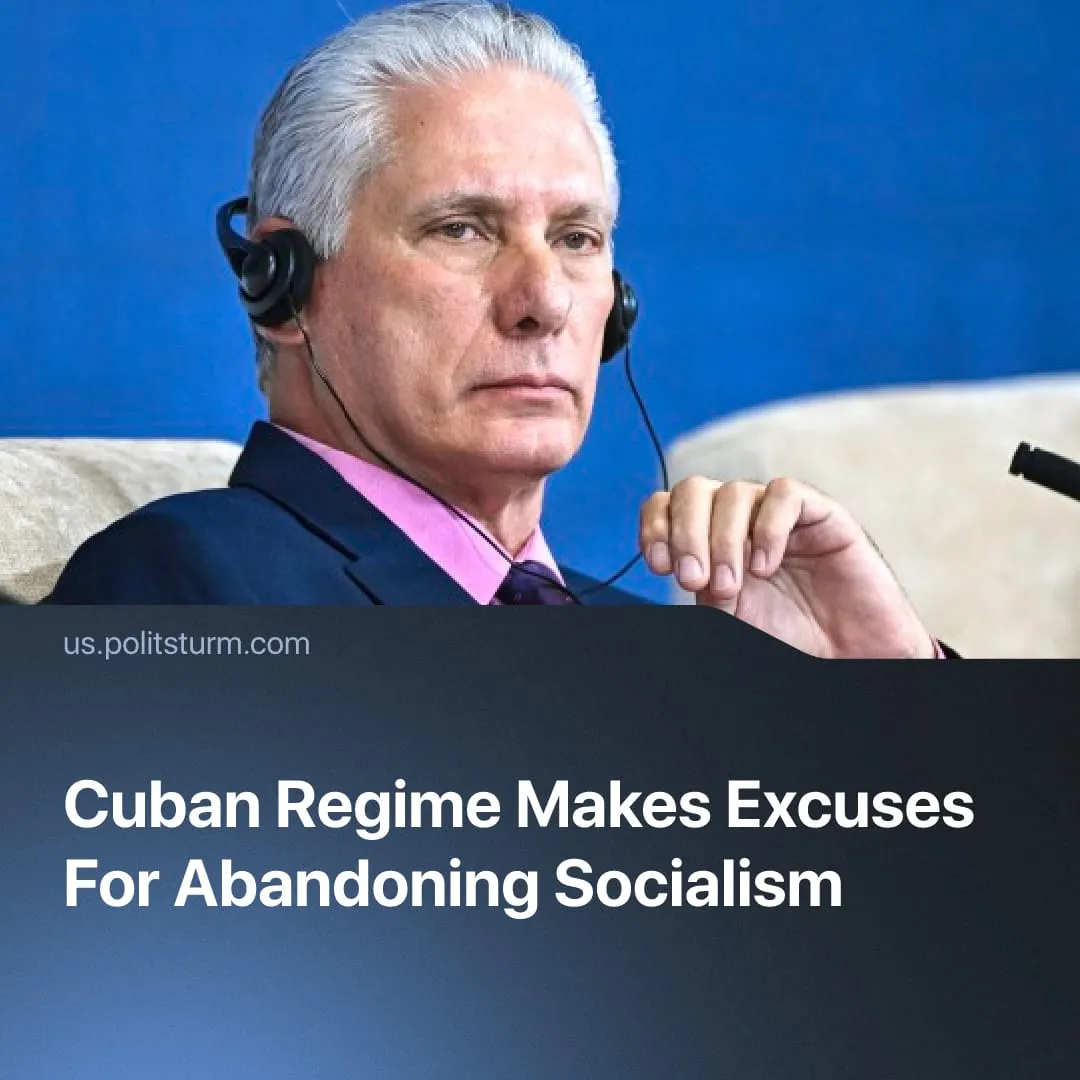
Cuba’s government claims that the restoration of capitalism is the only way out of the crisis. In the USSR, Trotsky and the Right-wing deviationists used similar justifications for the growth of capitalism during the NEP. They were proven wrong by Stalin and the Bolsheviks.
Details. Cuban government figures justified the formal restoration of capitalism in 2026 by the hardship of the “specific conditions of Cuba”, with the President and Prime Minister specifically blaming the “unprecedented combination of coercive measures” and the “blockade imposed by the United States” for their own reforms.
► Cuba’s President Díaz-Canel claims that “reality imposes urgent and necessary changes on us”, due to the "extraordinarily complex and challenging” crisis catalysed by the USA’s military blockade since January. The Cuban regime mouthpiece Granma explains that the capitalist reforms are “designed [...] to overcome the current circumstances”. Markets and the private sector are claimed to be the only way to achieve growth.
► The “Communist Party” of Cuba absolves itself of any responsibility for the crisis, and frames its policy of selling out the country to capitalists as a necessity. Cuba’s Minister of Foreign Affairs presented the crisis as a force of nature that the Cuban government couldn’t do anything about – except restore capitalism.
Quote: “How can the Cuban government be blamed for the consequences of the total deprivation of fuel and other essential supplies implemented over the past seven months?”
► The Communist Party of Greece newspaper Rizospastis recognised Cuba’s reforms as a “response to the extremely difficult situation created by [the US] blockade”. Whilst standing “firmly alongside” and in “unwavering solidarity” with the Cuban CP against external US pressure, the KKE will only offer vague “discussion” about the internal betrayal waged against Cuba’s working class.
Context. In June 2026, Cuba’s government implemented 176 privatization and liberalisation measures, finalising the long process which legally restored capitalism on the island. Historically, similar policies were enacted in the People’s Republic of China, Vietnam and the USSR under Gorbachev.
► Whereas Politsturm has extensively outlined the Cuban reforms and clearly exposed the bourgeois regime in Havana, opportunists and revisionists are exploiting the situation. Social-chauvinists hailed Cuba’s reforms as a confirmation of Chinese capitalism’s success. Trotskyists claimed the failure of the Cuban Revolution proves the “impossibility of socialism”. Meanwhile, the KKE-led Solidnet maintains “critical” support for capitalist Cuba, and hosted its 24th conference there.
► Historically, the Cuban Revolution throughout the 1960s faced sustained attacks from US imperialism, but 20th-century Cuba remained a strong ally of the Soviet bloc and refused to permit capitalists to regain power. Conversely, the renewed US military blockade of Cuba this year has now been used as a pretext to formally abandon socialism. Earlier, the USSR faced similar encirclement, invasions, and embargoes. How did the Bolsheviks resolve these crises?
Important to Know. Bolsheviks held revolutionary optimism, and were always eager to find communist solutions for problems, no matter how daunting they appeared. In Soviet history, the Bolsheviks faced multiple groups of opportunists that would rather have abandoned the fight and allowed capitalism to return.
► In the 1920s, following victory in the Russian Civil War, the Bolsheviks had to rebuild a devastated country – millions had been killed, industrial production was only 13% of prewar levels, and the grain harvest less than half. Foreign imperialists had launched blockades and attacks against the revolution, hostile powers continued to encircle the young USSR.
► In 1925, Trotsky argued that the USSR could only resolve this crisis through deeper integration with the world capitalist market. He dismissed concerns about dependence on capitalist trade as "too thread-bare and abstract", arguing that growing into the world market would make the USSR stronger. He urged "a clever use of the resources emanating from the existence of the world division of labour", claiming the USSR "cannot choose the rate of development" outside of world market pressures. Already, defeatists claimed the solution was more integration with capitalism, more opening to markets – rather than an expansion of socialist economy.
► Internally, during the NEP period (1921-1928), the USSR faced the challenge of building up a socialist sector of the economy whilst keeping the remaining capitalists in check. Lenin defined this challenge as a “duel between two methods, two political and economic systems – the communist and the capitalist”. He approached this with confidence.
Quote: “We shall prove that we are the stronger. We have no machinery; the war has impoverished us and deprived Russia of her economic resources. Yet we do not fear this duel [...]. We will not yield an inch”.
► Right-wing deviationists in the Communist Party, led by Bukharin, undermined these efforts with defeatism. Using Menshevik arguments, they belittled the socialist sector’s potential, and instead regarded the private sector as essential for development. In 1928, Bukharin claimed “the possibilities of planned economics must not be overestimated, nor the very considerable spontaneous [capitalist] elements overlooked”. He called for a “happy medium” between socialist and private production.
► Bukharin proclaimed that “an ideal plan is impossible for us”, that socialist economics were a “fatal” failure, and spread panic that “the peasant profiteer and the private capitalist have broken through our front”. The right-wing wanted to surrender to capitalism, because socialism was deemed just too difficult.
► Stalin perceived the political dangers this group posed:
Quote: “The social basis of [political] deviations is the fact that small-scale production predominates in our country, [which] gives rise to capitalist elements, the fact that our Party is [...] infected by these elemental forces. [...] What threat does the Right deviation hold out, if it should triumph in our Party? It would mean the ideological rout of our Party, a free rein for the capitalist elements, the growth of chances for the restoration of capitalism, or, as Lenin called it, for a ‘return to capitalism’ ”.
► As opposed to the panic, the Bolsheviks soberly and clearly appraised the USSR’s problems and immediately began organising the revolutionary counter-offensive. Through fierce and energetic economic improvement efforts, the USSR’s socialist sector won the NEP period struggle. Within five years (1925-1930), the 75% control of commerce by private capitalists was reduced to 5%. The central plan successfully developed Soviet self-sufficiency, doubling the volume of state industrial output (1928-1933).
► As revolutionary optimism paid off – and the USSR rapidly overcame its crisis – Stalin declared the approach of real communists, against the defeatists:
Quote:“No, we refuse to be beaten! [...] There are no fortresses that Bolsheviks cannot capture. We have solved a number of most difficult problems. We have overthrown capitalism. We have assumed power. We have built up a huge socialist industry. [...] What remains to be done is not so much [...]. And when we have done that we shall develop a tempo of which we dare not even dream at present. And we shall do it if we really want to”.