

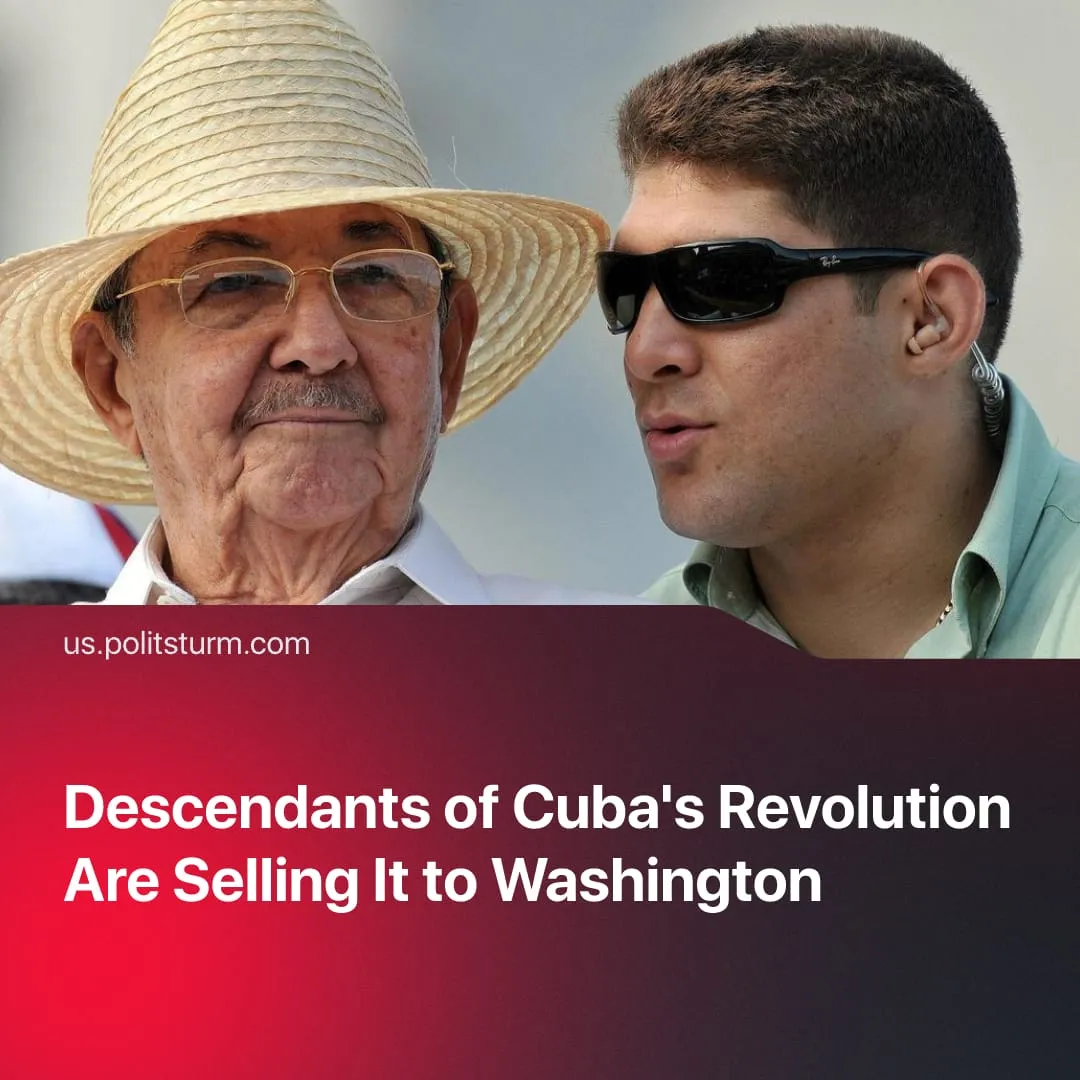
Fidel Castro's rebels stormed Moncada to liberate Cuba from a US-backed dictatorship 73 years ago. Today, Raúl Castro's grandson negotiates Cuba's opening to American capital, flies private jets and buys foreign property.
Details. July 26 marks National Rebellion Day in Cuba. On this day, in 1953, a group of rebels led by Fidel Castro launched an armed assault on the Moncada barracks in Santiago de Cuba – the military headquarters of Fulgencio Batista's US-backed dictatorship. The attack failed, and Castro was tried and imprisoned.
► In his defence speech, Castro described the plight of the Cuban population, one of the reasons for which was the American capital’s absolute control over the island. In 1962, Castro put it bluntly in the Second Declaration of Havana: "Cuba for the nationalisation of foreign enterprises; the United States for new investments of foreign capital... Cuba for sovereignty; the United States for intervention... Cuba for socialism; the United States for capitalism". By 1961, Fidel Castro declared the socialist character of the revolution. In the years that followed, Cuba nationalised foreign-owned and domestic enterprises, implemented land reform redistributing estates to peasants, established a state monopoly of foreign trade, introduced central planning, and built universal healthcare and education systems.
How is the current Cuban leadership selling the gains of the Cuban Revolution? The current regime in Cuba is managed by the descendants of the revolutionary leadership, who have grown up mostly within the so-called "special period", characterised by concessions to the private sector and the creation of the military state-monopoly GAESA, which reportedly controls 40% of the Cuban economy.
► GAESA was initially founded to provide a financial basis to the military and was then run by Raúl Castro’s son-in-law, General Luis Alberto Rodríguez López-Calleja, until his death in 2022. He built GAESA into a conglomerate spanning tourism, retail, banking, remittances, ports, construction, and foreign trade. Despite being a member of the Communist Party's Political Bureau, the highest authority within the party, little was known about his political opinions.
► Raúl Guillermo Rodríguez Castro – Raúl Castro's grandson – holds no formal government position, yet is negotiating Cuba's future with Washington. He has met directly with Secretary of State Marco Rubio, while personally backing the 2026 privatisation reforms. The day after the 176 reforms were approved, he gave his first public interview. The interview, given to official American media “USA Today”, backed the restoration of capitalism in Cuba: "Our country must seek a path to economic development where we must inevitably diversify our economy, diversify the way we do business and diversify the way we do investments". He added that Cuba "doesn't even slightly represent a threat" to the US. Tellingly, he was not sanctioned by the US, while Cuba's president, his son, and other senior officials were.
► In contrast to his famous ancestor, who fought against capitalism and led an ordinary life, Raúl Castro Jr. prefers wealth. While millions of Cubans have endured blackouts and growing poverty, he made at least 23 private jet trips to Panama between 2024 and 2025 for luxury shopping. Leaked social media videos show him on private yachts and in expensive nightclubs, wearing luxury clothing. About this, he has only said that "It pains me that many people can't live the way I do. It weighs on me how people struggle. And I'm working every day to change that situation".
► Historically, the descendants of prominent figures in the communist movement have often followed a similar trajectory. Jean Longuet, Karl Marx's grandson through his daughter Jenny, was repeatedly described by Lenin as an opportunist.
► Vyacheslav Molotov spent 13 years as the USSR's Foreign Minister, using Soviet power to resist American imperialism. His grandson Vyacheslav Nikonov is today a State Duma deputy for the capitalist “United Russia” party, building a career on the back of his grandfather's name, publishing a biography of him in 2005 while describing himself as anti-communist.
► Nikita Khrushchev's son Sergei became a naturalised American citizen, settling in Rhode Island and building an academic career based on his Soviet education and dissident fame, stating he had grown disillusioned with communism, which he said is "not effective in any society".
► Leonid Brezhnev's grandson Andrei spent his career founding and joining a series of opportunist "communist" parties in capitalist Russia – building his entire political identity on his grandfather's name while openly admitting: "I never spoke about communism with my grandfather. I was 20 years old and always regarded the old order and communist ideas with derision". He eventually settled in the opportunist Communist Party of the Russian Federation, a party that has pursued a consistent opportunist policy of support for the current Russian state.
Context. The 2026 package of 176 reforms in Cuba formalised a capitalist economy that had been developing for decades. The reforms included full privatisation of state enterprises and opening the economy to foreign investment.
► Cuban officials justify this as building "socialism with Cuban characteristics" – the same formula used by Deng Xiaoping to justify capitalist restoration in China. Prime Minister Marrero assured the National Assembly the reforms "do not constitute a deviation from the socialist project". Díaz-Canel claims they represent "a search for how to continue building socialism under the specific conditions of Cuba".
► Cuba's bourgeoisie is seeking to retain the "Communist Party" in place while opening the economy to American capital, possibly repeating the Venezuela model. After capturing Maduro in January 2026, his party retained power under Delcy Rodríguez while the country opened to US investment.