

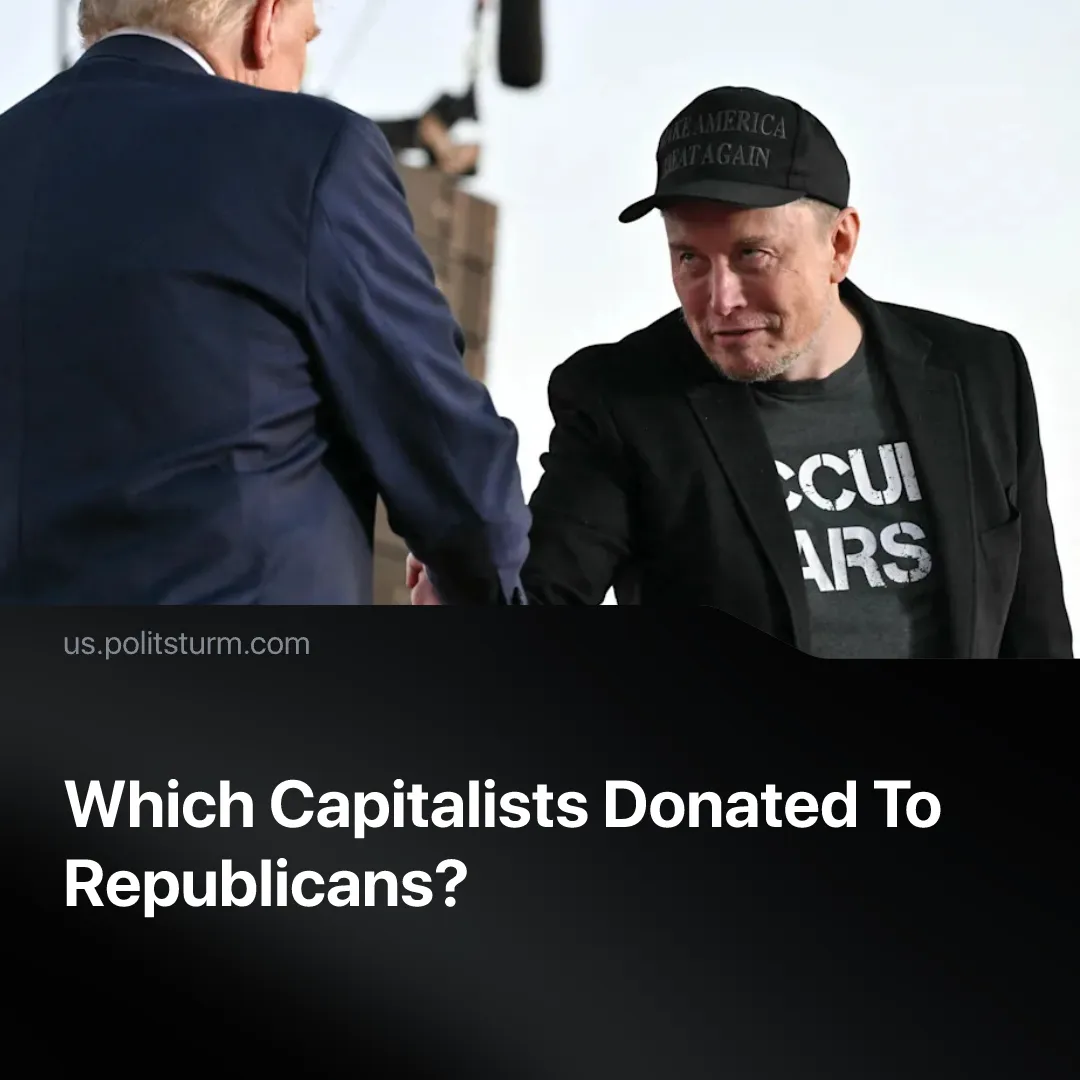
The biggest capitalist donors secured the largest amount of funding for Republicans in the midterm elections. Who are the megadonors, and what does the Republican Party offer them?
Details. The 2026 midterm elections saw a record $11.9 billion in capitalist “donations”. Republicans received three times as much as their Democratic counterparts, with the five largest donors all backing Republican candidates. Dozens of established Republican donors increased their contributions, while Trump’s MAGA Inc. alone received nearly 20% of all corporate donations.
► Near-trillionaire tech capitalist Elon Musk was the largest political donor of the 2026 midterms, contributing a record $483 million alongside his company, United States of America Inc., to support Republicans. He directed at least $225 million towards Texas elections alone, including $158 million channelled through the Senate Leadership Fund to support Republican Ken Paxton against Democrat James Talarico.
► Domestic shipping capitalists Richard and Elizabeth Uihlein ranked second behind Musk, spending up to $150 million. Around a third of their contributions went towards state-level races, particularly in Wisconsin.
► Silicon Valley venture capitalists Marc Andreessen and Ben Horowitz contributed over $115 million, mainly through two PACs backing pro-AI and pro-cryptocurrency legislation. Although these PACs also funded Democrats, they predominantly supported Republicans and gave over $10 million to Trump's PAC.
Context. Like the Democratic Party, the Republican Party serves the interests of different sections of the American capitalist class. The Trump administration has pursued policies that benefit many of the industries represented among its largest donors.
► The administration has supported oil and industrial monopolies through state investment and deregulation. It opened hundreds of millions of acres of federal land to oil drilling, approved nearly 6,000 drilling permits and reduced financial requirements for oil companies. It has also directed investment towards critical-mineral production, crucial for modern militarisation.
► Technology and cryptocurrency companies have benefited from reduced regulation and closer ties to the state. Trump has rolled back restrictions on AI and cryptocurrency, while major technology executives have been brought directly into the state and its military institutions.
► Defence and energy companies benefit from expanding military spending and hawkish foreign policy. US military funding reached nearly $1 trillion in 2026, while Trump's proposed 2027 budget would raise it to $1.5 trillion. The administration's foreign policy has also generated direct gains for American companies, which have secured lucrative oil concessions in Venezuela, gained access to the Cuban market, and profited from the surge in oil prices during the war with Iran. European allies have also been pressed to purchase American weapons.
► His administration has prioritised military spending whilst cutting workers’ living standards, with Trump arguing the US can't afford social spending whilst “fighting wars”. The Republican-controlled Congress passed the Big Beautiful Bill, maintaining $1.5 trillion in tax cuts for corporations and wealthy households while cutting $120 billion from Medicaid and food assistance. The Bill also expanded ICE funding, enabling further repression of immigrant workers. Republicans have also defended weak labour protections.