

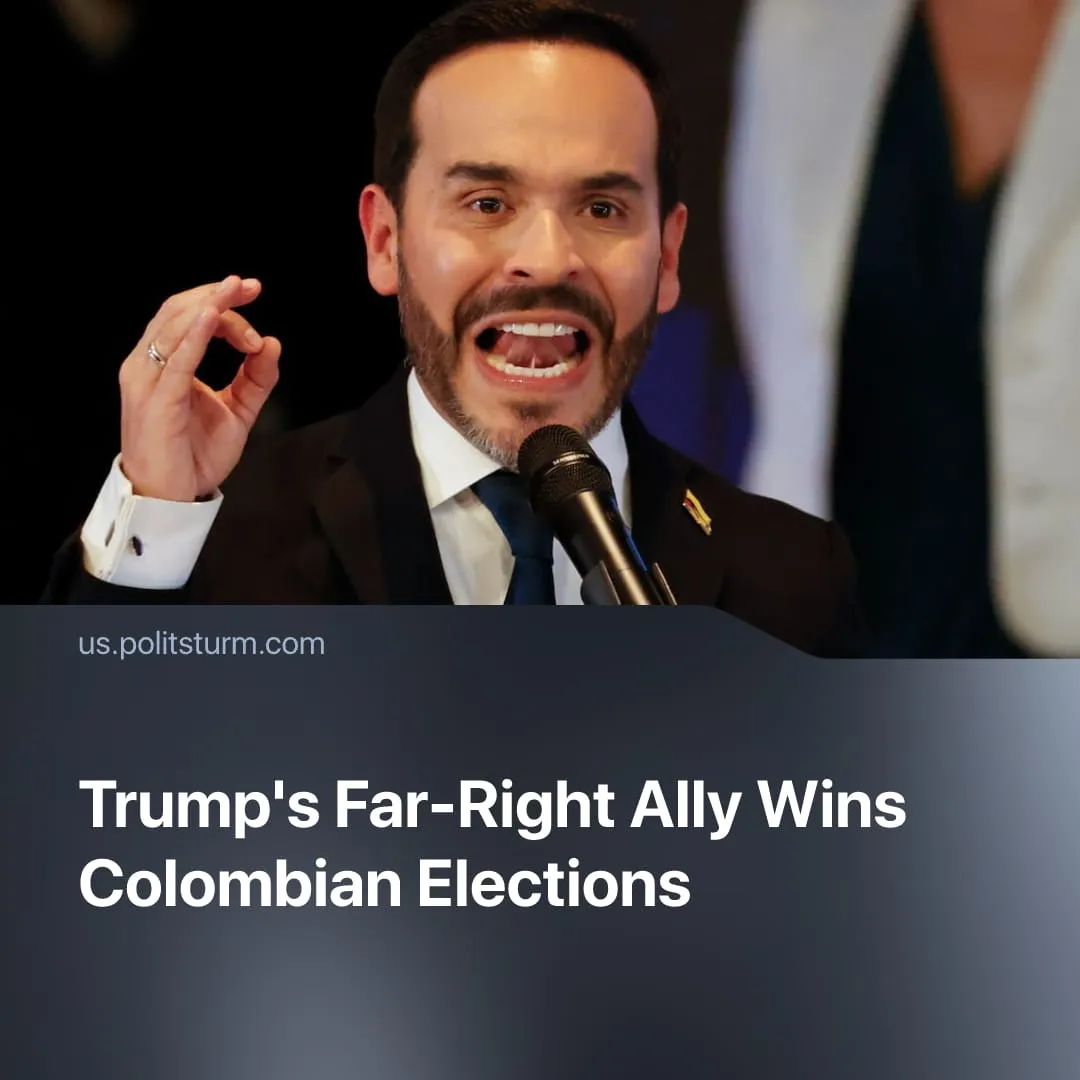
Four years of Colombia's "anti-imperialist" government changed little. Now it has elected a Trump-backed far-right president.
Details. Abelardo de la Espriella of the far-right "Defenders of the Homeland" defeated Iván Cépeda of the left-wing "Historic Pact" by 49.7% to 48.7% respectively.
► Former President Gustavo Petro argued that the results were fraudulent, while Cépeda contested the preliminary results, preferring to await a more detailed vote count. After his victory, de la Espriella accused both of attempting to undermine Colombian institutions.
► US President Donald Trump celebrated and took credit for de la Espriella's victory, having previously called him a "Smart, Strong, and Tough Leader" while labelling Cépeda a "radical left Marxist."
► De la Espriella promised to combat crime "with an iron fist," halt all negotiations with armed militia groups, lower corporate taxes, and build mega-prisons modelled after those in El Salvador, which are described as torture-like.
► In contrast, Cépeda called for the continuation of peace talks with armed militia groups, higher taxes on the wealthiest, and increased public spending. He was expected to follow Petro's course of "peacefully" reforming capitalism.
Context. Other "left-wing" countries in Latin America have also experienced a rightward shift. Venezuela began greater market liberalisation following direct US intervention. In Bolivia, 20 years of reformist Movement for Socialism rule ended in 2025 with the election of Christian democrat Rodrigo Paz. On June 18, the Cuban parliament's reforms officially restored capitalism. Colombia, Venezuela, Bolivia and Cuba all had close economic ties to China and, to a certain extent, Russia.
► This rightward shift is a clear reflection of the US's renewed focus on securing "its hemisphere." The so-called "Donroe Doctrine," formulated by pro-Trump media, proposes an imperialist strategy to aggressively pressure or intervene in nearby countries to seize control of oil and other valuable resources, install US-friendly governments, and weaken rival Chinese imperialist influence.
► During his presidency, Petro employed outspoken "anti-imperialist rhetoric" and was explicit in criticising US domestic and foreign policy. His government achieved limited success in pro-labour reforms and was labelled Colombia's "first left-wing" government. This success was minor: after four years in office, inequality dropped by only 3%, yet Colombia remains South America's most unequal country. A large budget deficit also slowed or halted further reforms.
► Despite this "anti-imperialism," Colombia deepened its economic dependency on China by joining the Belt and Road Initiative. Like all left-leaning governments of the "pink wave," reformists diverted workers from building socialism by claiming capitalism could be peacefully fixed through reforms. As a result, workers were left disoriented and susceptible to far-right influence.