

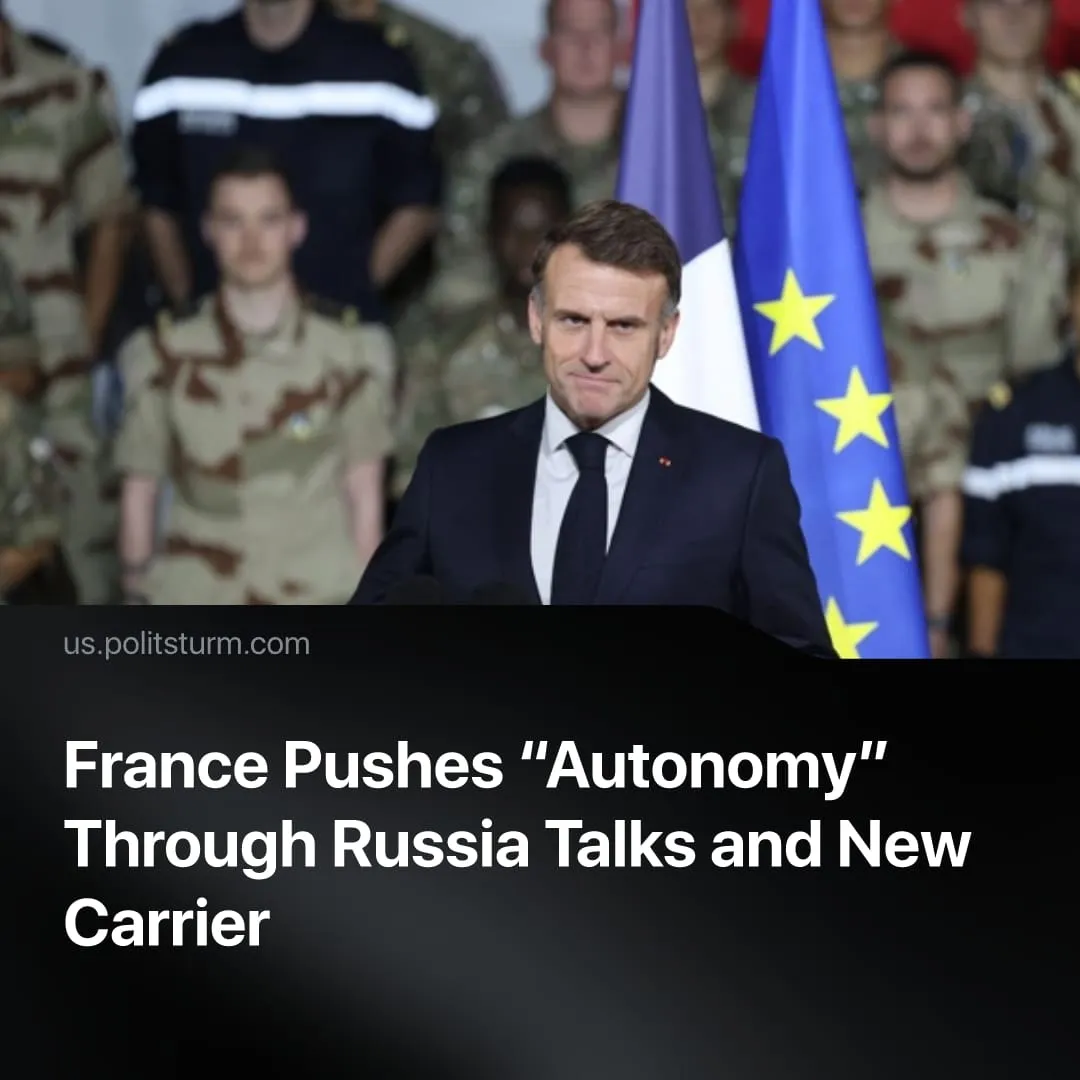
Paris is pursuing parallel diplomatic channels with Moscow and plans to build a new aircraft carrier, pushing for autonomy from the US.
Details. President Macron stated that he and Vladimir Putin are both open to holding direct negotiations alongside existing diplomatic tracks. Macron stressed that any talks would be transparent and coordinated with Ukraine, seeking to present France as an “honest broker”.
► Simultaneously, France has announced major new military investments. Macron confirmed that France will build a new nuclear-powered aircraft carrier, PANG (Porte-Avions Nouvelle Génération), expected to enter service around 2038 at an estimated cost exceeding €10 billion.
► The government justified the carrier as essential for power projection, the protection of “strategic interests,” and reinforcing France’s nuclear deterrence. Set to become the largest aircraft carrier ever built in Europe, it would place France alongside only a few European states with carriers, while remaining far behind the US, which operates eleven nuclear-powered carriers.
Context. These developments unfold amid accelerating EU and US militarisation, growing uncertainty over the reliability of US security guarantees, and open NATO calls to prepare for large-scale war. Repeated signals from Washington about reducing its commitments to Europe have intensified demands for “strategic autonomy,” meaning the ability to act as an independent imperialist power.
► The talks with Putin take place within intensified inter-imperialist competition, as rival powers manoeuvre to shape the outcome of the “SMO” following Washington’s renewed push for a peace deal.
► Since Britain left the EU, France remains the EU’s only nuclear power, strengthening its leverage within the bloc and its ambitions to shape European defence policy.
► Paris, as the second-largest economy in Europe, has repeatedly pushed for greater European military autonomy, including proposals that France’s nuclear forces could contribute to a wider EU deterrence framework. Various existing European defence funding programmes have already laid the institutional groundwork for rapid rearmament.
► While the military has opposed any delays, critics have argued that the PANG project should be postponed amid economic strain, rising debt, and social unrest, highlighting how militarisation advances at the expense of welfare and public services.