

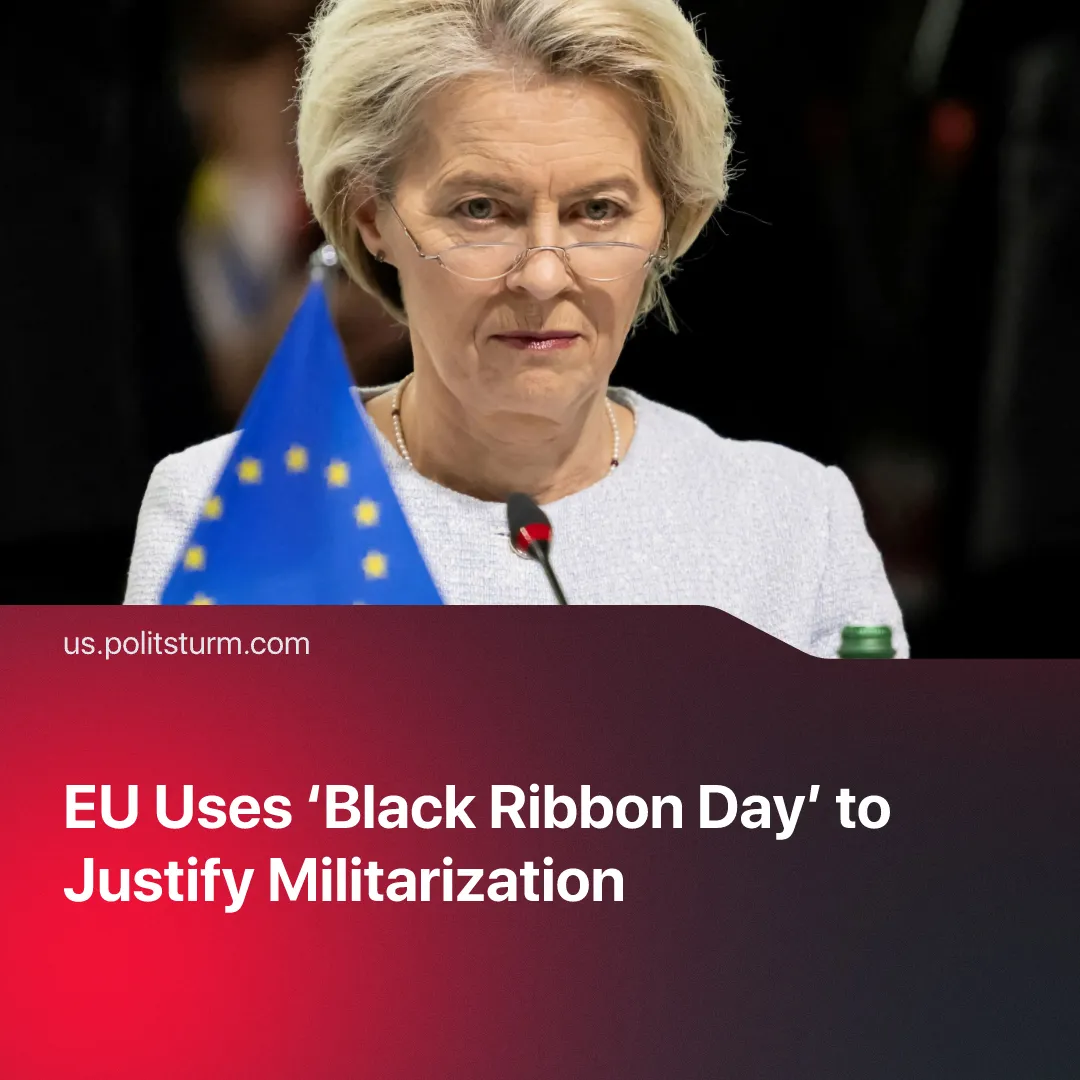
87 years ago, the Molotov-Ribbentrop pact was made. The EU calls this anniversary "Black Ribbon Day", using it to justify growing anti-communism, militarisation and fascisation.
Details. Officially known as the European Day of Remembrance for Victims of Stalinism and Nazism, "Black Ribbon Day" is observed on August 23. It supposedly serves as a reminder against "authoritarianism", but functions practically as a state-sponsored anti-communist holiday. The date specifically targets the anniversary of the 1939 Molotov-Ribbentrop pact, portrayed as a mutual agreement between Hitler and the USSR to conquer Poland.
► Using this narrative of "historical totalitarianism", comparing today’s Russian imperialism with the USSR’s foreign policy, European leaders continually play up fears of an imminent invasion. By painting Russia as a naturally aggressive power in league with Nazi expansionism, the EU spreads hysteria to justify massive militarization to the working class. However, rapid rearmament is funded by attacking workers’ living standards, through severe social austerity and welfare cuts.
► Despite the EU’s “anti-fascist” rhetoric, Europe is rapidly normalizing the far-right. Nationalists have consolidated power domestically, with Giorgia Meloni’s Brothers of Italy taking executive power, as well as France's National Rally and Germany's AfD surging as major political forces. Once empowered, they push hardline border militarization and anti-worker policies, whilst blaming Europe’s problems on minority groups (mostly immigrants), mirroring the very fascism this holiday claims to condemn.
Context. The mainstream European narrative deliberately obscures the historical reality that led to the Molotov-Ribbentrop pact. Throughout the 1930s, the Soviet Union made numerous, repeated appeals to Western bourgeois democracies to form a collective military alliance against Nazi Germany, but these were consistently stalled or outright rejected by London and Paris.
► The non-aggression pact was a necessary strategic maneuver that bought the Soviet Union nearly two years of vital time to relocate its industry and prepare its military for an inevitable Nazi invasion. Furthermore, it forced the Western Allies to finally confront the Nazi war machine, dismantling their hope that Germany and the Soviet Union would simply exhaust and destroy each other in a localized eastern war.
► While the EU focuses exclusively on the 1939 pact, official commemorations remain completely silent on the numerous treaties Western democracies signed with the Nazis. Not a word is said of the 1938 Munich Agreement, in which Britain and France actively appeased Hitler by partitioning Czechoslovakia and handing its industrial base over to the Third Reich, a full year before the Soviet Union signed its own non-aggression pact.