

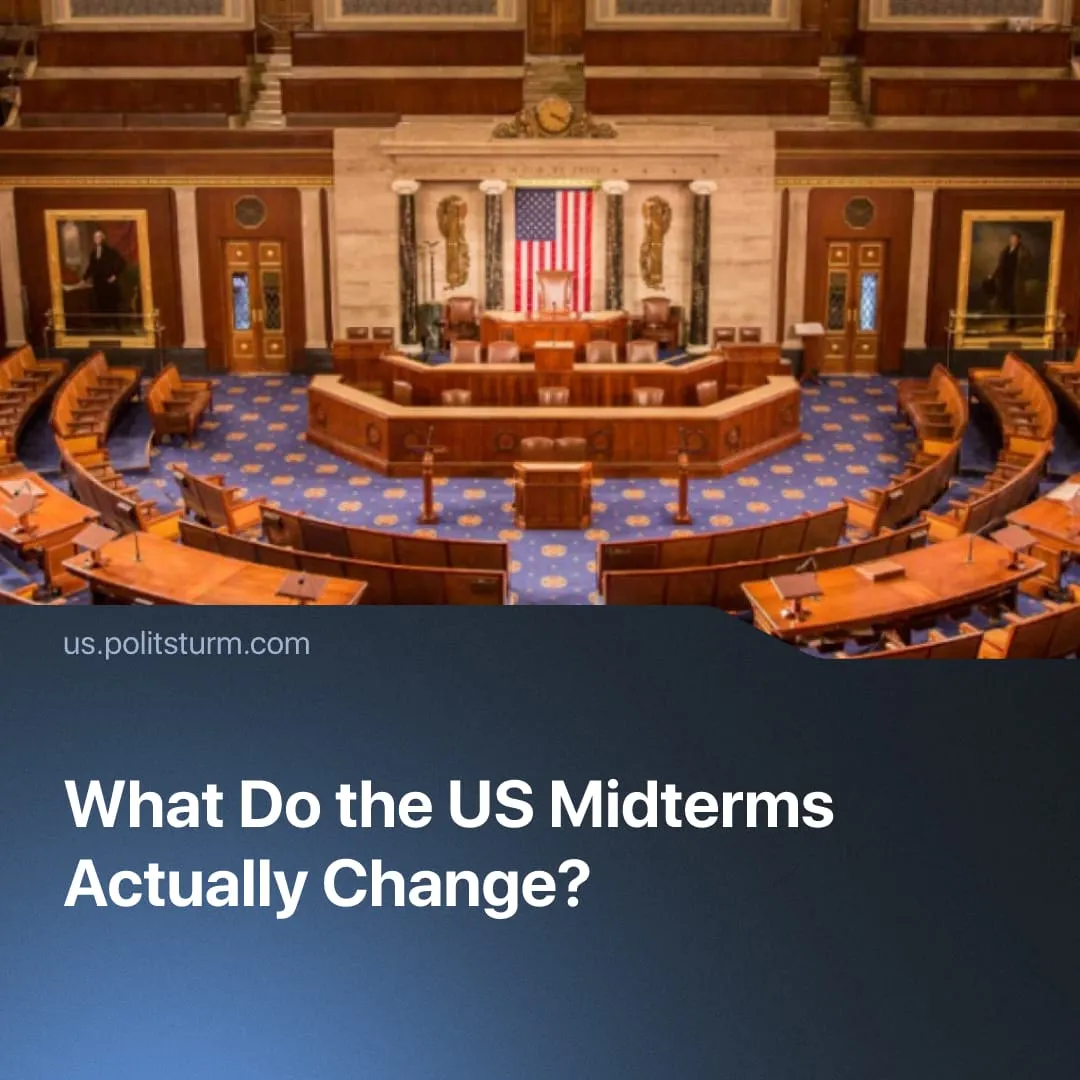
Democrats are slated to win the House in the US midterms. Will this significantly change the course of domestic and foreign policy?
Details. The upcoming November midterm elections will decide control of the US Congress legislative apparatus, where Republicans currently hold majorities in both chambers. The vote puts all 435 seats in the House of Representatives (two-year terms) and one-third of the 100 Senate seats (six-year terms) on the ballot.
► The House is expected to have a Democratic majority. The Senate is tighter, Democrats need to flip four seats in key Republican-held states, and Republicans remain slight favourites to hold the chamber.
Context. The US legislative process relies on two distinct chambers. The House is designated to react quickly to immediate political needs, while the Senate acts as a slower, deliberative body insulated by six-year terms. Any newly introduced law must successfully pass both chambers.
► The President cannot force Congress to adopt laws, but holds a powerful veto requiring a two-thirds congressional supermajority to override. Furthermore, the President shapes the state apparatus by dismissing executive officials at will and nominating Supreme Court justices to lifetime appointments, which are subject to Senate approval.
► Congress has some executive oversight. The House holds the authority to investigate and vote on articles of impeachment, while the Senate conducts the trial and determines removal. Democrats used this power to impeach Trump twice, before the Senate voted not to remove him.
► The House can also block presidential proposals through budgetary control and legislative blocks, as when it denied Trump border wall funding in 2019 and defeated his repeal of the Affordable Care Act in 2017.
► The constitutional separation of powers frequently breaks down in foreign policy. The executive branch holds vastly expanded war powers, allowing the President to largely bypass Congress to initiate military actions and broker foreign agreements through executive pacts.
Important to Know. The Republicans seek unified control of Congress and the Senate to wield executive authority without legislative friction, recently leaning on tech and finance billionaires to inject millions into the 2026 midterms. By dropping bourgeois democratic rhetoric to openly prioritise business interests and foreign aggression, his administration has exposed the class nature of the state and intensified class contradictions.
► The Democrats seek to restore the more liberal form of capitalist rule, pacifying growing unrest through minor social concessions, less openly aggressive foreign policy, and a tolerated “democratic socialist" wing to channel popular discontent back into the two-party electoral system.
► They have postured as "resistance" to Trump while in the minority, gaining popularity without having to enact anything. The few times they staged this resistance by blocking bills, individual Senate Democrats crossed the aisle to reverse them, as with weapons sales to Israel and increased ICE funding. The minority position gives them cover to posture without accountability.
► Even winning both chambers would not allow Democrats to significantly impede Trump's core agenda. They represent the same capitalist class interests and cannot agree on reversing even his most unpopular measures. On foreign policy, their objections are over process, not objectives. For example, Kamala Harris called the capture of Maduro "unlawful and unwise", but the Biden administration had raised the bounty on him to $25 million weeks before leaving office.
► Biden's presidency clearly illustrated the continuation of the essence of Trump’s first term policy. The Democrats preserved Trump's China tariffs, sustained military commitments abroad, and further expanded deportations. Both parties ultimately defend the expansion of US capitalist profits and foreign interests against rival imperialist China – the course of US imperialism will continue regardless of which party wins the midterms.