

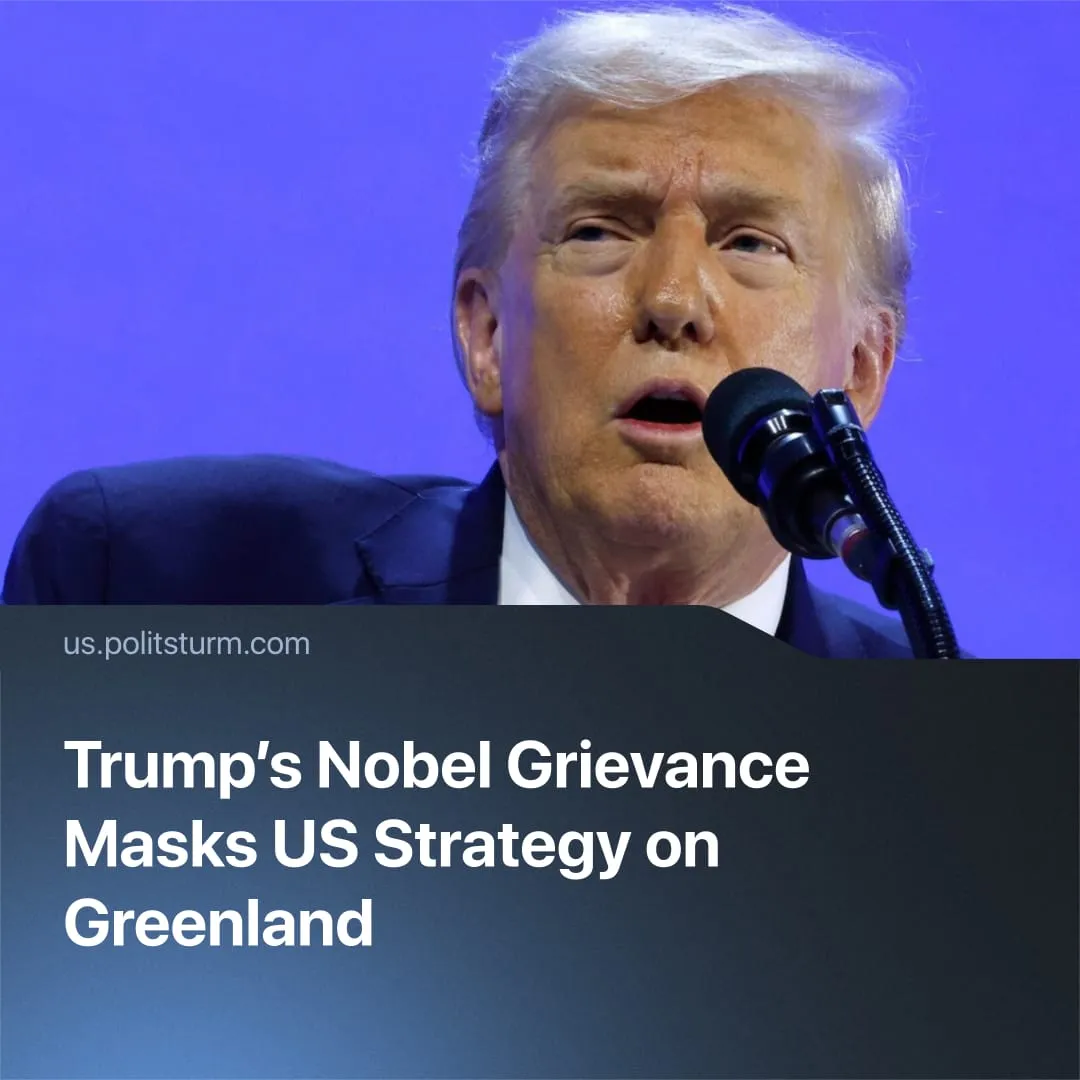
Did Trump’s Nobel Peace Prize grievance really explain US pressure on Greenland?
In January 2026, Donald Trump publicly linked renewed US pressure on Greenland to a personal grievance over the Nobel Peace Prize. Liberal outlets quickly seized on the Nobel angle, presenting Trump’s personal grievance as a key explanation for the renewed US pressure on Greenland.
Quote: “Considering your country decided not to give me the Nobel Peace Prize for having stopped 8 Wars PLUS, I no longer feel an obligation to think purely of Peace, although it will always be predominant, but can now think about what is good and proper for the US.”
Context. The remarks followed the US seizure of Venezuelan president Nicolás Maduro in early January 2026, after which Washington issued threats and warnings toward a range of countries, signalling a broader escalation in US coercive policy.
► In this climate, Donald Trump revived earlier demands for Greenland, first raised in 2019, triggering renewed resistance from European allies and further straining EU–US relations.
► After initial tensions, Trump called off tariffs and military threats, as the US, Denmark, and Greenland agreed on a cooperative framework for Arctic security and rare earth collaboration.
► This story fits a broader pattern of liberal hysteria, recently seen in speculation over Trump’s supposed death, where personal drama is used to distract from the continuity of US imperial policy.
In reality, Trump’s appeal to the Nobel Peace Prize does not explain US policy toward Greenland. It serves to personalise and obscure the material drivers of US strategy.
► As climate change opens access to Arctic resources and shipping routes, Greenland’s strategic military position and rare earth reserves have gained heightened importance, increasing its value for extraction and control over future trade.
► US strategic and economic engagement with Greenland long predates Trump. The United States has maintained a permanent military presence on the island for decades and has cooperated with Danish and Greenlandic authorities on mineral surveys and resource development well before the current rhetoric.
► Regardless of any individual politician’s ego, such actions depend on the backing of the US ruling class, whose overriding priority is containing Chinese imperialism as it challenges US hegemony through trade expansion and dominance over rare earth supply chains.
► Past fascist regimes are often attributed to “great figures” like Hitler or Mussolini, but in reality, they emerged with the backing of sections of the capitalist class, in order to defend property and suppress labour during periods of crisis.