

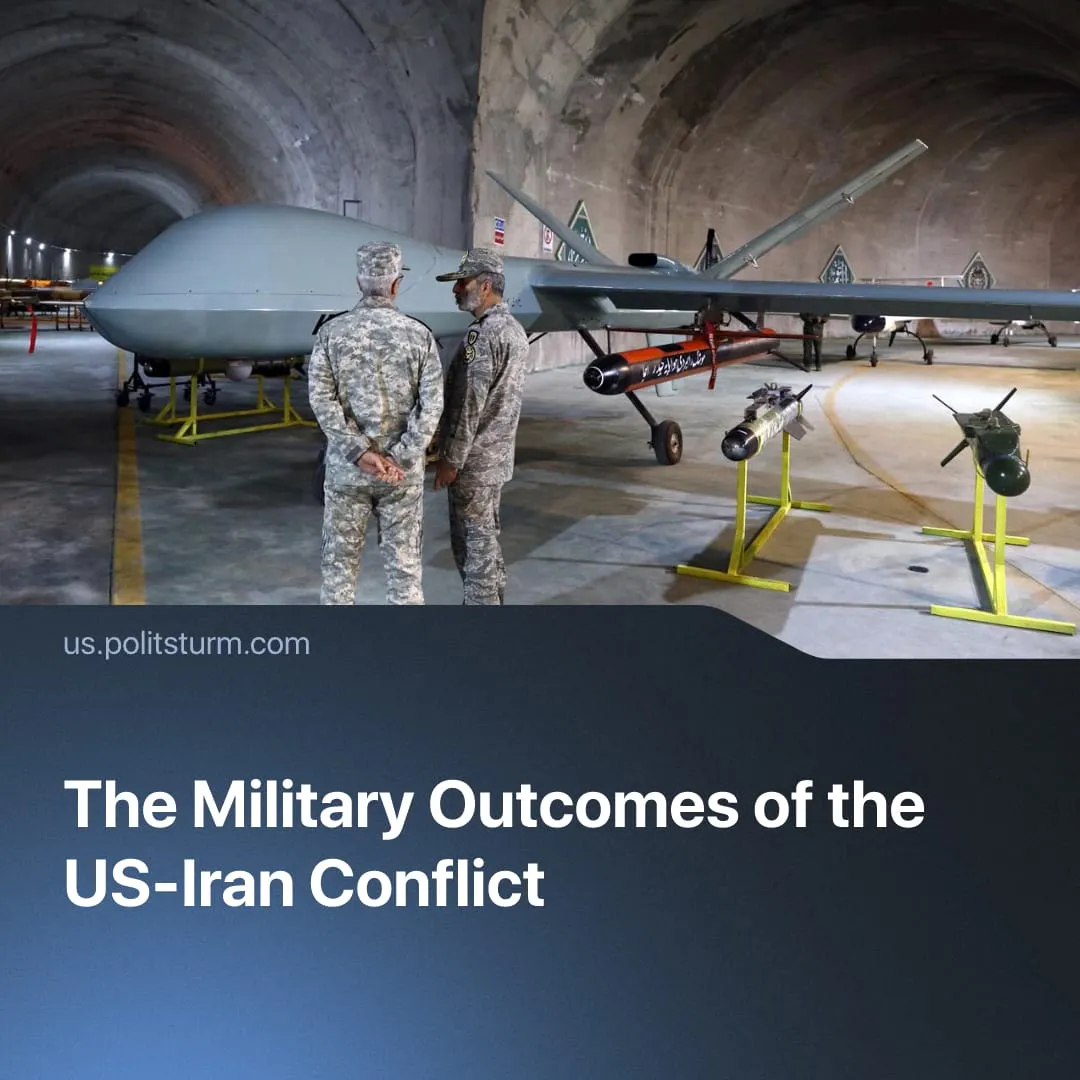
While Iran suffered conventional military setbacks, the conflict has exposed the limits of US military dominance.
Details. Iran suffered a conventional military defeat in joint US–Israel operations, losing at least 33% of its air force and 50% of its missile arsenal, including launchers; whilst 92% of its large naval warships were sunk. Dozens of officers and Iran’s senior leadership were eliminated. American forces faced little resistance: the US launched over 6,500 bombing runs, but only 1 fighter jet was shot down by Iran.
► Despite the decapitation strike and initial shock, Iran implemented “decentralised mosaic defence”, delegating authority to 31 local commanders. Iranian forces successfully waged asymmetric warfare – launching massed drone strikes and using camouflaged missiles. Iran selectively closed the Strait of Hormuz, economically pressuring the US to a ceasefire.
► The US also suffered an estimated $3.6 billion worth of equipment losses, initially failing to counter Iran’s asymmetric attacks. On the ground, Iran struck 10 expensive US radar systems and several aircraft, including a $270 million Sentry plane. Pentagon officials are reportedly hiding the scale of damage on US bases, infrastructure which will require $5 billion to repair. The US spent up to $31 billion on Operation Epic Fury in total.
► The American military has used up more than 50% of its pre-conflict stockpile of four key munitions – Patriot, THAAD, PrSM and Tomahawk missiles – during the 5-week operation. Officials in Washington say it will take years to replace these, and thus express fear that US forces are now too weak to defend Taiwan from a Chinese attack.
► Despite losses, US forces so far have achieved air supremacy over Iran and devastated its military, signalling to China that the US can still deploy hard power, able to achieve conventional victories across the globe. During the Iran conflict, the American military began to adapt, planning to mass-produce cheaper weaponry and widely implement artificial intelligence.
Context. Asymmetric tactics and mass-produced weaponry are becoming increasingly common in the 2020s, as seen with drone usage in the “Special Military Operation” zone. Major imperialist powers – such as the US – are consolidating class rule ahead of a larger conflict while using proxy states to test out new technology, for example, with the deployment of Anthropic’s Claude AI in the attack on Venezuela.
► Military escalation requires billions to be spent on arms instead of improving the lives of the working majority. For example, Trump plans a further 10% cut in federal social spending to fund a $500 billion military budget increase, claiming “it’s not possible” for the US to provide healthcare because “we’re fighting wars”. Workers of European states are already paying for accelerated militarisation.
► China also supported its proxy Iran with missiles and useful military production assistance. China and Russia allegedly provided a spy satellite used by Iran to precisely target US bases. This marks further escalation in the global inter-imperialist conflict.