

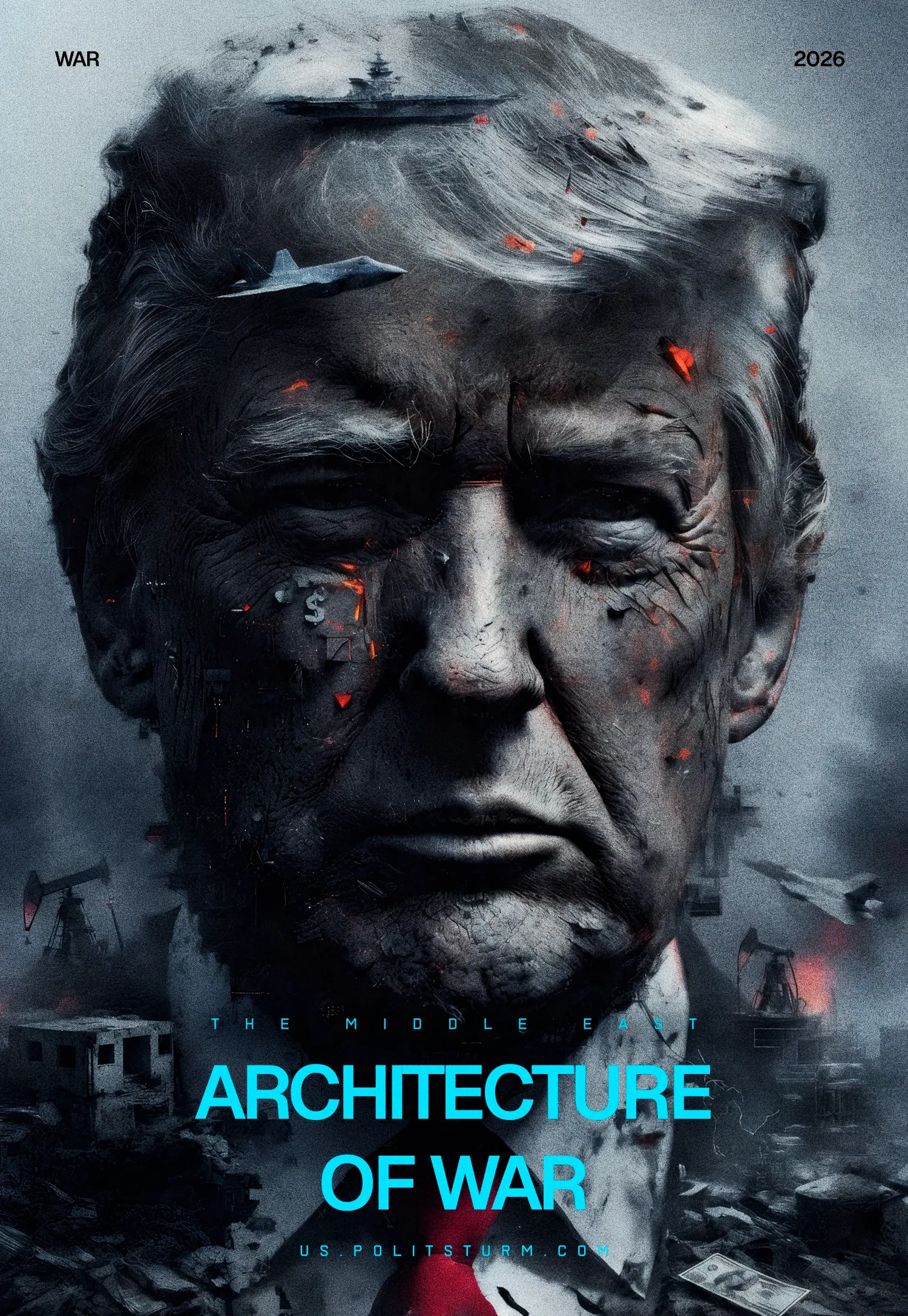
On February 28, the United States and Israel launched strikes on Iran. Official US government media reported about the "Operation Epic Fury". The United States and its allies struck numerous military and civilian targets on Iranian territory. The strikes targeted high officials of the state, as well as ordinary citizens.
The Islamic Republic's regime responded by launching strikes against Israel, Middle Eastern countries, and energy infrastructure facilities.
The mutual attacks disrupted trade flows in the region. Global oil prices exceeded $110-120 per barrel. US President Donald Trump stated that the military operation will continue until the set objectives are achieved.
The war in Iran is yet another manifestation of the crisis of the capitalist system and the aggravation of contradictions between the imperialist blocs.
I. Sides, Goals and Objectives
United States
1. The United States continues to consistently weaken the Chinese imperialist bloc. American financial capital seeks monopoly control over oil resources, markets, and trade routes in the Middle East, actively arming Israel as its regional outpost.
At the beginning of the year, Trump carried out a successful strike against Venezuela, securing access to its oil and undermining China's position in the Western Hemisphere. Like Venezuela, Iran is part of the Chinese bloc and a major energy supplier to the Chinese economy – in 2025, more than 80% of Iranian oil exports went to China. In addition to exerting direct pressure on competitors, the United States is seeking to establish a leading position in the oil and gas market and strengthen its position in the global trade war with China and the EU.
For the US ruling class, aggression abroad simultaneously addresses crucial domestic issues. War is used to distract the American working class from the escalating class contradictions within the country. War also serves as a tool for chauvinistic and nationalist mass mobilization to boost Trump's approval ratings and maintain power.
2. US military-political tactics are based on massive missile and air strikes – the imperialist Douhet doctrine, “modernized” with the help of high-precision weapons – and hybrid destabilization.
The Trump administration is seeking to avoid drawing the United States into a protracted ground war. However, Iran's blockade of the Strait of Hormuz is forcing the Pentagon to redeploy ground forces to seize key points in the region. In addition to direct military action, the US and Israel are banking on destabilizing the regime. Their leadership actively uses rhetoric about the Iranian people's struggle for freedom in their propaganda. To this end, airstrikes are being carried out against Iranian security forces.
The goal of this rhetoric is not the freedom of the Iranian people, but the weakening of the Iranian bourgeoisie at the hands of the working class, students and adjacent strata.
This rhetoric is even more hypocritical given the large-scale protests against the “Islamic Republic” regime in January-February 2026. While the Iranian regime suppressed the protests, killing thousands of protesters, the ruling classes of the United States and Israel bargained with the Iranian bourgeoisie and waited for the right moment to attack.
3. The US's strategic priority in the war is the subjugation of Iranian capital. The Western bloc wants to force Iranian capital to make concessions, either by preserving the facade of the theocratic regime or by bringing about its destruction, a bourgeois coup, and the rise of pro-Western forces to power. At the same time, despite the dismantling of Iran's political superstructure, Western capital is strictly focused on preserving its production and raw material base intact for subsequent ruthless exploitation.
Israel
1. Israel's key objective is to inflict maximum damage on Iranian imperialism. The complete destruction of this competitor will ensure Israeli financial capital's dominant position in the region. This decision conflicts with the interests of American capital. The US hopes to move Iran into the Western camp without excessively destabilizing the country.The minimum task for Israeli capital is the maximum possible weakening of Iranian imperialism and its proxy forces, the closure of the nuclear program, and the elimination of the threat to Israel from Iran.
2. The Netanyahu government, which represents the interests of the most reactionary circles of Israeli capital, continues its expansion in the region. Simultaneously with the strikes on Iran, Israel announced mobilization and a ground operation in Lebanon. IDF forces have previously invaded Gaza Strip, Lebanon, Syria, and launched attacks on Iran's allies in the region.
3. Continuing the fight against its main competitor in the region, Israel strives to create a counterweight to regional Turkish imperialism, which is carrying out its own expansion in the Middle East and building its own coalition with the bourgeoisie of Saudi Arabia, Pakistan, Egypt and Qatar.
Iran
1. The “Islamic Republic” regime represents classic state-monopoly capitalism. The dictatorship of the bourgeoisie is exercised through a reactionary theocratic elite, which uses open fascist terror against the working class and communists.
Iranian capital is closely linked to the state apparatus and the clergy. For example, the family of the assassinated "supreme leader" controls assets worth tens of billions of dollars, which are located in foundations, offshore companies, and shell companies. The “Islamic Revolutionary Guard Corps” operates as the largest armed monopoly and has its own economic structures, receiving significant funds through shadow operations, corruption and smuggling of illegal goods.
Since the counter-revolutionary seizure of power in 1979, the Iranian bourgeoisie carries out brutal repression against the working class and communists. Thousands of revolutionaries and activists were executed or died under torture. The Iranian bourgeoisie banned trade unions and brutally suppresses any manifestation of discontent among workers, especially in extractive industry.
The ayatollah regime regularly faces popular discontent. The last major protests by workers, students, intellectuals, and the petty bourgeoisie in January-February 2026 were provoked by inflation exceeding 70% and the depreciation of the national currency. They were brutally suppressed by the Iranian bourgeoisie. The number of victims makes up tens of thousands of people, exceeding the number killed during the events of 1979.
2. On the international stage, Iran acts as part of the Chinese imperialist bloc and defends its interests. In addition to supplying resources, Iran is a part of China's Belt and Road economic bloc. Iran is also closely linked to Russia and Belarus and carries out cooperation in the military sphere.
At the same time, Iran is emerging as a regional imperialist in the Middle East. The “Islamic Republic” regime has actively pursued regional expansion since its inception and developed a network of proxy forces in the region. The constant state of conflict with Israel, which is growing stronger with US support, is a consequence of the competition for dominance in the region, and not a "fight against imperialism".
3. Nuclear weapons and the ability to develop them remain the only means of protecting the interests of the Iranian bourgeoisie and its dominance in the region. Iran's acquisition of nuclear weapons fundamentally contradicts the interests of Israel and the United States. It was the Iranian nuclear program that became the pretext for the strikes in 2025-2026.
4. Iran's ruling class has a direct interest in prolonging the current war. The Iranian bourgeoisie is using US and Israeli aggression to justify the catastrophic decline in living standards and is attempting to rally the working class around the regime with nationalist rhetoric following the mass repressions of January 2026.
Tehran's military strategy boils down to a protracted war of attrition. By blocking the Strait of Hormuz, activating all proxy forces, constantly striking the American fleet and transiting tankers, Iranian capital seeks to make the conflict economically untenable for the United States and negotiate for itself the preservation of political power in the redivision of the region.
China
1. Over the past year and a half, the Chinese imperialist bloc is experiencing growing pressure from the Western bloc. At the end of 2024 the Assad regime fell in Syria. In the spring of 2025, Trump unfolded a trade war against Chinese exports and began negotiations with Russia over Ukraine. In early 2026, the Chinese bloc lost Venezuela.
2. In the context of the arms race and preparations for a major conflict, Chinese imperialism is trying to avoid openly supporting its allies. As in the case of Venezuela, Chinese aid to Iran is mainly expressed in diplomatic support and military supplies through its allies. China also provides access to the Beidou satellite navigation system and satellite imagery. Chinese capital hopes to draw the US into a long, costly war with Iran, test its own weapons, and maintain flashpoints in Western Eurasia to divert the Western bloc's attention from the Asia-Pacific region.
3. China seeks to preserve trade routes and prevent excessive destabilization of the region. This explains the contradictory statements by the Iranian leadership regarding the blockade of the Strait of Hormuz, through which about 45% of all Chinese imports passes.
4. Like the US and Israel, China is not interested in Iran acquiring nuclear weapons, as this would weaken its dependence on the Chinese imperialist bloc.
II. The First Results of The War
1. US and Israeli strikes against Iran's ruling class and security forces have not yet led to regime change or an uprising. Attacks on civilians, such as destruction of schools with children, destroy the Western bloc's propaganda about the struggle for freedom of Iranians.
The death of "Supreme Leader" Ayatollah Ali Khamenei was used to rally support for the regime and fuel a surge in Islamic radicalism in neighboring regions. The US, Israel, and Iran continue to exchange air strikes. However, in the fourth week, Iran's offensive capabilities have sharply declined: according to various estimates, less than 10-15% of its long-range missile and drone launchers remain.
2. The Trump administration failed to replicate the rapid Venezuelan scenario. Despite public statements about achieving the operation's goals "within weeks", the US began to be drawn into a protracted war and started to transfer additional forces to the Middle East.
Within the United States itself, the war with Iran is unpopular. The working class, the petty bourgeoisie, and parts of the ruling elite oppose the war. Parallels are drawn with the US invasions of Iraq and Afghanistan. Feeling weak at home, the American bourgeoisie fears rising worker consciousness and seeks to avoid further deterioration of the socioeconomic situation. Following the rise in oil prices and the rise in the cost of American gasoline, Trump announced an unprecedented release of 172 million barrels of oil from the US Strategic Petroleum Reserve in coordination with the International Energy Agency.
3. The scale of the war in 2026 is much larger than military aggression in 2025. Iran's retaliatory strikes against American bases in the Middle East provide a pretext for drawing more countries into the war. The conflict demonstrates that the crisis of capitalism and inter-imperialist contradictions are intensifying. The intervals between military clashes are shortening. Almost simultaneously with the war in Iran, a conflict began between Afghanistan and Pakistan. The bourgeoisie, unable to achieve its goals through diplomacy, is pursuing its goals through war, drawing in ever more countries.
4. Chinese imperialism has failed to provide significant support and protection to its imperialist ally of Iran. The fate of China's allies – Syria, Venezuela, and Iran – threatens the internal integrity of the Chinese imperialist bloc and opens the way for American imperialism to further aggression against Cuba, Colombia, and other countries. The concentration of additional US forces in the Middle East weakens US influence in the Asia-Pacific region, allowing Chinese imperialism to increase pressure on Taiwan.
5. The US and Israeli strikes on Iran are a direct consequence of the Hamas attack on October 7, 2023. Our organization previously conducted a comprehensive analysis of the war in Gaza. We demonstrated its essence as part of a global clash between the Western imperialist bloc and Iranian proxy forces, Iran itself, and the Chinese capital behind them.
The provocative attack by an Iranian proxy group was intended to weaken the position of American capital in the region and demonstrate the power of Iran and its allies. In reality, it placed millions of Palestinians under attack by the Israeli military, complicated their struggle for independence and led to tens of thousands of casualties.
The attack of October 7, 2023, and Israel's subsequent invasion of Palestine became the catalyst for a general escalation in the Middle East. Over the past three years, the Israeli ruling class, led by Netanyahu, has successfully used the threat of war to aggressively militarize the economy, fascize society, and expand territorially throughout the region.
The US and Israeli military aggression against Iran in 2025 led to a sharp weakening of Hamas, Hezbollah, the Yemeni Houthis and other Iranian proxy forces.
After the second anniversary of the Hamas attack on October 7, the Iranian bourgeoisie began to publicly acknowledge the strategic defeat of this course.
The new war of 2026 has completely disrupted the interaction between Iran and the forces it controls, confirming their puppet nature and complete dependence on Iranian finances and logistics.
The 2026 war was the culmination of the Islamic Republic's failed policies in the Middle East. Thus, the Palestinian issue was finally revealed as one manifestation of a global inter-imperialist struggle, in which Israel acted as the US's strike force, and Iran and its proxies, with the support of imperialist China and its allies.
The thesis of blind support for an abstract "resistance", promoted by social chauvinists and centrists, has suffered complete political bankruptcy. In practice, the denial of Hamas's essence has led to tailism and the serving of Iranian capitalist interests.
III. The Position of the Communists
1. Communists express solidarity with the workers of Iran, Israel, Lebanon, Palestine, and other countries in the region. The war in Iran is a struggle between capitalists: the workers have no side to support.
2. No support for the theocratic bourgeois government of Iran, no support for the bourgeois governments of Israel and the United States. Communists must expose bourgeois propaganda about fighting for the "Iranian people" and point out the true causes of the conflict and the interests of both sides.
3. The tactics of decapitating strikes and the outright destruction of competing bourgeois factions demonstrate that monopoly capital has abandoned even the semblance of bourgeois international law. This is a sign of the profound crisis of the capitalist system and the acceleration of the redivision of the world through war.
4. The war in Iran is not an accident or the result of a single individual. It is a link in a chain of imperialist conflicts. The bourgeoisie is increasingly resolving contradictions through force, and the periods between wars are shortening. The crisis of capitalism is deepening, and intensifying competition among capitalists is leading them to increased militarization, fascization, increased exploitation of workers, and inevitable new wars for the redivision of the world.
5. Communists must accelerate their work on reviving the communist movement: expose social chauvinists and centrists, form genuine communist organizations on the platform of Marxist-Leninist theory, and establish contacts with communists and sympathizers. We are already participating in this process. Join us and become a member of Politsturm.