

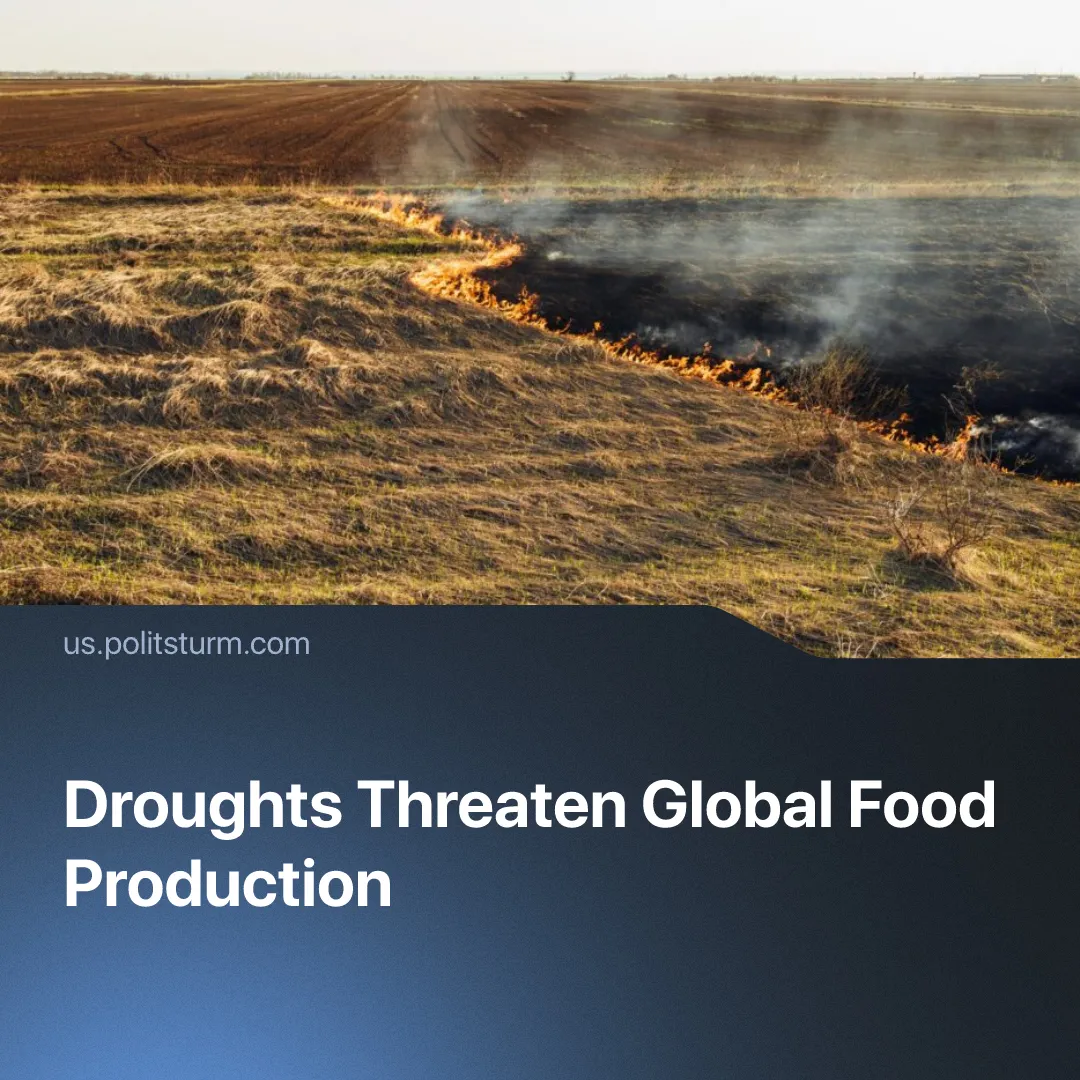
Global droughts are threatening to lead to major food shortages, as UK farmers claim this year could be “their last harvest”. How would socialist farming deal with this crisis instead?
Details. Water supplies have become one of the main challenges for global agriculture. Around 3 billion people and over half of global food production are located in regions where total water storage is declining or unstable. More than 170 million hectares of irrigated cropland face high or very high water stress.
► More than 50% of global agricultural land is already moderately or severely degraded, threatening desertification as damaged soil loses its ability to retain moisture.
► Farmers in the UK are rushing to salvage their crops as winter floods disrupted planting and severe heatwaves led to a nationwide drought, with harvest at half its normal height. One-third of British farmers report that they are operating at a loss or merely breaking even.
► India, a vital link in the global food chain, faced a severe dry spell starting in June due to a massive rainfall deficit – 13% below the average of July. The India Meteorological Department also projects below-normal rainfall for the remainder of the season. Agricultural challenges in India could soar prices of such crops as rice, for example.
► Brazil, another vital link, is also threatened by severe drought, which has affected its coffee industry – though other crops have remained mostly unharmed for now. However, worsening climate change, exacerbated by the degradation of the Amazon, threaten to prolong these droughts and worsen rainfall shortages.
Context. World food prices have surged to a three-year high. Even though capitalist states have been warned about such climate outcomes since 1988, they’ve ignored the warnings entirely and avoided funding climate measures, spending hundreds of billions to fund militarization instead.
► The Iran war has contributed to the climate crisis through massive CO₂ emissions – 5 million tons in just 14 days of bombings. The Strait of Hormuz closure further risks global food shortages by disrupting fertilizer distribution, as roughly one-third of the world's seaborne fertilizer trade passes through. It also drives up oil and natural gas prices, raising transport and fertilizer production costs.
► This year’s El Niño phenomenon – a periodic global weather disruption caused by abnormal Pacific Ocean warming – is intensifying, being referred to as a “super El Niño”. The World Meteorological Organization (WMO) warns that it will bring extreme weather across the planet in coming months.
Important to Know. The capitalist economic model inherently fails to tackle its own climate damage due to the anarchy of production. Capitalists, driven by profit, are forced into fierce short-term competition, rendering the system incapable of addressing even long-term problems whose resolution would benefit capital itself.
► Under socialism, workers could plan the economy sustainably, developing scientific, long-term solutions to the climate crisis and improving farming techniques. In the short term, a planned economy, freed from capitalist competition, could immediately implement targeted measures to resolve the food crisis.
► In the USSR, farms were socialized, equipped with modern technology, and planned for maximum efficiency. Such organization is impossible under capitalism, which lacks centralized planning over agriculture and industry. Soviet agricultural production between 1926–7 and 1952–3 increased by 2 to 4 times, and by 1954 over 80% of basic field work on collective farms was mechanized.
► Science and organization were not only utilized on individual farms; the Soviet system also enabled projects on a national scale. Logging was banned along major rivers, with protective belts reaching 20 kilometres wide by 1936. Under Stalin, a fifteen-year plan was made to plant 5.7 million hectares of trees to combat drought, described as the world's first explicit attempt to reverse human-induced climate change.