

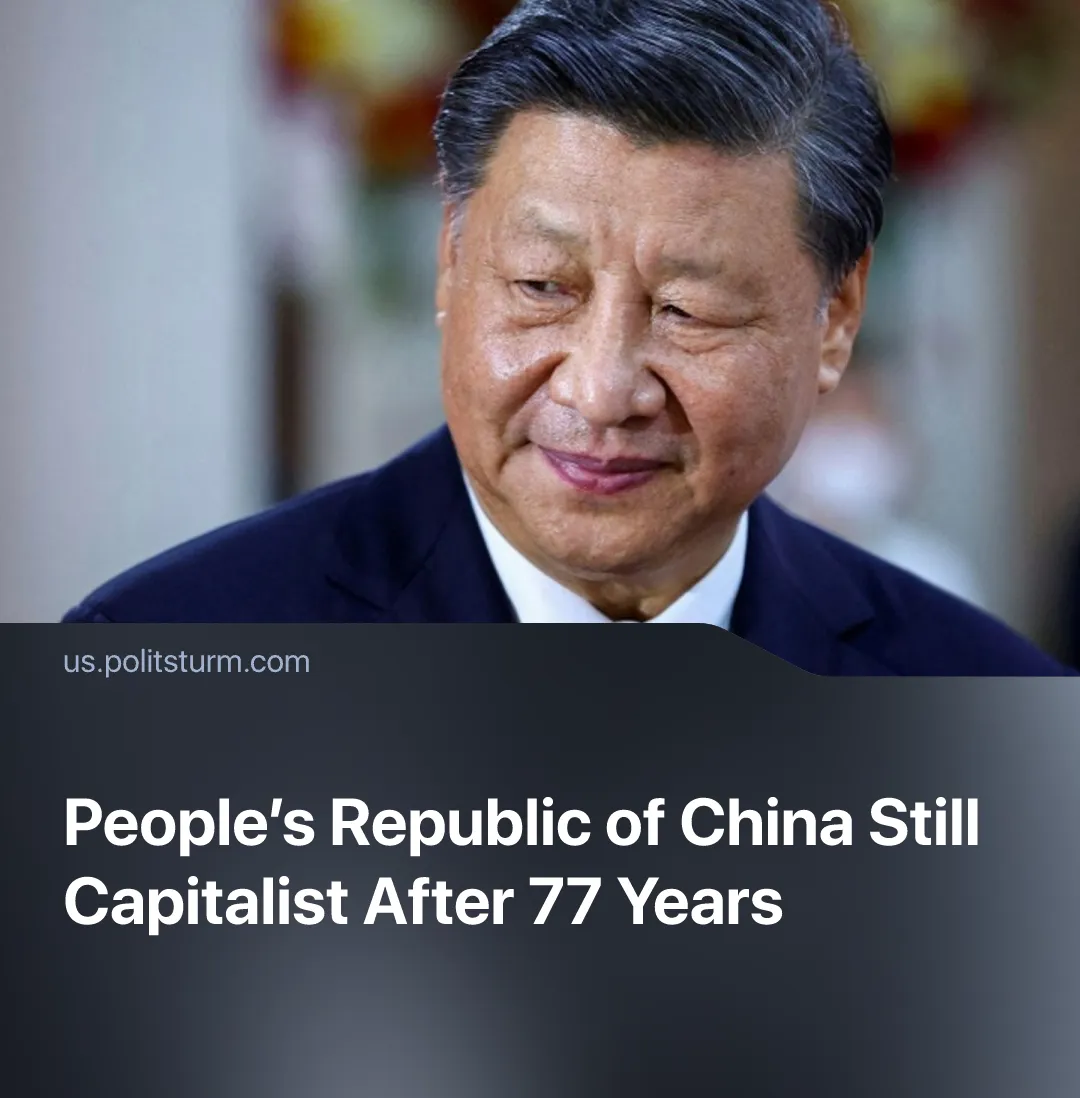
77 years after its founding, the PRC has remained a capitalist country, whilst leaders have pushed back the achievement of “socialist modernisation” by several decades. Following the successes of the first Five-Year Plan, Chinese and Soviet communists believed capitalism would be eradicated in China within 15 years.
Details. The People’s Republic of China was founded on 1 October 1949, and it marked another major victory for the growing communist movement. Though not underestimating the extreme difficulty that lay ahead, with the aid of the Soviet Union, and observing the initial successes of the first Five-Year Plan, both nations believed socialism could be achieved in the space of a few decades, as said in the 1955 National Conference of the CPC.
Quote: “We may be able to build a socialist society [i.e. society without capitalists – Politsturm’s addition] over three five-year plans, but to build a strong, highly industrialized socialist country will require several decades of hard work, say, fifty years, or the entire second half of the present century”.
► The Plans envisioned that China’s rapid industrialization would take place with socialist industry comprising ever-greater share of production; that the peasantry would be drawn into cooperatives and brought into the construction of socialism; and that the alliance between workers, peasants and “patriotic elements” would function strictly under the state as the dictatorship of the proletariat.
► Assuming the dictatorship of the proletariat was in place, communists envisioned a plan that would see 90% of industry nationalised in four Five-Year Plans, with the remaining 10% being seized or even being peacefully handed over upon realizing their defeat.
► This sentiment was shared by Soviet political economy, which understood the “gigantic task” that was building socialism in China, but that nonetheless “the Communist Party is working on the principle that socialist society will be built […] in the course of about three Five-Year Plans”.
Context. Prior to the revolution, China had an extremely backwards economy: semi-feudal relations were prevalent and the underdeveloped capitalist relations were further suppressed through semi-colonial relations between foreign imperialism and domestic feudal lords; small tenant farming with pre-capitalist forms of rent prevailed; nearly the whole of China's territory was lacking in machine industry, with most manufacturing being done by small handicraft enterprises.
► China’s modern Five-Year Plans are distinct from Soviet and early Chinese plans. Since 2005 they have been referred to as “guidelines” (only a minority of their goals are binding). Soviet plans were able to command the entire economy towards specific goals thanks to public ownership of all means of production, but contemporary Chinese plans function like regular capitalist “forecast” plans.
Important to Know. China is now a modern industrial powerhouse, but socialism was never achieved. China’s growth was achieved through the extreme exploitation of its proletariat, with the country gaining the title of “world’s factory” in the 80s and 90s, by attracting foreign capital investments through some of the lowest wages on Earth. Today the working class faces significant wage disparities between skilled and unskilled workers, a rising cost of living, a culture of overwork, and growing youth unemployment.
► China's leaders say the country is in the primary stage of socialism, with “socialist modernisation” to be basically realised by 2035. The Party's own 1987 Congress report went further, saying the period from the 1950s to the basic realisation of socialist modernisation would take "at least a hundred years". None of them sets a date for eliminating the capitalist class and with it, exploitation, the term socialist modernization is instead used to vaguely signify general growth and economic development of the nation.
► Its proletariat remains exploited by a bourgeoisie that extracts profit from its labour. Where the state holds stakes, ownership is increasingly mixed and indirect, with private capital sharing in the profits; without the dictatorship of the proletariat, these nationalised or partly nationalised industries are organised on behalf of the collective capitalist class.
► Capitalists were explicitly allowed to grow from the 1980s and now hold positions within China’s National People’s Congress and Chinese People's Political Consultative Conference. Though billionaires are often touted as being under the control of the party – with individual capitalists famously being imprisoned or even executed – the party acts in the interests of the capitalist class as a whole by slurring over class antagonisms, preaching unity and maintaining capitalist relations of production.
► China is the second strongest world imperialist power, and its relations to other countries is characteristic of this. The Belt and Road Initiative expands the influence of Chinese capital through loans and infrastructure investments, which trap various nations economically and politically, and allow for the extraction of massive profits. Just like its rival imperialists, China is rapidly militarising in preparation for a violent redivision of the spheres of influence, particularly eyeing up targets such as Taiwan and the Indo-Pacific area.