

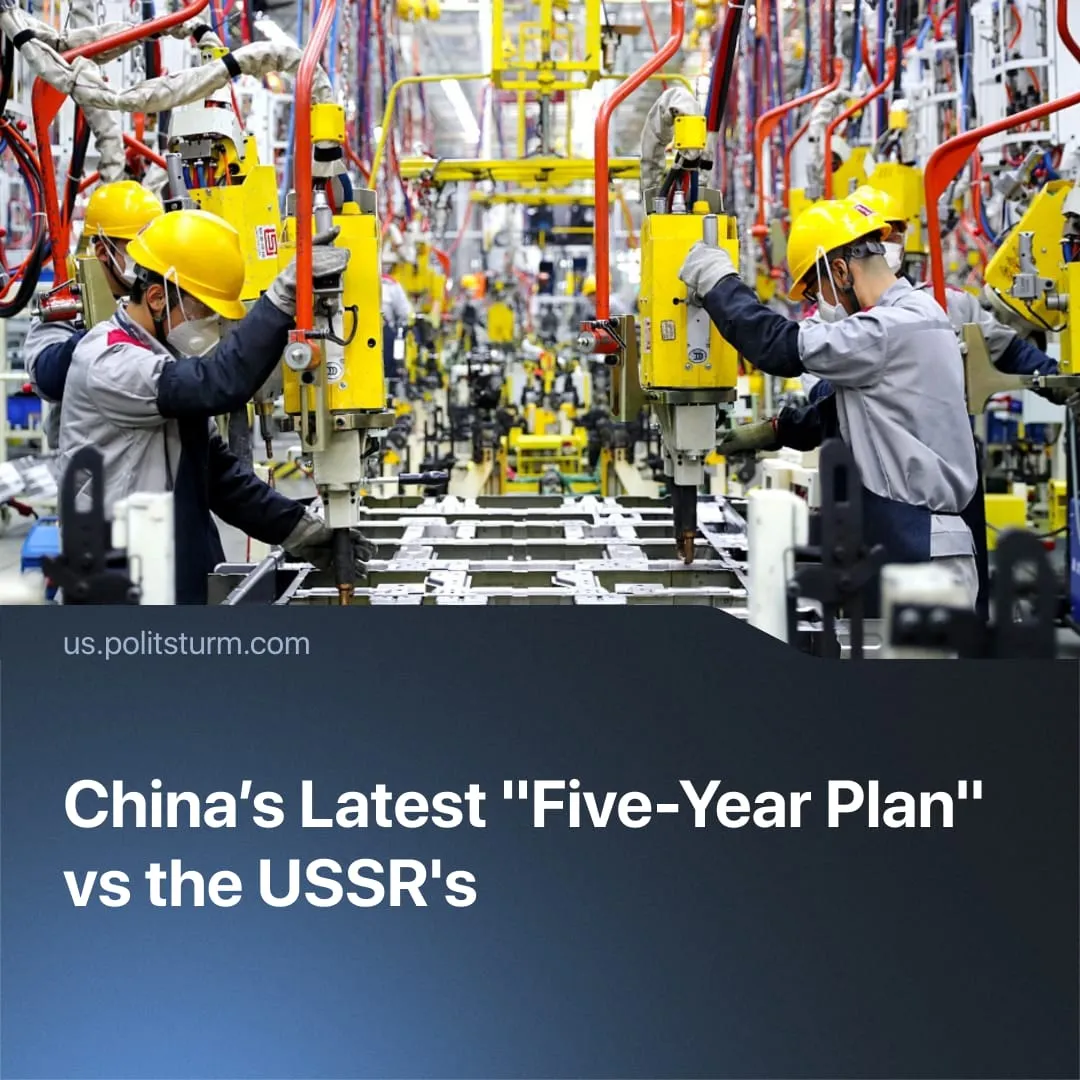
China unveils its latest five-year "plan". It defends corporations and bears little resemblance to Soviet plans.
Details. The CCP approved the draft resolution for its 15th Five-Year Plan (2026–2030), calling for “national rejuvenation on all fronts through Chinese modernisation,” prioritising technological self-reliance, AI and developing “new quality productive forces,” while pledging to meet the PLA’s 2027 and 2035 military modernisation goals “on schedule.”
► The summary of the plan includes four repetitions of “protecting property rights” and five mentions of strengthening the “private sector” and “private investment,” to consolidate “a first-class business environment that is market-oriented.”
Context. China’s “five-year plans” nowadays function as investment and coordination frameworks rather than binding production directives. Official statements have referred to them as “guidelines” rather than “plans” since 2005, as the detailed quantitative program was dropped in favour of vague strategic visions.
► We previously explained how other capitalist states also use indicative planning, such as US President Biden’s “Build Back Better Plan” or Germany’s “Industrie 4.0 Plan.”
► The previous plan (14th, 2021-2025) only set 20 quantitative targets, with merely 8 being binding. The National Development and Reform Commission reported that these goals were roughly met. Grain production surpassed 700 million tonnes for the first time, and annual GDP growth rates held at 5.5% – 86% of this growth being driven by domestic demand.
► However, Chinese GDP growth slowed to 4.8% through 2025. In the summer, domestic investment shrank by 6.6%. Youth unemployment soared to 18.9%, a 2-year high, the second-worst rate on record. Real estate remained unstable: sales of newly built commercial buildings fell by 8%. The government had to inject a monetary stimulus package to soften the effects of Trump’s tariffs.
► The new plan emerges under intensifying inter-imperialist rivalry between China and the USA. Xi Jinping stressed that China “must gain strategic initiative in fierce international competition” through the 2026–2030 period. The two superpowers are decoupling their economies, seeking to reduce vulnerable dependency (China on high tech, the US on critical minerals) and strengthen their military-industrial bases.
Important to Know. China’s system is completely different from the USSR's. The Soviet five-year plans were binding socialist programmes with set outputs and quantitative goals. Through public ownership of all means of production, they were able to fully unlock the potential of large-scale economic planning.
► Chinese “plans” – in their own wording, mere “guidelines” – by contrast, function within capitalism’s laws of anarchy and competition. The 15th plan, managing investment in state and private monopolies, will coordinate Chinese capitalists and their government to maximise accumulation and strengthen their position in the world.
► Under imperialism – the highest stage of capitalism – the scale and complexity of socialised production make some planning necessary. Monopoly firms plan their operations, and capitalist states issue targeted plans for economic sectors. Coordinating capitalist production is especially important during imperialist wars. The fact that capital recognises the necessity of planning – but only applies it within limits and squanders its greater potential – highlights the need for socialism.
► In 1927, Comrade Stalin explained the difference between Soviet plans and those of imperialist states: “True, they also have something in the nature of plans; but these are forecast plans, guess-work plans, not binding on anybody, and they cannot serve as a basis for directing the country's economy. Things are different in our country. Our plans are not forecast plans, not guess-work plans, but directive plans, which are binding upon our leading bodies, and which determine the trend of our future economic development on a country-wide scale. You see, we have a fundamental difference here.”