

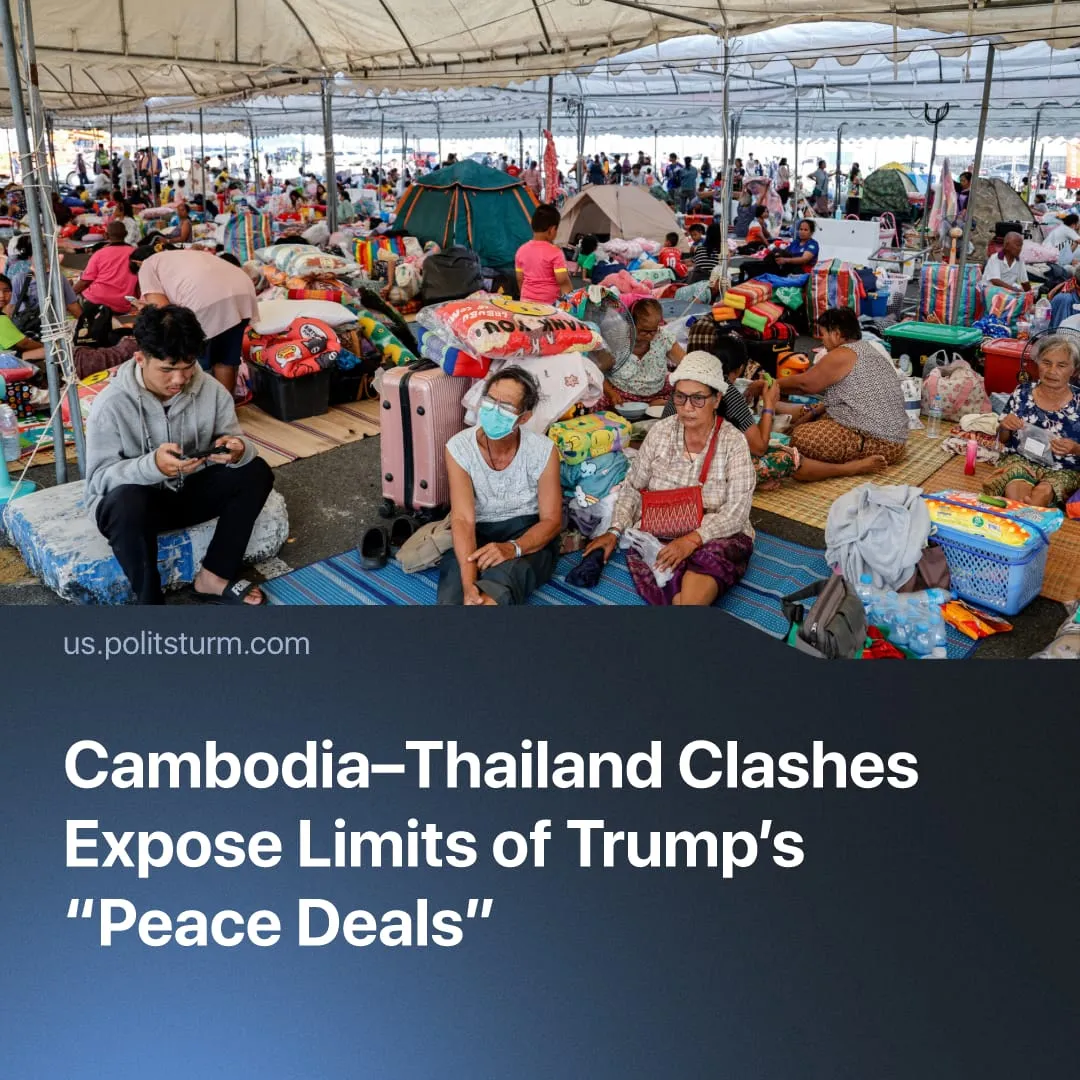
Renewed clashes between Cambodia and Thailand expose the limits of Trump’s capitalist “peace deals.”
Details. Recent border clashes in the Preah Vihear region and the adjacent Oddar Meanchey-Sisaket area have escalated sharply. Reports confirm Thai airstrikes, heavy artillery exchanges, and strikes on both military and civilian targets. Cambodia states that four civilians were killed, while Thailand reports one soldier dead and 18 wounded.
► Cambodia condemned Thailand’s actions as a clear violation of its sovereignty and a breach of the peace agreement. Phnom Penh urged the international community to denounce Thailand’s military aggression and demanded that Bangkok take full responsibility for escalating the situation, and also emphasised the right to self-defence.
► Thailand’s Foreign Affairs Ministry briefed 70 ambassadors, claiming Cambodia initiated a series of 14 border incidents and violated the ceasefire. Bangkok insists its military response – including airstrikes – is an act of self-defence to protect sovereignty and civilian safety, and vows to continue until Cambodian aggression ends.
► US Secretary of State Marco Rubio urged Thailand and Cambodia to halt the clashes immediately and return to the terms of the peace accord. Donald Trump separately called on both governments to honour the agreement they signed with him and restore calm along the border.
Context. In July 2025, after a five‑day conflict, Cambodia and Thailand agreed to an unconditional ceasefire. In October, they formalised an expanded peace agreement with Trump present. The US state has been aiming to freeze secondary conflicts to focus on its primary inter-imperialist conflict with China.
► The agreement required the withdrawal of heavy weaponry, prisoner releases, and joint border-monitoring, yet it left the core territorial dispute unresolved. Both governments came away dissatisfied, as the pact failed to address claims over land, resources, and long-standing “security concerns”.
► The renewed clashes reflect a broader pattern of instability inherent to capitalist “peace deals.” Such agreements do not resolve underlying economic contradictions, but temporarily manage them. In 2025, a US-brokered ceasefire signed under President Trump between the Democratic Republic of the Congo and Rwanda failed to halt fighting. Likewise, the collapse of the early-2025 Gaza ceasefire shows that once the immediate tactical utility of capitalist diplomacy expires, hostilities resume.