

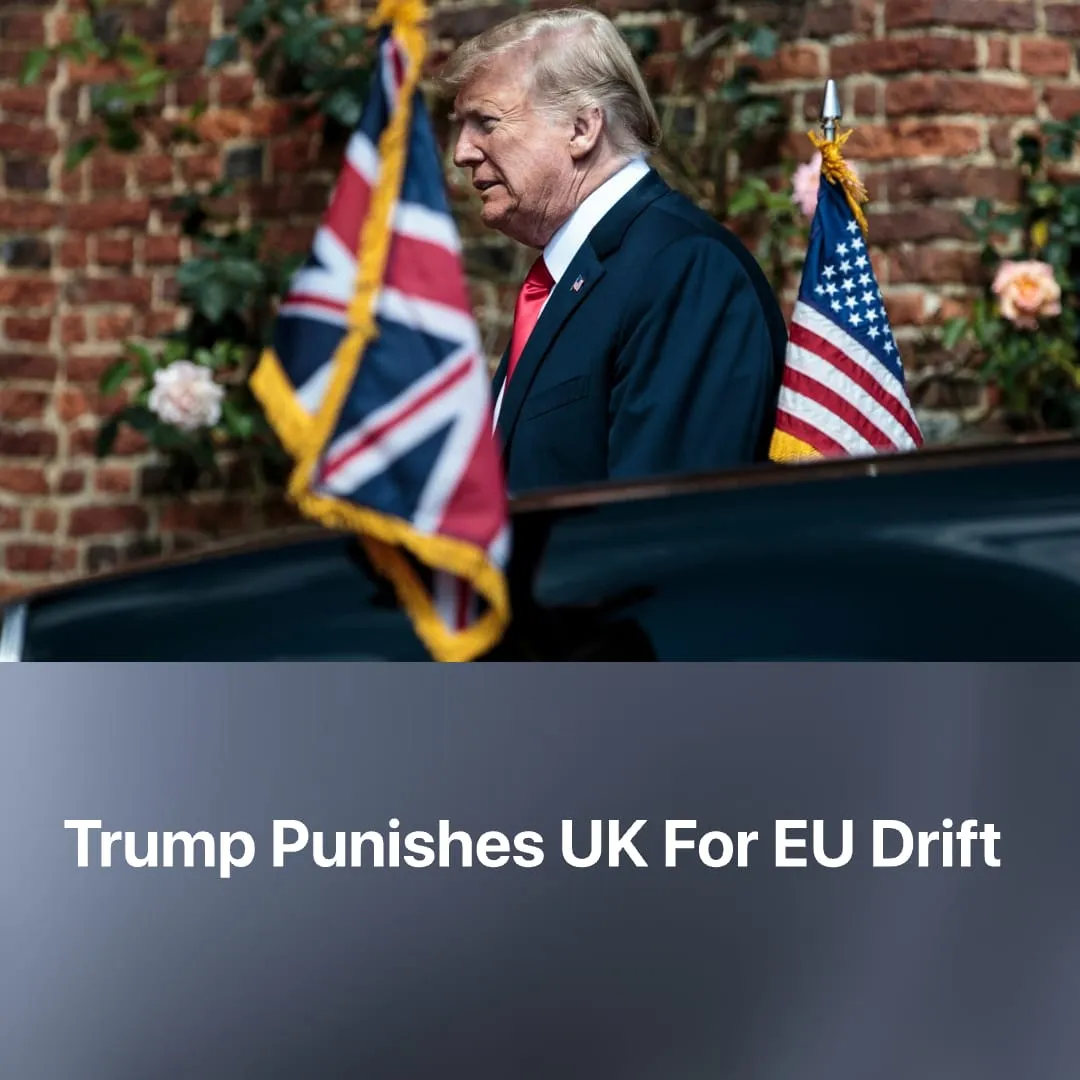
Trump punished the UK for its drift towards the EU by questioning its territorial claims.
Details. During his weekend visit to Dublin, US President Donald Trump undermined the UK's territorial claims by saying he would "love to see" a united Ireland, and rather than walking back the remarks, he spent the second day of his trip doubling down on unification. This triggered a pushback from both Downing Street and pro-British unionists, and confused support from the pro-unification and anti-Trump Irish republicans.
► This follows Trump's August threat to officially reconsider Washington's stance on the Falkland Islands. Casting himself as a peacemaker, he offered to step in and settle the dispute, while openly doubting whether Britain still has the will to fight to defend the territory should Argentina invade.
► These attacks cap a year of Trump relentlessly criticizing the UK over its domestic immigration policies, warning the country is being "ruined," alongside its refusal to aggressively escalate the Strait of Hormuz closure, which he publicly blamed on "non-responsive" allies. On both issues, the UK shares the exact same positions as most EU nations.
Context. Under Keir Starmer, the UK attempted to hold a middle position between the EU and the US, yet still absorbed heavy tariffs and political insults from Trump. While Starmer showed early signs of shifting closer to Europe, current Prime Minister Andy Burnham has pushed even harder, at least in rhetoric, for rapidly aligning with the bloc.
► Trump’s push for a united Ireland coincides with a deeply volatile moment for British stability. After all three nationalist parties recently won elections to lead their respective governments, leaders from Northern Ireland, Scotland, and Wales met in Cardiff to formally coordinate breaking up the UK.
► Simultaneously, Argentina has sharply intensified its rhetoric claiming ownership of the Falklands. Under the right-populist President Javier Milei, Argentina has positioned itself as a close Trump ally, actively exploiting the diplomatic friction between London and Washington.
► Currently, British capitalism is fundamentally dependent on American imperialism, being Britain's largest trading partner, leaving the UK with no choice but to rubber-stamp Washington's agenda. This subservience is repeatedly demonstrated through its concrete actions, such as London opening military bases for strikes on Iran, raising NATO defense spending, and authorizing North Sea oil drilling.