

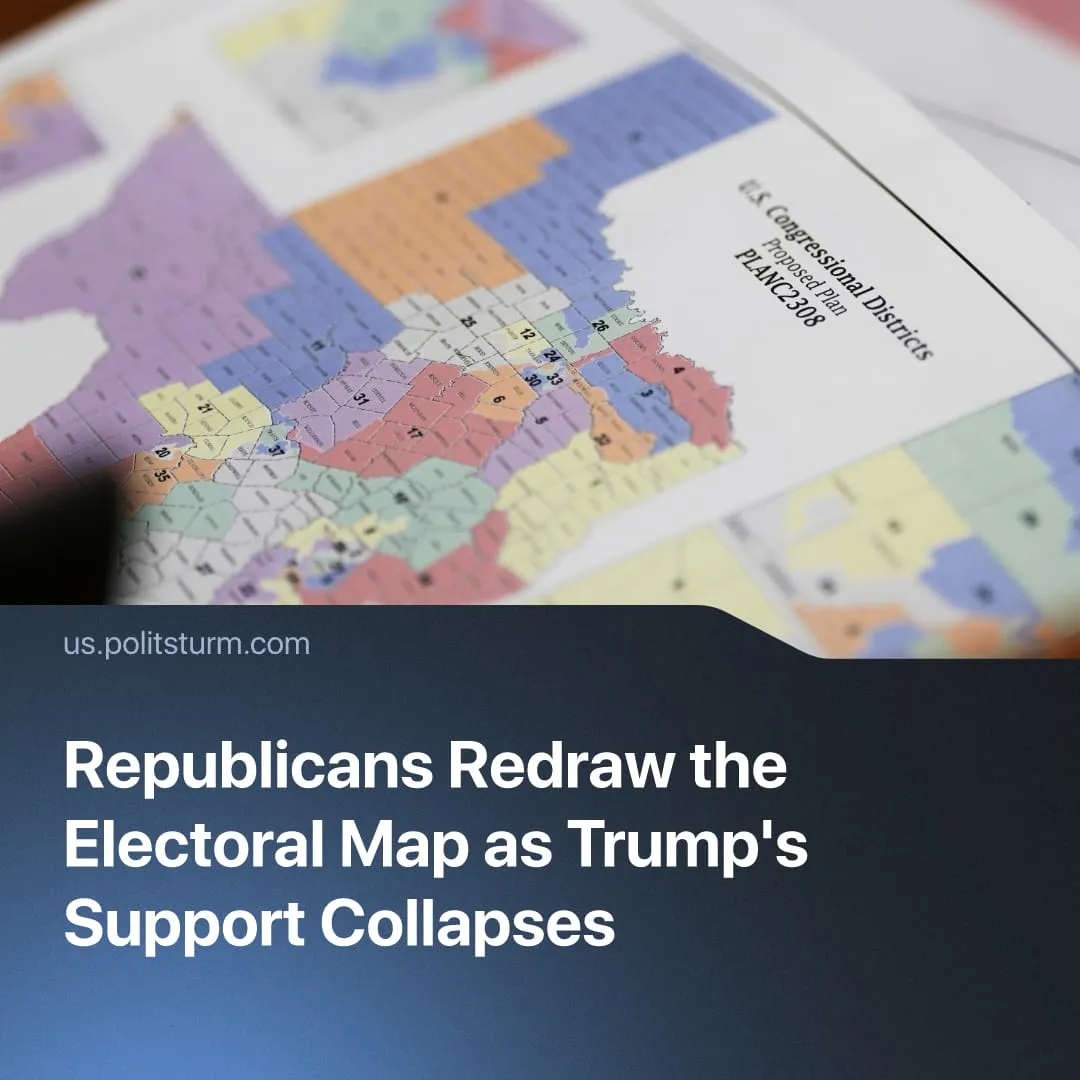
As Trump's approval rating hits 35%, Republicans have completed a major push to redraw the electoral map.
Details. Republicans have completed redistricting in 8 states ahead of the 2026 midterms, redrawing electoral district boundaries to favour Republican candidates. Congressional maps are normally only revised after a census, with the next due in 2030. The effort was openly encouraged by Donald Trump to strengthen Republican electoral prospects before 2026.
► In Texas, Republicans redrew districts to potentially secure 5 additional House seats. The maps faced legal challenges over minority representation and voting rights, but courts ultimately allowed the redistricting to proceed while appeals continue.
► Similar disputes emerged in Alabama, Louisiana, Tennessee, North Carolina, Florida, Ohio, and Missouri, where Republicans also completed their redistricting efforts, potentially securing 11 House seats.
► Democrats have also pursued their own gerrymandering measures. In California and Utah, Democrats secured redistricting efforts, potentially securing 6 House seats in the midterms.
► Current projections suggest Republicans are likely to benefit most from the new maps, potentially gaining enough seats to counteract growing dissatisfaction with the party.
Context. Gerrymandering is the manipulation of electoral district boundaries for political advantage. The two main methods are "cracking," splitting opposition voters across districts, and "packing," concentrating them into a few to waste votes. Both major US parties have historically used these tactics, though the current push is primarily Republican-led.
► Donald Trump currently has an approval rating of around 35%, lower than both Joe Biden at the same point in office and Trump's own first term. Inflation, concerns over jobs and economic growth, and opposition to the war with Iran have become major drivers of declining support.
► The 2019 Supreme Court ruling in Rucho v. Common Cause largely closed federal courts to partisan gerrymandering challenges, allowing the current wave of redistricting to proceed through largely legal channels.