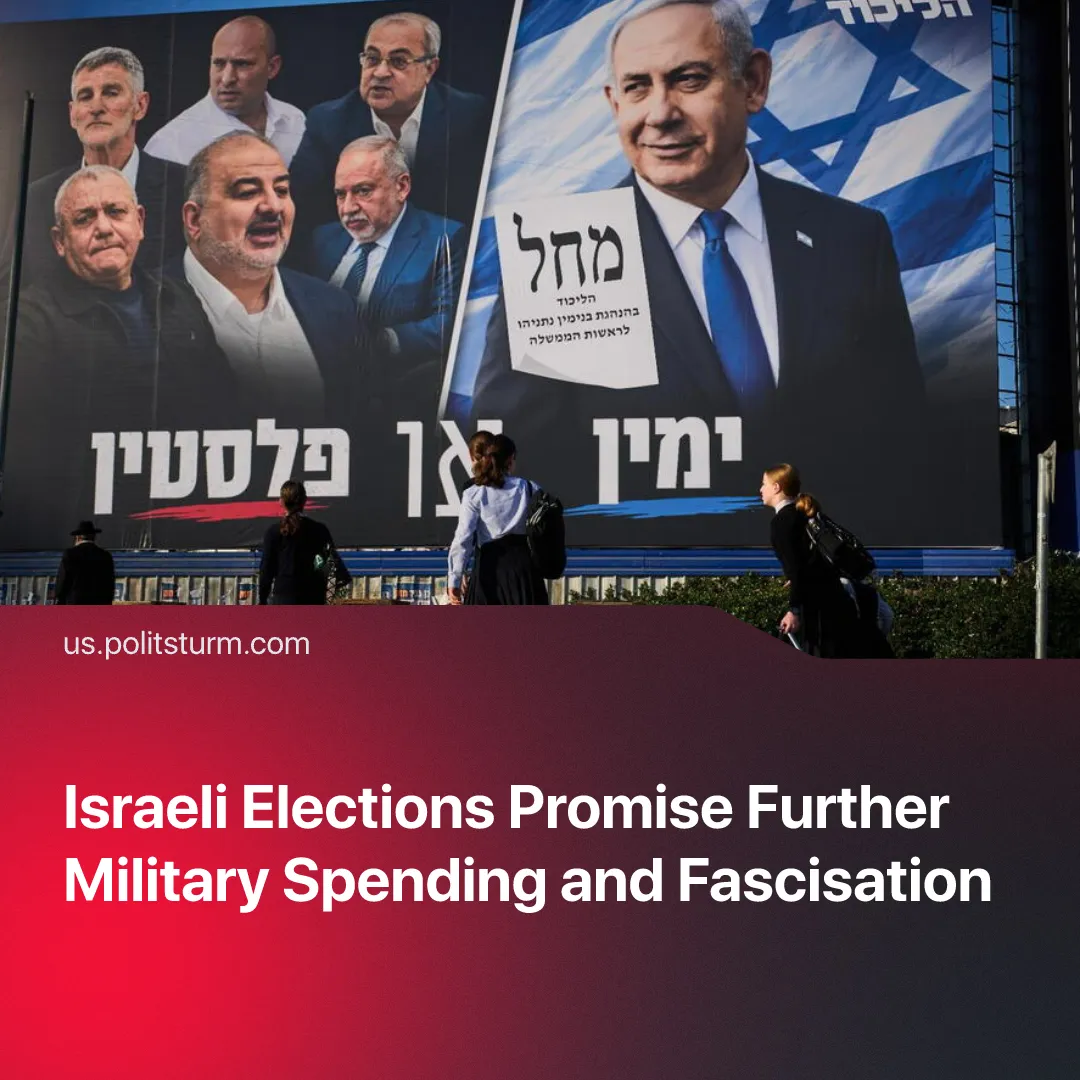
Upcoming Israeli elections come at a time where defence spending has nearly doubled since pre-October 7, along with rapid fascization under the justification of an "existential threat".
Details. Israel will hold its parliamentary election on 27 October 2026. The 120 seats will be distributed by proportional representation. The prime minister will be the leader of the largest party able to assemble a Knesset (parliament) majority, either alone or in a coalition.
► Polls show a tight race between Likud and Yashar, with neither reaching a majority. Yashar was founded last year by former IDF chief Gadi Eisenkot over "failed leadership", rising living costs and Likud's 'handling' of October 7 and the war in Gaza. Both parties oppose Palestinian statehood and have pledged to exclude Arab parties.
► Trump endorsed Netanyahu after withholding support for months as their strategies in the Middle East diverged. He then suggested that without Netanyahu they would have to fight Iran alone.
Context. Before October 7 Hamas raid, anger was aimed at the government itself. In 2023, its attempt to limit the Supreme Court's powers brought major protests, and the Court struck the changes down.
► Israel already had one of the highest costs of living in the OECD, 38% above average, mainly due to monopoly prices. VAT has since risen, and a further increase is being debated to fund military efforts.
► Constant conflict has been used to dramatically raise military spending. Defence spending rose from about 4.2% of GDP in 2022 to nearly 8% in 2026, and from 16% to a quarter of the state budget.
► Workers are increasingly being drawn directly into conflicts. The 2026 budget assumed about 40,000 reservists, but the number mobilised rose to roughly 110,000 on the eve of the second war with Iran. This has reopened debate about exemption of ultra-Orthodox men from military service, long accepted in Israeli politics.
► VAT has already been raised from 17% to 18% to fund the military, and the Finance Ministry has warned it could reach 22.5% if the army's full 2026 request is met.
Important to Know. The ruling nationalists have used constant regional wars to portray Israel as under permanent threat. This distracts from the economic crisis and builds chauvinism between Arab and Jewish workers. It also justifies fascist measures that once faced mass resistance, including civilian militarisation, media control and personal-device surveillance.
► Many so-called "communists" push Israeli workers further in this direction. By supporting Hamas and excusing the killing of Israeli civilians as "citizens of an enemy state", social-chauvinists leave workers open to the influence of Israeli nationalists. This also lets the Western bourgeoisie portray communists as supporters of Islamism and terrorism, helping justify mass surveillance and repression.
► External conflicts, internal divisions, the cost of living, and other factors could lead to a crisis and create conditions for further fascization. Even the CIA has reportedly drawn comparisons with post-WWI Germany.
Israeli Elections Promise Further Military Spending and Fascisation