

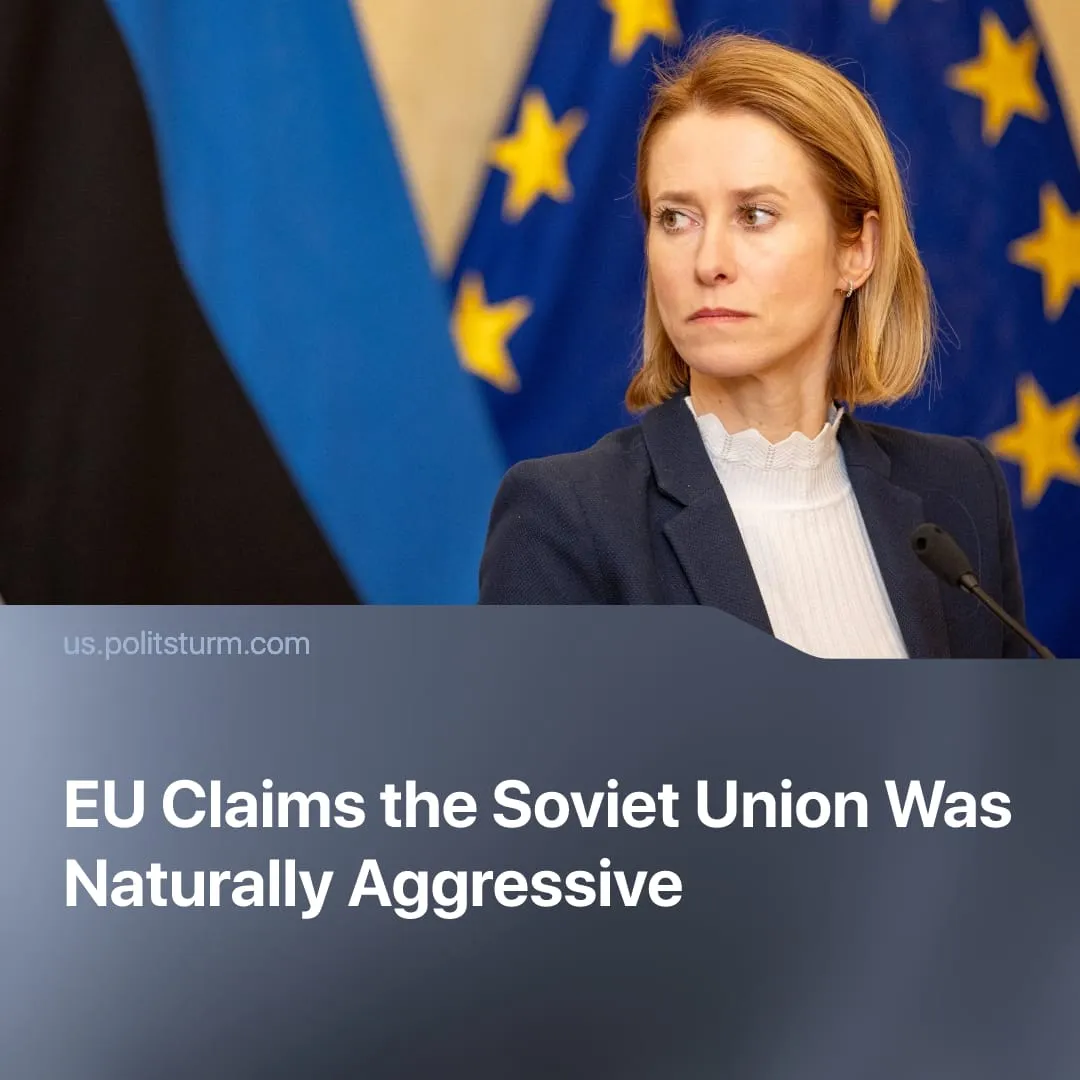
The Soviet Union was naturally aggressive, claims EU foreign policy chief.
EU High Representative Kaja Kallas recently spoke at a press conference following an informal EU Foreign Affairs Council meeting. She claimed that “Russia’s” supposed historical aggressiveness – by which she implicitly refers to the USSR – should be remembered in peace negotiations.
Quote: “In the last 100 years, Russia has attacked more than 19 countries, some as many as three or four times. None of these countries has ever attacked Russia.”
Context. The main focus of this meeting was the ongoing peace talks, with the US administration proposing 20 points regarding the ending of the special military operation (SMO) in Ukraine. The meeting also addressed the intensification of Europe's remilitarisation and preparations for conflict with Russia.
► Anti-communist propaganda is not an isolated phenomenon. Europe, the United States, and Russia itself have systematically spread slander against the international communist movement, obscuring the historical reality of invasions, interventions, and defensive Soviet actions.
In reality, the rhetoric employed by Kaja Kallas and others suggests that the foreign policy of the USSR was essentially the same as that of modern capitalist Russia, obscuring the historical and class differences between socialism and capitalism. Capitalist propagandists use this false equivalence to discredit communism, portraying it as a “totalitarian, aggressive regime.”
► The USSR adopted a defensive policy against openly counter-revolutionary threats, protecting the workers’ state. Finland shows this: born after 1918 through White Terror backed by German imperialism, Finnish communists were physically exterminated, as in the Perttula executions. The Finnish ruling class was fiercely nationalist, anti-communist, and promoted “Greater Finland” expansion into Soviet Karelia.
► Despite this, the USSR pursued diplomacy in the late 1930s, proposing territorial exchanges and mutual security guarantees to protect Leningrad, even offering more land than it planned to take. When Finland repeatedly rejected these measures, the Winter War (1939–1940) became a necessary defensive action, not “Soviet aggression,” amid the growing Nazi threat.
► The claim that these countries never attacked Russia or the USSR is false. Between 1918 and 1921, Britain, France, the United States, Japan, and others intervened in the Civil War to try crush Soviet power. In 1920, Poland invaded Soviet territory. During the late 1920s and 1930s, the USSR faced ongoing military encirclement and border provocations, notably from Japan. In 1941, Finland joined Operation Barbarossa, attacking the USSR alongside Nazi Germany, confirming Soviet security concerns.