

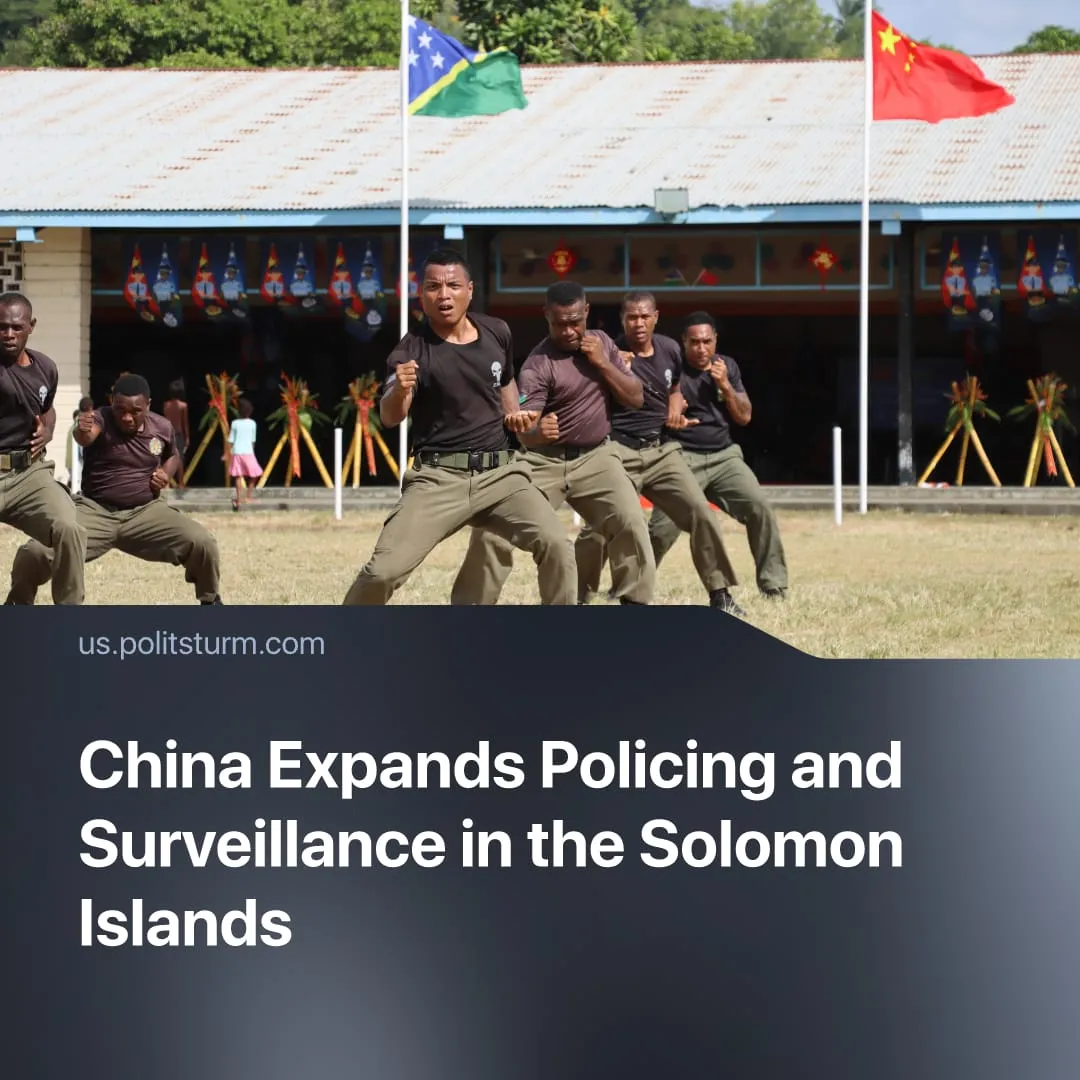
Beijing adopts a common imperialist strategy, training and assisting capitalist security forces to advance its regional influence.
Details. In 2025, China intensified its policing presence in the capitalist Solomon Islands, moving from training to embedding surveillance and social-control methods through formal training centres and an advisory group that channels PRC practices into local security forces.
► China operates a Police Cooperation and Training Centre, providing classroom instruction, joint drills, investigative mentoring, and embedded support to the Royal Solomon Islands Police Force (RSIPF) – integrating PRC policing methods into Solomon Islands security structures under the banner of technical “capacity building”.
► Chinese police advisers have introduced village-level surveillance tools in the Solomon Islands, including CCTV networks, biometric data collection and school activities that normalise drones among children. Public posts from the RSIPF show Chinese officers promoting digital registration and community-monitoring programmes across rural areas.
► Beijing has also encouraged local authorities to adopt the “Fengqiao model”, a Mao-era system of grassroots oversight centred on informant networks, household mapping, and population registers – presented as a template for expanded social-control structures.
► Defending its own imperialist interests, Australia raised concerns in 2023, called for transparency, and launched a US$118 million policing support package for the Solomon Islands. The Australian Strategic Policy Institute (ASPI), an Australian defence think tank, has stated that China is exporting its domestic surveillance regime to the Pacific, describing it as “not community policing but policing of the community”.
Context. China’s approach is a common imperialist strategy in which powerful states build influence by exporting policing, weapons, intelligence, and security training – a method the United States has long employed as well, strengthening local capitalist regimes in dependent countries and enabling them to repress workers while maintaining economic and political subordination.
► China–Solomon Islands security cooperation began in 2019–2022 with negotiations on policing and security pacts, followed in 2022 by training exchanges. By 2023–2025, it expanded into on-island advisory teams, model policing units, and pilots of Chinese-style surveillance and community-governance methods. Implementation accelerated in 2025 as these systems were integrated into the national police force.
► The Solomon Islands government pivoted from traditional partners like Australia and the United States toward closer cooperation with China after judging Western aid "unreliable" or "slow". Following the 2021 riots, Beijing exploited local instability with offers of funding and rapid infrastructure deals.
► This cooperation is part of China’s broader export of surveillance and social-control systems. Similar programmes have been deployed across Africa, Latin America, and Southeast Asia, including exporting the “Great Firewall” to Belt and Road countries.