

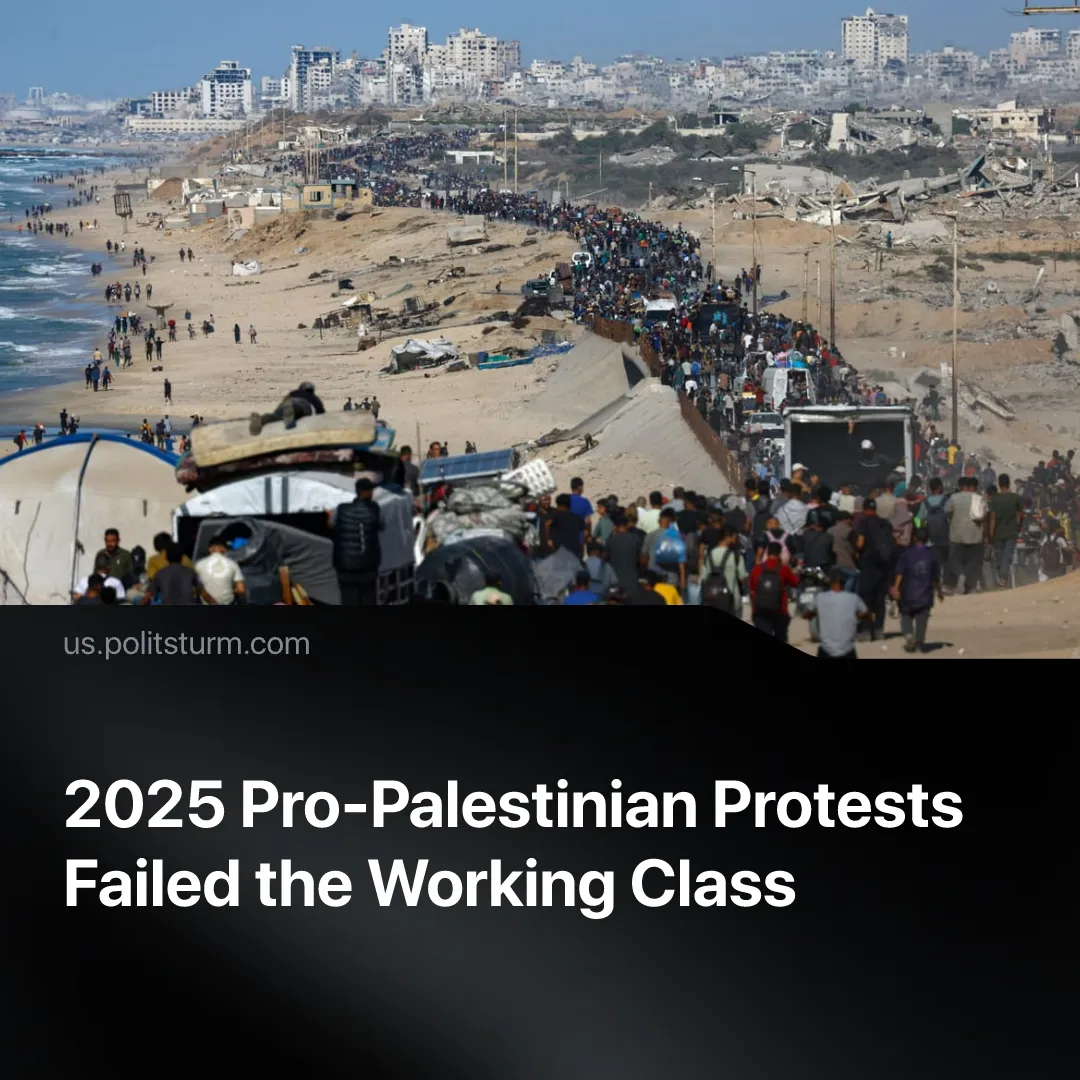
Pro-Palestinian protests continued over the most part of 2025. They failed to defend the working class and started to fade out after the status-quo ceasefire.
Details. Throughout 2025, solidarity with Gaza took place through demonstrations and symbolic actions across Western states, repeating slogans such as "from the river to the sea" and calls for an immediate ceasefire. Attempts at actionism, such as the repeated flotillas, briefly drew media attention before being blocked by Western states.
► Various self-described communist and left organisations maintained unchanged positions, either offering forms of critical support to Hamas or limiting their intervention to abstract calls for “solidarity” detached from class analysis and imperialist contradictions in the region.
► After the ceasefire took shape as a post-war framework in which Gaza remained devastated while Hamas retained limited political leadership, protest activity and support declined from its earlier peak. Public attention increasingly shifted toward domestic economic and political issues, including rising living costs and job insecurity.
Context. The ceasefire was originally promoted by Trump as a diplomatic success amid domestic political pressures, with subsequent US security strategy documents confirming a shift in priorities toward great-power competition, particularly with China. In practice, it consolidated Western control over Gaza and marked a clear defeat for Iranian-aligned forces and other so-called “counter-hegemonic” imperialisms in the region.
► The agreement remains fragile, with both sides regularly accusing each other of violations, while the Israel state continues to kill Palestinians through raids, airstrikes, and enforcement actions carried out under the banner of “security compliance.”
► Israel continues to demand the complete disarmament of Hamas and the return of all hostages, framing these demands as preconditions for stability. Hamas has expressed willingness to freeze its weaponry but refuses to surrender it, arguing that surrendering its arms under current conditions would be unacceptable.
Important to Know. Gaza is now in a worse position than before the October 7 attack. The ceasefire reflected shifting US and Western priorities rather than any gain secured by protest activity. While mass demonstrations expressed widespread opposition to the war, they failed to alter imperialist policy or prevent Gaza’s devastation. Left-wing mobilisation remained largely symbolic, leaving the initiative firmly with capitalist forces.
► Communists failed to use this moment to win working-class trust or develop an independent political pole. By neglecting class analysis and the inter-imperialist character of the conflict, they reduced a leadership opportunity to tailing petty-bourgeois forces, producing episodic actionism that dissipated once immediate pressure subsided.
► This failure strengthened the Israeli ruling class, which used chauvinism and permanent “security” measures to consolidate power, while Palestinian workers remained subordinated to capitalist forces that do not represent their class interests.
► Without consistently linking Palestine and Israel to the wider class struggle and advancing proletarian internationalism – uniting Israeli and Palestinian workers against their respective bourgeoisies – any ceasefire or peace arrangement under capitalism can only remain temporary, leaving imperialism intact and the working class disarmed and at the whims of the capitalist class.