

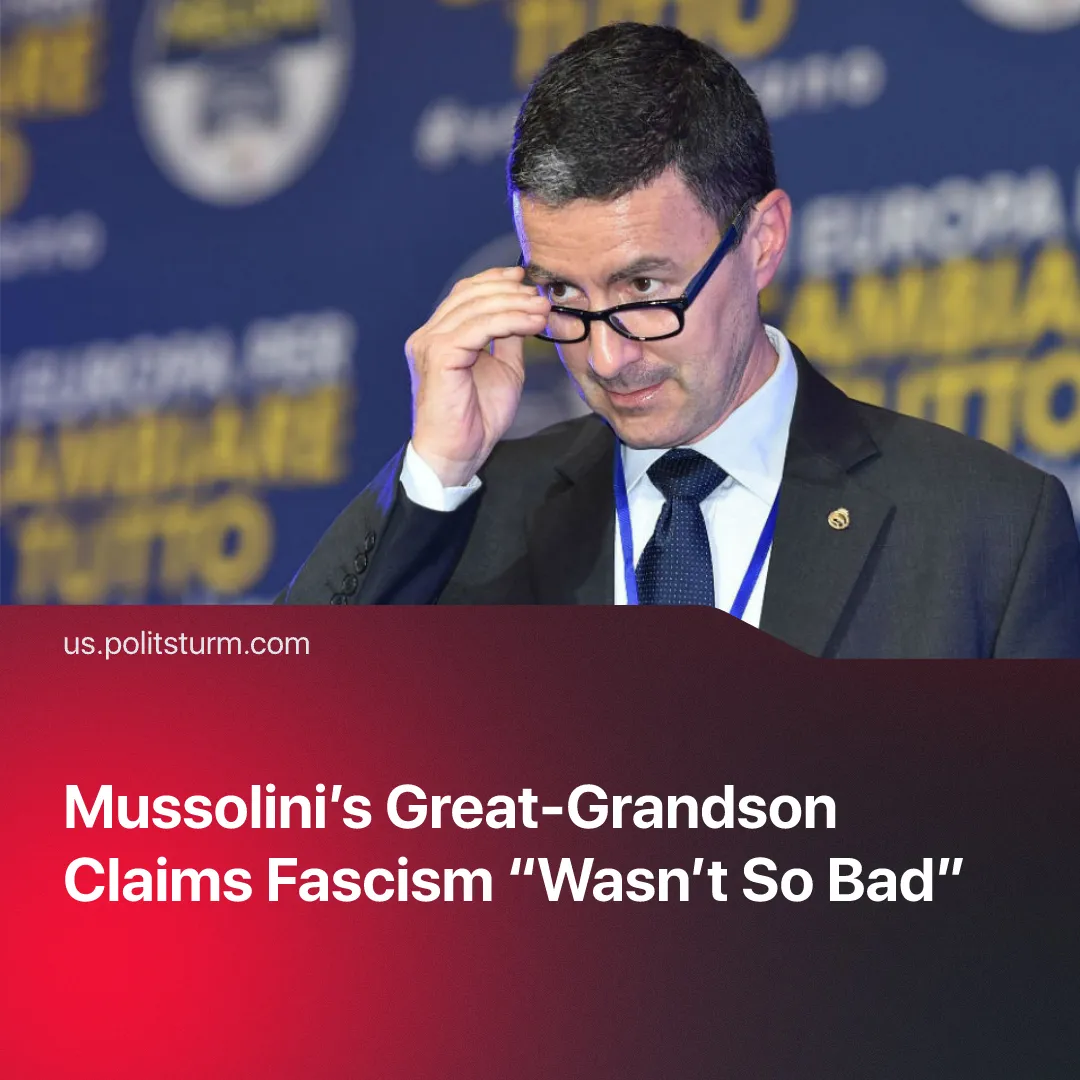
Mussolini's great-grandson is trying to whitewash his ancestor. He claims that fascism was "not so bad", that Italian Jews lived well, and that terror and expansion were "a response to leftist violence".
Details. Caio Mussolini, great-grandson of Benito Mussolini, has released another book where he justifies Italian fascism and minimises the suffering it caused. He defends the dictator, claiming he was unfairly demonised, and portrays the regime as a response to leftist violence.
► Although rejecting Italy’s 1938 racial laws, Caio Mussolini downplays their severity – claiming they were imposed by Hitler, that some Jews held positions under fascism, and that Italy even helped Jews flee Europe.
Context. The book appears at a time when the Italian far right continues to consolidate political influence. Prime Minister Giorgia Meloni leads ‘Brothers of Italy’, a party that traces its political lineage to post-war fascist officials.
► Most of Mussolini’s book tour proceeded without disruption, with several appearances hosted by local mayors in town halls and other municipal venues. Only two scheduled events were cancelled following opposition protests. Despite this, he claimed his “democratic rights” were under attack.
► Caio Mussolini has also been active in contemporary right-wing politics and was a candidate for the European Parliament with Brothers of Italy, linking his public presence directly to the current governing camp.
► Within ‘Brothers of Italy’, some members and affiliated figures have openly described themselves as fascist or expressed admiration for aspects of Italy’s fascist past. The party has actively try to soften public assessment of the fascist period, including debates over historical memory, monuments, and the use of fascist symbols.
Important to Know. Fascism dismantled democratic institutions after taking power in 1922, outlawed opposition parties, dissolved independent trade unions, and placed labour under state corporatist control. While repression targeted socialists and communists, industrialists and large landowners benefited from suppressed wages, banned strikes, and rising profits.
► The regime also carried out systemic crimes: the 1938 racial laws stripped Italian Jews of civil rights and enabled deportations to extermination camps; in Libya and Ethiopia, Italian forces used concentration camps, mass executions, forced relocations, and chemical weapons against civilians.
► Attempts to portray fascism as “not so bad” emerge at a time of intensifying social and economic instability produced by capitalist crises. Recasting the regime as orderly or misunderstood shifts attention away from its class character and crimes, gaining ground in conditions where no strong communist movement consistently challenges such narratives.