

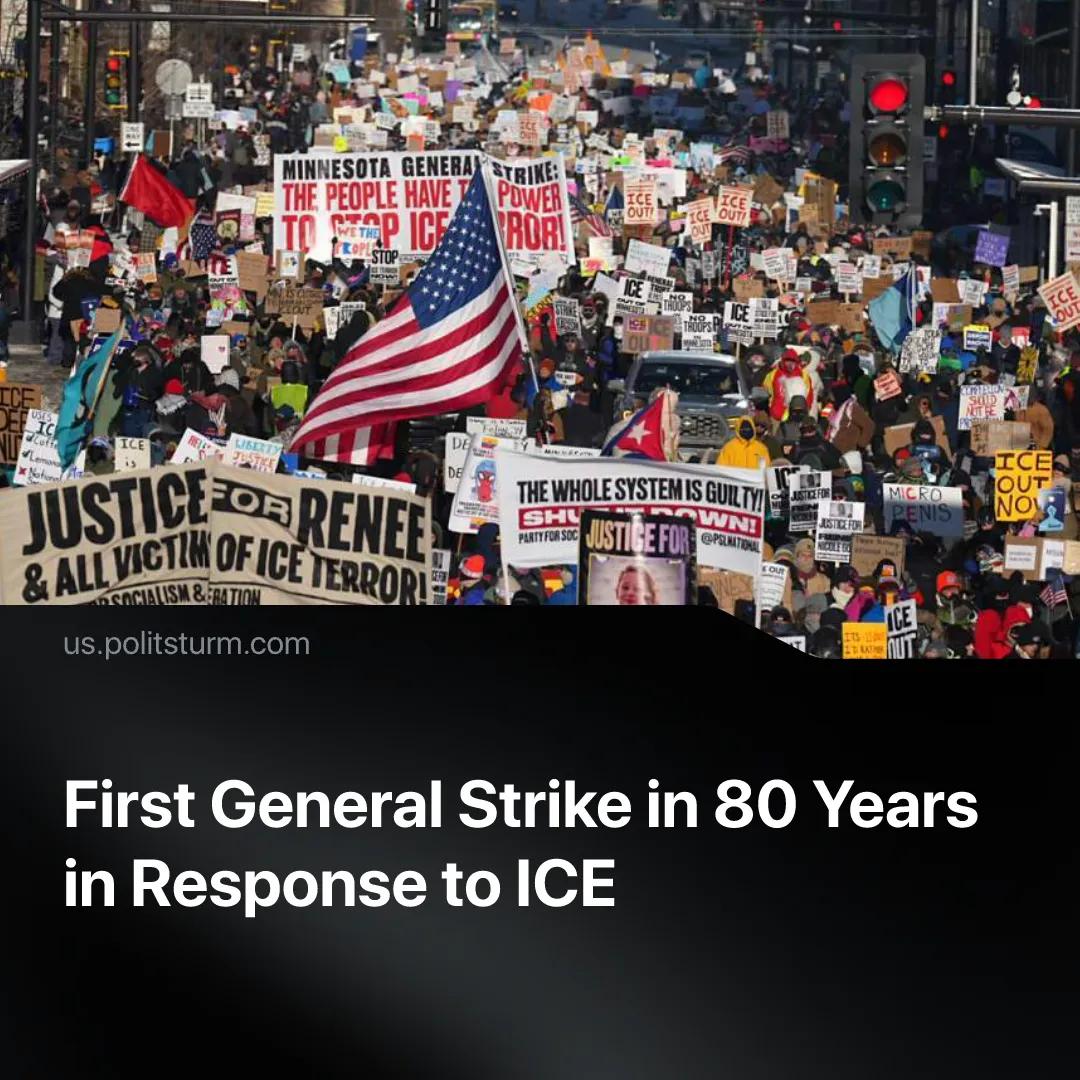
Minneapolis saw the first US “general strike in 80 years” after actions were called in reaction to ICE repression and killing.
Details. Between 50,000 and 100,000 people in Minnesota participated in a one-day “general strike” two weeks after the death of Renee Good, a US citizen shot by Immigration and Customs Enforcement (ICE) agents, prompting demands for accountability and the removal of ICE from the state.
► Despite frostbite temperatures, protestors mobilised in the streets, some stopping work, with explicitly political demands for accountability and the removal of ICE from Minnesota. Trade unions and community organisations endorsed "strike" action, but participation remained voluntary, and much of the shutdown took the form of small business closures rather than coordinated workplace strike action.
► Protests escalated after the killing of Alex Pretti, shot while peacefully intervening in a confrontation with ICE agents. Organisers tied this to the earlier Minnesota action and called a voluntary “national shutdown” for January 30 under the slogan “no work, no school, no shopping,” demanding justice and an end to ICE funding. However, fewer formal labour bodies backed the Jan 30 call than on Jan 23, and business closures were less widespread and less comprehensive than during the earlier Minnesota action.
► The government initially doubled down, with Trump calling Pretti a “domestic terrorist”. But as protests intensified and more information was released, the rhetoric shifted – the shooting was described as “a very unfortunate incident,” and officials distanced themselves from repeating earlier claims. Operation commander Greg Bovino was replaced by “border czar” Tom Homan, who alleges a more “targeted” approach with ICE.
Context. Previous state violence has also sparked mass reaction from the American people after George Floyd was killed. Massive protests took place, and some escalated into riots, prompting fierce unorganised clashes between protestors and state forces.
► In contrast to these ICE protests, the first economic actions after George Floyd’s death in May 2020 were mainly symbolic, occurring two months after his killing and limited to boycotts and an 8-minute work stoppage. Although the Minnesota strike was also voluntary and dependent on small business closures, the speed at which economic methods were put forward shows progression from the George Floyd protests.
► Lenin, in “On Strikes”, highlighted their progressive role, noting that they “teach the workers to unite” and encourage them to “think of the struggle of the whole working class against the whole class of factory owners and against the arbitrary, police government.” At the same time, he warned it is a “mistaken idea” to believe the working class can achieve considerable improvements or emancipation through strikes alone.