

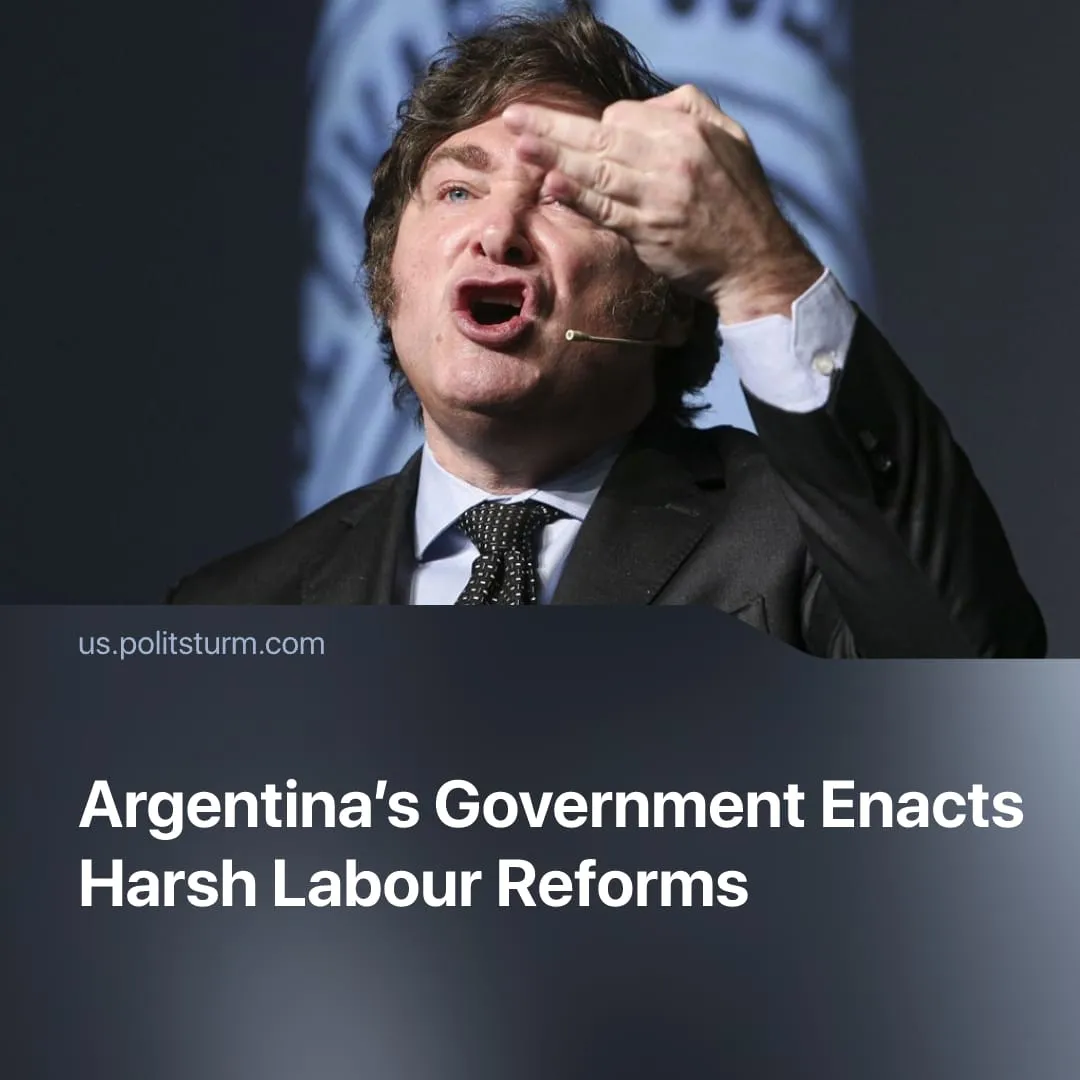
Argentina has reintroduced 12-hour working days, payment in-kind, and significantly restricted workers’ ability to strike.
Details. Argentina’s political leadership has passed a radical overhaul of labour laws that represents one of the most significant attacks on workers’ rights in decades. Most strikingly, wages can now be offered not only in Argentine pesos but also in foreign currencies or even in kind.
► Under the new legislation, employers can extend the legal workday from 8 to 12 hours, using a time-bank system that allows extra hours to be offset by shorter shifts later, letting firms intensify labour during peak periods or reduce staffing while maintaining output.
► Severance calculations have been simplified in ways that favour employers. Employers may still terminate workers without cause, but the reform narrows which bonuses and benefits count toward severance, reducing payouts and weakening job security for workers.
► The reform tightens requirements for legal union recognition, limits strikes in “essential” sectors by requiring 50–75% staffing, and imposes stricter rules on union assemblies, which must not disrupt business, may require employer permission, and are unpaid for attending workers.
► Opposition has been fierce among trade unions and organised labour. Major federations such as the General Confederation of Labour (CGT) and other worker organisations have mobilised strikes and protests, with CGT leaders declaring, “We don’t want fewer rights; we want more work, more dignity.”
Context. Labour legislation in Argentina, as elsewhere, was written under the shadow of strikes, mass organisation, and violent repression, such as during the Semana Trágica (Tragic Week) of 1919, when police and army forces crushed workers’ protests in Buenos Aires, leaving hundreds dead and thousands wounded.
► Today, the ruling capitalist class worldwide is weakening labour protections to advance its economic interests. In Germany, labour costs are frequently cited as a central issue by business leaders and government officials. France has seen repeated confrontations over pension and labour law changes aimed at extending working lives and weakening collective protections. In Greece, following its debt crisis, legislation expanded permissible working hours, justified by the need for economic recovery despite nationwide protests.
► Argentina faces a chronic debt crisis, with public debt reaching roughly $316 billion by the end of 2025. Last year, Trump offered $20 billion in US currency, conditional on a Milei midterm victory, to stabilise his government and secure a pro-US ally, reinforcing pressure for austerity and labour discipline.
► These measures are being driven by President Javier Milei, elected in 2023 on an explicitly libertarian platform centred on deregulation, privatisation, fiscal shock therapy, and the dismantling of labour protections in the name of restoring “market freedom.”