

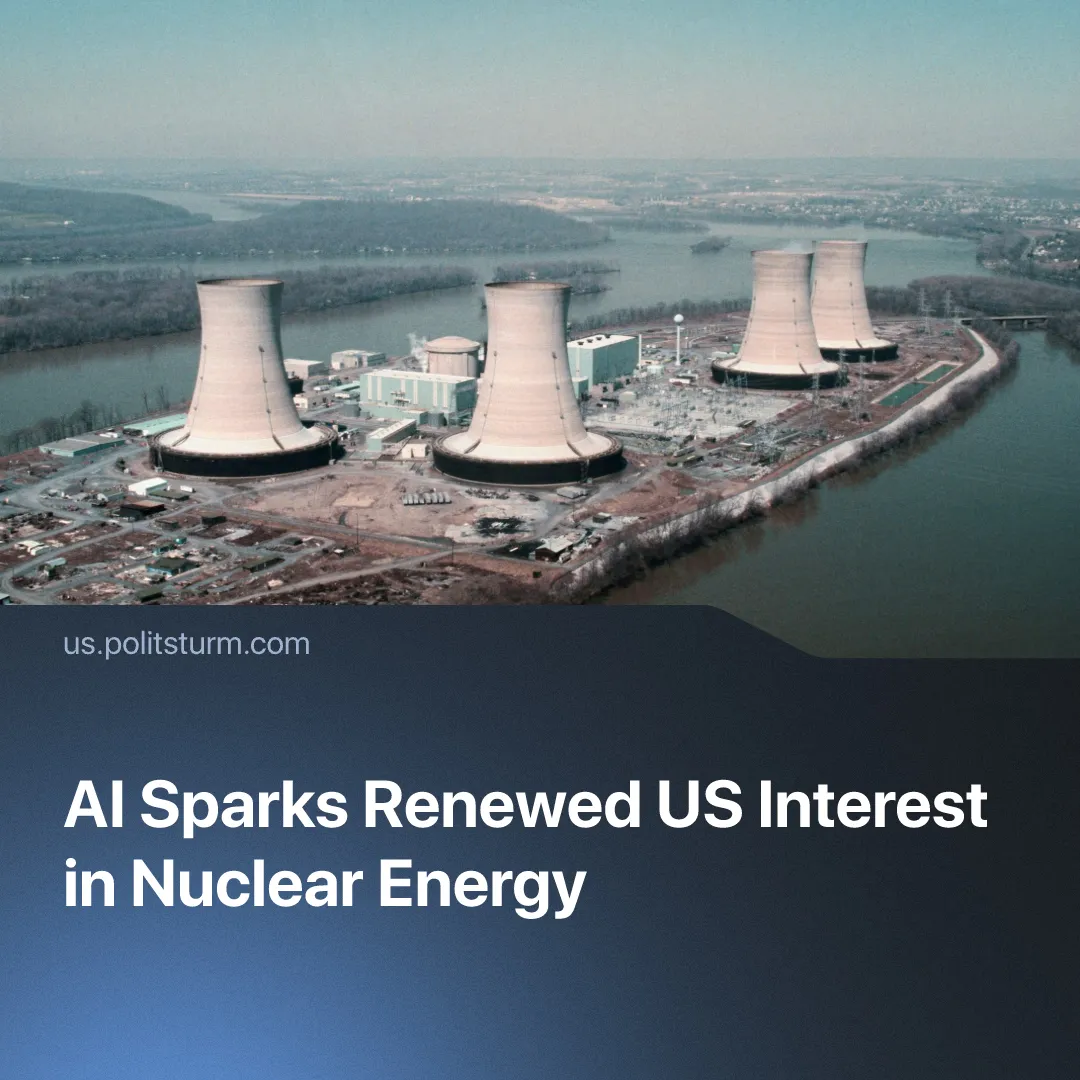
Interest in nuclear energy is revived by corporations and the federal government to meet the needs of AI data centres. In the USSR, nuclear energy was extensively used in the interests of the people.
Details. Several major AI companies (Amazon, Google, Meta, Microsoft) have signed at least one nuclear deal in 2026. Microsoft is investing $16 billion to restart one of the reactors at the Three Mile Island plant. At the beginning of the year, Meta signed a deal for more than 6 gigawatts of nuclear energy, enough to power 5 million homes. Alongside these corporations, the United States and Canada have announced plans to build 10 new nuclear reactors each.
► Nuclear energy has regained support in the US government, backed by both Democrats and Republicans. The Trump administration aims to quadruple nuclear energy output in the United States by 2050 – for rising energy demands driven by the expansion of AI. Just one medium-sized AI data centre consumes as much electricity as 100,000 households. By 2030, AI related energy demand is expected to account for 20% of electricity growth in advanced economies.
► Special interest has been shown in “Small Modular Reactors” (SMRs) – mini nuclear power plants which can be produced from prefabricated parts and subsequently shipped to a site for assembly. The US Army’s Janus Program boosted SMR companies’ stocks by giving them contracts to power military bases. These reactors have several advantages over large and traditional nuclear plants: SMRs can be built much faster, have cheaper initial investment costs and are highly versatile.
► However, the deployment of SMRs has difficulties. To date, only 2 SMRs are actually operable and deployed, one in China and one in Russia. Both small and large reactors are still expensive to build and require extended timelines. For instance, the last nuclear reactor built in the United States was 7 years overdue and ended up costing double the expected amount.
Context. This renewed interest in nuclear energy is primarily driven by the surge in electricity demands of AI data centres. The US government is attempting to strengthen American monopolies in the AI race with Chinese capitalists. China’s electricity output is more than double that of the US, giving them a strong advantage in energy-intensive markets, which Americans need to catch up to.
► The rising electricity costs of AI data centres are often socialized, meaning that the masses of workers are forced to contribute to the soaring expenses. Furthermore, AI has already been used to replace tens of thousands of workers who have been laid off, with even further job cuts predicted in the future.
► Additionally, these data centers primarily rely on “forever chemicals” (PFAS) to cool their giant servers and suppress fires. Once these chemicals enter the human body and the local environment, they do not break down but instead accumulate over time. Existing research already shows that PFAS increases the risk of cancer and weakens the immune system.
► Whilst nuclear power does not itself release CO2, plants are vulnerable to capitalist-driven climate change. This summer, France had to take 20% of its reactors offline, due to heatwaves and droughts which endangered their riverwater cooling systems and caused blackouts affecting over 100,000 people. Under capitalism, environmental and wartime nuclear risks are dumped on workers, whilst benefits are used for corporate profits.
► Contrary to capitalist propaganda, history shows that the USSR pioneered the use of safe nuclear energy in the interests of its people. In 1954, it constructed the world’s first nuclear power plant. Applying atomic energy to society-wide development, rather than personal profit, opened unprecedented possibilities for improving production and raising labour productivity without mass layoffs. Nuclear power saved colossal amounts of labour, fuel and transport, and was a decisive factor in providing the level of productive forces necessary for advancing to the higher phase of communism.